Loading...
Please wait while we load the content...

Loading...
Please wait while we load the content...
Stay informed about our latest publications, calls for proposals, and special announcements. As a subscriber, you'll also enjoy exclusive member discounts of 10%-20% on all orders. Join our community of scholars, librarians, and readers today.


Availability
In stock
ISBN
9781648897344
Edition
1
Publication Date
September 19, 2023
Physical Size
236mm x 160mm
Number of Pages
218
Currency
Quantity
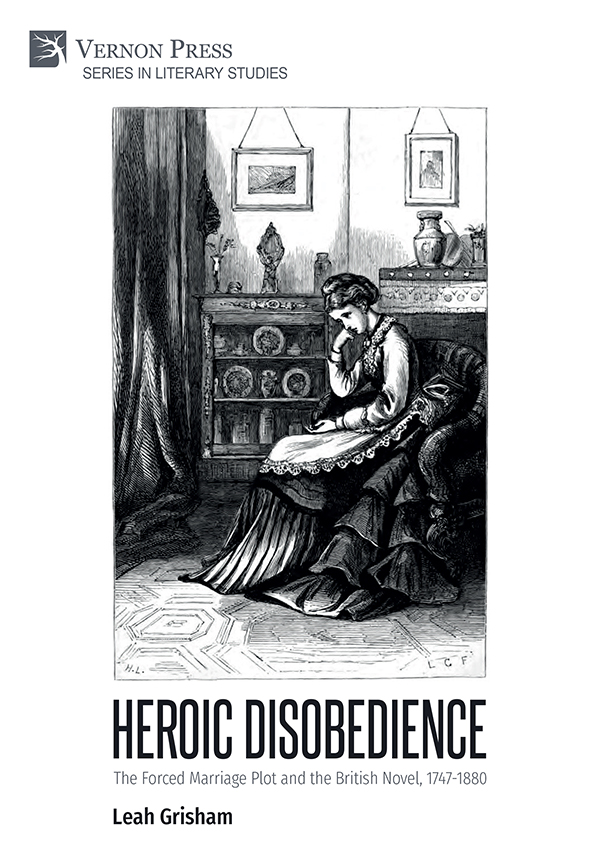
Grisham’s “Heroic Disobedience” is a timely, incisive, and well-researched work on the British marriage plot, so universally infused in nineteenth-century reading and writing novelistic practices. As a whole, it considers how women, as either victims or actors within a larger patriarchal, capital-driven social system, have been integrated in our larger narrative history. Though Grisham writes of novels shaped by, and published within, a more transparently oppressive social context, it is easy to see how the experiences of the discussed fictional heroines are translatable to the lived experiences of many women today. Grisham’s adroit ability to discuss how eighteenth- and nineteenth-century authors were able to depict the nuanced networks designed against women in the period, is a very useful guide in the literary classroom. Though this monograph is quite specialized and speaks to the conventions of one novel genre, it has a long scope that details, even implicitly, how the genre evolved over the period.
Dr. Victoria Barnett-Woods
Associate Director of Experiential Learning and Programming
The Starr Center
“Heroic Disobedience: The Forced Marriage Plot and the British Novel, 1747-1880” by Leah Grisham is an illuminating and original exploration of the rise of capitalism and its effect on gender relations and women’s rights in eighteenth and nineteenth-century Britain. Through her skillful examination of the “forced marriage plot” in novels by Samuel Richardson, Charlotte Lennox, Charlotte Smith, Mary Robinson, Jane Austen, Elizabeth Stone, Charles Dickens, and Anthony Trollope, Grisham shows how patriarchal and capitalist notions about women as objects of exchange were portrayed and subverted in these texts. Grisham highlights the ways in which the disobedient heroines of the novels display agency and resist patriarchal control, and pays attention to how these novels are able to arouse empathy for the rebellious women. Grisham’s generative and compelling analysis makes “Heroic Disobedience” a unique and valuable contribution to the field of literary studies. Written in an accessible and engaging way, “Heroic Disobedience” will be a particularly useful addition to undergraduate and graduate syllabi of courses that deal with questions of gender, capitalism, class, resistance, and the British novel.
Prof. Dr. Turni Chakrabarti
Jindal School of Languages and Literature
O. P. Jindal Global University, India
Discover books that expand on the themes explored in this work—titles that engage with similar questions, intersecting disciplines, and complementary perspectives to deepen understanding and broaden the conversation.
Browse all titles
Eulalia Piñero Gil and María Laura Arce Álvarez (Eds.)
View more