Loading...
Please wait while we load the content...

Loading...
Please wait while we load the content...
Stay informed about our latest publications, calls for proposals, and special announcements. As a subscriber, you'll also enjoy exclusive member discounts of 10%-20% on all orders. Join our community of scholars, librarians, and readers today.


Availability
In stock
ISBN
9781648891311
Edition
1
Publication Date
March 2, 2021
Physical Size
236mm x 160mm
Illustrations
25 Color
Number of Pages
266
Currency
Quantity
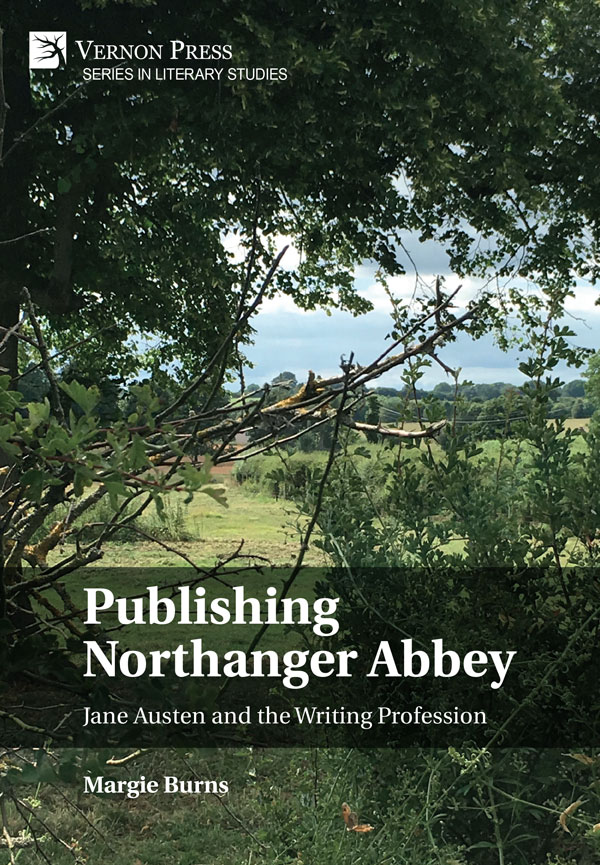
“Northanger Abbey” should have been Jane Austen’s first published novel—it had been accepted under the title “Susan” and paid for by the publisher—but it did not appear in print until after her death (and then from a different publisher). “Publishing Northanger Abbey: Jane Austen and the Writing Profession”, drawing on its author’s impressive lifetime intimacy with Austen’s writings and an astonishing trove of vigorous, detailed, and innovative research, finds a more intelligible and complex story in that unaccountable delay than anyone else yet has. Burns discovers new documentation, corrects chronology, gets inside the dynamics and personalities of the publishing world in informed and imaginative ways, makes some carefully considered literary and biographical judgments, and also uncovers some genuine surprises that not just Austen scholars but Austen’s impassioned community of readers generally will very much want to know about. The result is a vivid and nuanced picture of what in day-to-day practical terms it was like to be a superlatively talented writer making her way in a world that hadn’t figured that out yet because it always had other things on its mind.
Dr Gordon Braden
Professor Emeritus
University of Virginia
Like “Northanger Abbey”, Margie Burns’s “Publishing Northanger Abbey: Jane Austen and the Writing Profession” has two parts. First, with impressive archival research and closely-reasoned forensic analysis, Burns examines why Austen chose to submit her novel “Susan” to Crosby and why Crosby chose not to publish it, painting a detailed picture of the late Georgian publishing industry and drawing plausible inferences about Austen’s strategy as a writer as she composed and revised her novel. Burns then uses her conclusions to illuminate our understanding not only of “Northanger Abbey,” which she defends against the common charge of having structural flaws, but also “Mansfield Park,” which she reads as Austen’s remaking of the earlier work. This lively, accessible study will interest both scholars and lay readers of Jane Austen.
Dr Elaine Bander
President of JASNA (CANADA)
Margie Burns’ book sheds a light on the conundrum of Jane Austin’s first novel, which remained unpublished for more than a decade after the purchase of her manuscript. Burns’ thorough research refutes some established opinions, including the belief that Austin’s unpublished years were also non-writing years, and that the author was occupied with family matters instead of engaged in writing. Burns’ hermeneutical style poses important questions and gives persuasive answers. Moreover, it is bookended by Burn’s infinite expertise on British literature, politics, and history during the late eighteenth and early nineteenth century. Among the controversies discussed by Burns is Austin’s six year-long suspension before she confronted the publisher who bought and advertised her manuscript, but failed to publish it. The author takes us on a fascinating journey revealing the complicated world of publishing in Britain, examining the motives of the editors, writers and publishers in the background of contemporary historic events. Burn’s nonfiction demonstrates a deep understanding of the relations of power among canonical and obscure writers, reputable and non-established publishers. Burns unveils the role of personal interests in the context of anti-slavery and early feminist zeitgeist in the choice and promotion of various topics and genres. More important, Burns knows how to keep the reader’s attention by weaving intriguing, little known facts in the fabric of her uniquely rich, masterful writing.
Dr Tamara Hammond
University of Utah
Throwing new light on the many myths about Austen and her journey to publication, Burns’s book will delight and intrigue both academia and Janeites. Diving fearlessly into the cut-throat world of early nineteenth-century publishing, she presents fresh evidence that publisher Benjamin Crosby certainly intended to publish “Susan” soon after its 1803 submission. She traces the fate of the book within the context of the publishing business of the time, and argues that Austen and her family members would have closely followed the situation, and similarly that there were no “lost years”—Austen was busy writing and revising in the period before the family settled at Chawton. Dr. Burns returns “Northanger Abbey” to its rightful place in the mature Austen canon and affirms Austen as a professional and hard-working writer.
Janet Mullany, JASNA-DC
“Publishing Northanger Abbey: Jane Austen and the Writing Profession” provides illuminating and suggestive ways to understand the curious publishing history of Jane Austen’s novel Northanger Abbey (1818), which has been the subject of much scholarly speculation.
[…] Access to and scrutiny of innumerable digitized sources helps provide new material and insights into the publishing world and business. Burns offers careful and extensive reading of advertisements, including those for “Susan,” in newspapers, magazines, and end pages of other publications.
[…] the study offers some valuable and fascinating primary material for scholars and fans of Austen alike.
[Extract from book review appearing on the journal 'Tulsa Studies in Women’s Literature' (41.2), Fall 2022 issue. Reviewer: Claire Grogan (Bishop’s University)]
Discover books that expand on the themes explored in this work—titles that engage with similar questions, intersecting disciplines, and complementary perspectives to deepen understanding and broaden the conversation.
Browse all titles
Ailsa Cox, James Hewison, Michelle Man, and Roger Shannon (Eds.)
View more