Loading...
Please wait while we load the content...

Loading...
Please wait while we load the content...
Stay informed about our latest publications, calls for proposals, and special announcements. As a subscriber, you'll also enjoy exclusive member discounts of 10%-20% on all orders. Join our community of scholars, librarians, and readers today.


Availability
In stock
ISBN
9781622734108
Edition
1
Publication Date
March 31, 2019
Physical Size
236mm x 160mm
Illustrations
22 Color, 73 B&W
Number of Pages
552
Currency
Quantity
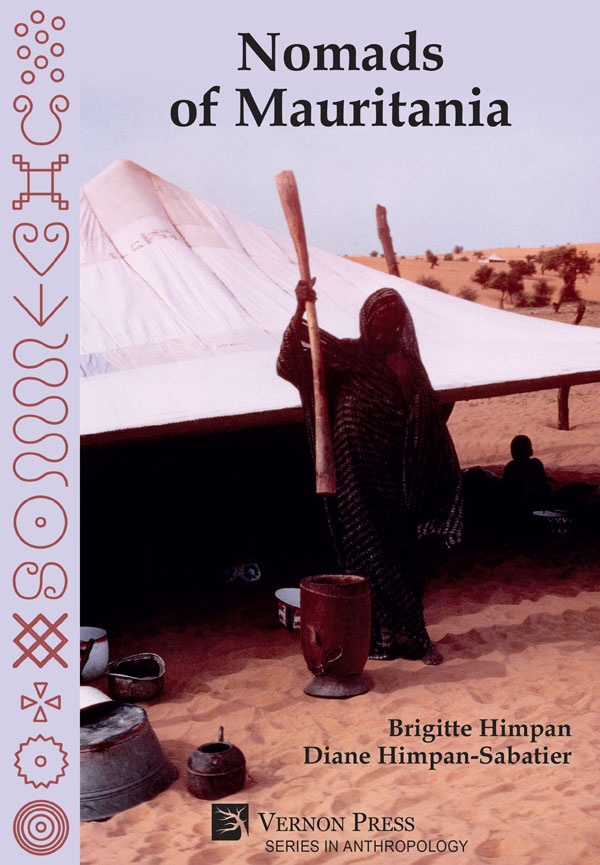
"Nomads of Mauritania" re-conceptualizes the idea of the Mauritanian nomads’ geographical environment, characterized by its desertification. It addresses the Mauritanians' way of life (nomadism), their culture and customs. Moreover, not only it reflects the current situation of the vast majority of Mauritanians today, but also it captures the experience in writing of a fast-growing number of individuals belonging to migrant communities in other parts of the Maghreb.
One of the main objectives of Nomads of Mauritania is to develop the new theoretical concept of strategic nomadism. In other words, it invites the reader to re-think the stereotypes of the “nomad” and “nomadism” in the present day and age. It approaches the phenomenon of nomadism from the theoretical perspective of intercultural and postcolonial studies.
Therefore, Nomads of Mauritania will give its readers a new viewpoint of the different methodological schools and theories undertaken by the major scholars in the field of migration, as well as validating modern research orientations to the intercultural relationships between Maghrebian countries and beyond.
Prof. Dr. Cristián H. Ricci, Professor of Iberian and North African Literatures, University of California, Merced, USA and Director of the University of California Education Abroad Program Chile-Argentina.
This is a special collaborative work between an artist and a researcher that describes the lives of nomadic people in Mauritania. The authors explore the intersection of culture, nomadic life, art, and climate in the lives of these nomads. Their exploration illuminates the complexity of these factors and how they shape the everyday life and ephemeral artistic activities of the nomads. The authors’ insights have broader implications for climate change and identity well beyond this nomadic group in extinction.
Prof. Dr. Thomas D. Hall, Professor Emeritus, Department of Sociology & Anthropology, DePauw University, USA.
An outline and overview of Mauritania, its environment, history, and ways of living, as well as the visual and material culture of its nomadic peoples. It can serve as an introduction for students and others wishing to explore these topics in critically focused, in-depth studies.
Prof. Dr. Henry John Drewal, Evjue-Bascom Professor of Art History and Afro-American Studies, University of Wisconsin-Madison, USA.
Nomads of Mauritania is remarkable for its depth, breadth, and penetration into the inner world of nomadic society. The authors, Brigitte Himpan and Diane Himpan-Sabatier, provide the reader with detailed geographical and historical context—essentially the stage on which the social drama unfolds. Natural resources are described, their social relevance discussed, and the consequences of environmental change explored. The authors’ historical analysis of Mauritania is equally ambitious—extending from the Paleolithic, through documented arrivals, external relationships, and political history to the present in a continuum of cause and effect. The reader is then led into the lives of Mauritanian nomads, with a level of detail that is both welcome and overwhelming. The structure and complexity of society are examined, including consideration of caste and hierarchy; folkways and mores are explored; diet and material culture are described; and the composition and management of herds is discussed, as well as the role of Mauritanian nomads in the trans-Saharan trade. The treatment of nomadic arts and crafts includes practical considerations, social meaning, and spiritual significance. The lives of Mauritanian nomads are then projected into the future. The authors have arguably produced the most comprehensive, substantive, and accessible treatment of Mauritanian nomads ever to grace the literature.
Prof. Dr. Jeffrey A. Gritzner, Emeritus Professor, Department of Geography, University of Montana, USA and Director, The Earth Restoration Project.
This monograph deals with the cultural identity as well as the future of the Mauritanian nomads. It highlights their history considering climate change, the importance and cultural ramifications of what the authors describe as their “geometrical-abstract art” in everyday life, and their future. This interdisciplinary study is at the same time erudite, extremely instructive, well-documented, comprehensive, and easy-to-read. It should be applauded for its clarity, carefully drawn maps and beautiful illustrations. This fascinating essay will appeal to a wide range of people: generalists and specialists as well as students interested in the nomads of Mauritania.
Dr. Thérèse De Raedt, Associate Professor of French, Department of World Languages and Cultures, University of Utah, USA.
Adopting an interdisciplinary approach that combines art history, cultural studies, geography, ethnography and history, Nomads of Mauritania offers a rare window through which to see the complex world of the heterogenous nomads inhabiting the southern edge of the Sahara Desert that is today’s Mauritania. The author Brigitte Himpan and editor Diane Himpan-Sabatier have weaved a multilayered scholarship that illuminates the identity, lifestyle, moral and spiritual values, creative arts, cultural and environmental constraints and prospects that define the nomads of Mauritania. By exploring the peoples and an area often at the margins of academic studies on West Africa, this book breaks new ground by threading a path frequently bypassed.
Dr. Tamba E. M’bayo, Associate Professor of History, Department of History, West Virginia University, USA.
Discover books that expand on the themes explored in this work—titles that engage with similar questions, intersecting disciplines, and complementary perspectives to deepen understanding and broaden the conversation.
Browse all titles
Désirée Cappa, James E. Christie, Lorenza Gay, Hanna Gentili, and Finn Schulze-Feldmann (Eds.)
View more