Loading...
Please wait while we load the content...

Loading...
Please wait while we load the content...
Stay informed about our latest publications, calls for proposals, and special announcements. As a subscriber, you'll also enjoy exclusive member discounts of 10%-20% on all orders. Join our community of scholars, librarians, and readers today.

Availability
In stock
ISBN
9781622732302
Edition
1
Publication Date
September 30, 2017
Physical Size
236mmx160mm
Illustrations
43 Color
Number of Pages
122
Currency
Quantity
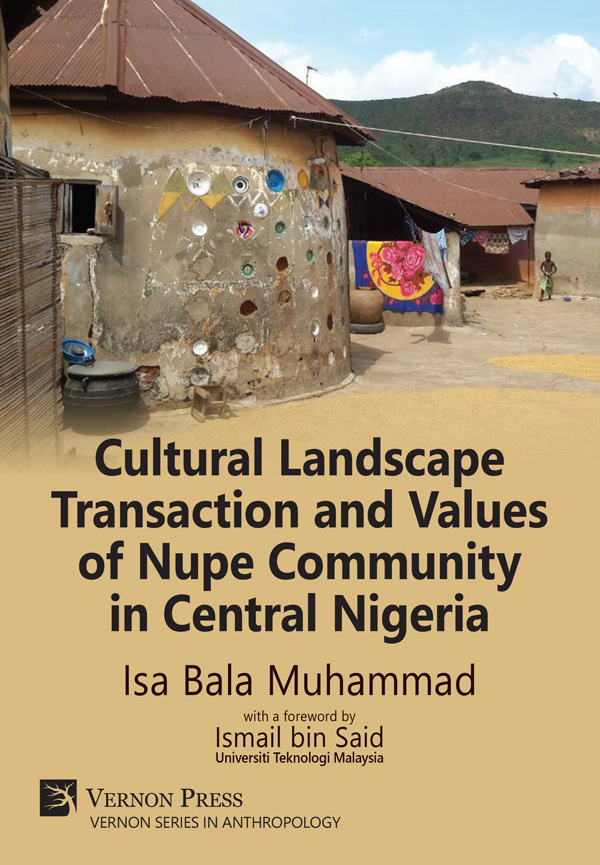
"The book is an account of Nupe cultural landscape- a product of peoples’ steady way of life influenced by culture and landscapes’ social transactions. It covers Nupe cultural values with specific references to a typical Nupe community- Doko. The output is largely from the inhabitants’ perspective derived from an ethnographic research compilation that led to grounded theory assertions. These assertions evolved as the climax of the research from their unique tangible and intangible values, belief and myth, a viewpoint showcasing inhabitants’ collective identity.
Nupe cultural values stem out into tripartite branches that cover landscape (e.g., hill or valley, water bodies, and market scenes), indigenous professions (e.g., farming, trading and traditional barbing) and architecture (e.g., compound design that includes bedroom, courtyard and entrance hut). The meanings derived from the values as lived by the people are common socio-spatial traits passed from generation to generation. The tangible physical features that are shaped by the intangible values as elaborately discussed by the author are essential interpretations towards sustainable rural development and nature conservation as realities essential for planning, policy formation and developmental programmes. Significantly the meaning extracted from the cultural landscape transactions are expressed spatially.
The book affirms the uniquely characterized cultural landscape transactions with overriding design implication that relates typical Nupe compound design influenced by Nupe family system. Furthermore, it showcases theoretical inference which exposes the need to focus on minority ethnic groups in order to preserve, sustain and as well understand cultural landscape transactions of such groups both by content and method. This is because interpretations of manmade features and human lived experiences exhibited in tangible and intangible forms constitute the mainstream values of inhabitants and contribute to environmental orderliness.
Invariably, developmental plans by governments could be optimised through the comprehension of peoples’ living experiences such as provided in this book. This scholarly contribution is a valuable asset to architects, anthropologists, psychologists, environmentalists, and sociologists. It also provides research ethnographers with great benefits in understanding indigenous cultural landscapes. Beyond these, the built environmentalists are impacted by the sustainable human-place transactional ideals and insights in the book."
Abubakar Isah Danladi, Federal University of Technology, Minna, Nigeria
Discover books that expand on the themes explored in this work—titles that engage with similar questions, intersecting disciplines, and complementary perspectives to deepen understanding and broaden the conversation.
Browse all titles
Jonathan O. Chimakonam and Fainos Mangena (Eds.)
View more
Suiven John Paul Tume and Vincent Itai Tanyanyiwa (Eds.)
View more
Jonathan O. Chimakonam and Edwin Etieyibo (Eds.)
View more
Abubakar Danladi Isah and Isa Bala Muhammad (Eds.)
View more