Loading...
Please wait while we load the content...

Loading...
Please wait while we load the content...
Stay informed about our latest publications, calls for proposals, and special announcements. As a subscriber, you'll also enjoy exclusive member discounts of 10%-20% on all orders. Join our community of scholars, librarians, and readers today.


Availability
In stock
ISBN
9781622730261
Edition
1
Publication Date
July 1, 2015
Physical Size
236mm x 160mm
Number of Pages
210
Currency
Quantity
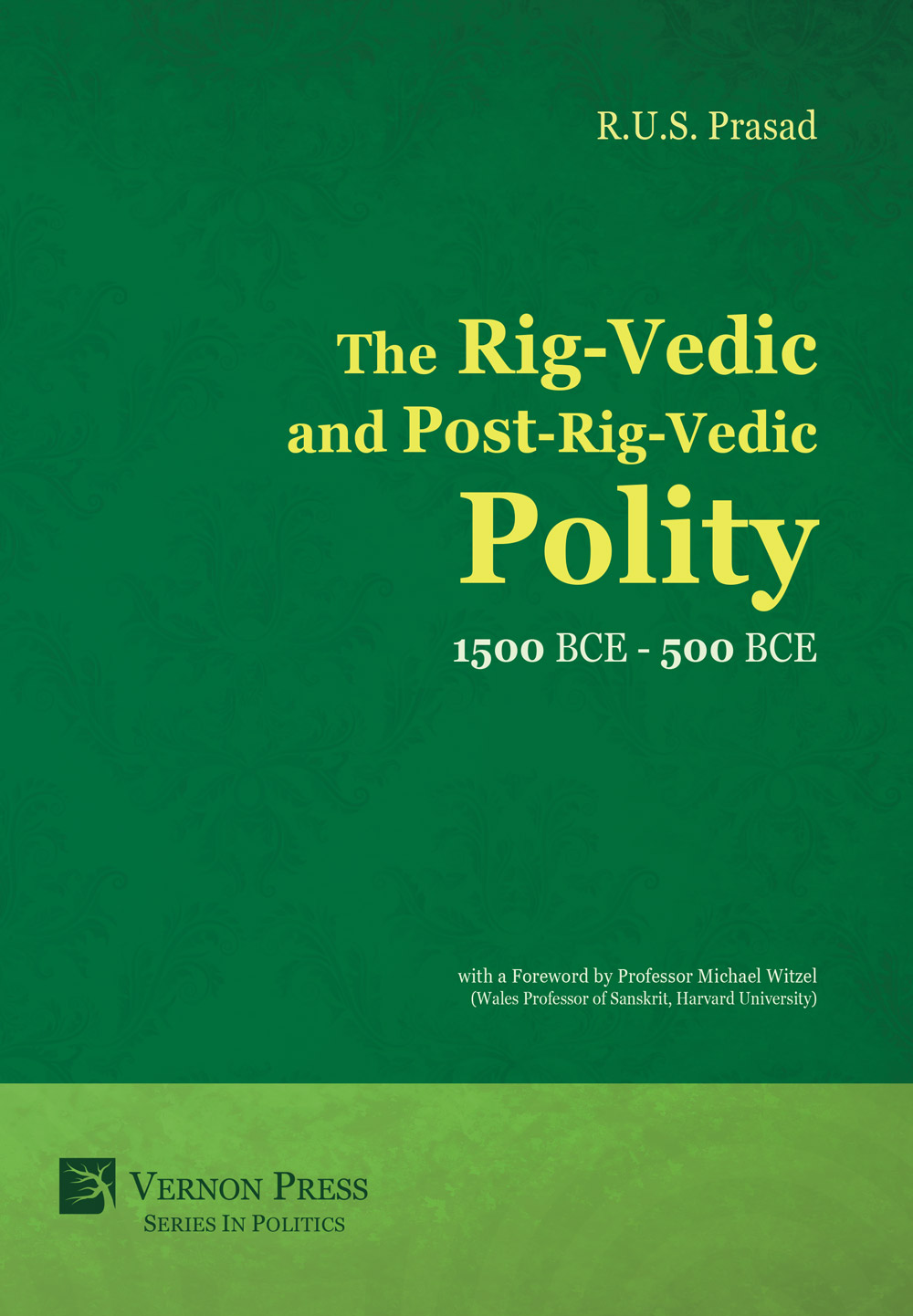
"R.U.S. Prasad rightly introduces the Vedic corpus as a 'legacy of perennial value for mankind'. As depicted by his excellent scrutiny of the Rig-Vedic and Post-Vedic polity, the Vedic corpus constitutes world-wide also the most comprehensive and perseverative documentation of various facets early state formation of one of the great civilizations of mankind. The work constitutes a systematic study and breakdown of the vast literary evidence of the Vedic corpus and comprises a 'construction of a Vedic grid' with detailed graphic representation. Thus it epitomises, too, a unique documentation of the socio-political development of early India in the second and early first millenniums BCE. It comprehends the successive development stages from the early settlement of the semi-nomadic Aryan tribes and the emergence of the Brahmana-Kshatriya dominated varna society in the Punjab and the Ganga-Yamuna doab to the rise of the first north Indian historical kingdoms in the Gangetic plain on the eve of Buddha's age."
Prof. Hermann Kulke (Emeritus)
Kiel University, Germany
"It has always been a temptation to view ancient documents and social configurations through lenses provided by later texts and social mores. When the ancient document is a sacred text, like the Rig Veda, this propensity is magnified by theological imperatives. In the case of ancient India in particular, the historical view has been clouded by the fog of nationalist discourse. Dr. Prasad clear and comprehensive book on the political structures of the Rig-Vedic and Post Rig-Vedic times lifts that fog and presents with clarity the changing and vibrant landscape of ancient Indian society and political formations. This will be fruitful reading especially for those who want an accessible yet accurate and comprehensive introduction to ancient Indian society."
Patrick Olivelle
University of Texas at Austin
"Prasad traces the development of systems of governance from early to late Vedic times, paying careful attention to correlating the development of power structures with early tribal movements and dynamics, shifting geographical horizons, and changes in modes of production and sustenance as these unfold through the diachronic textual strata reflected in the early sources. An important study that enhances our understanding of early Indian polity."
Edwin Bryant, Professor of Hinduism
Rutgers, State University of New Jersey.
"Dr. R.U.S. Prasad has made an excellent grid to show the relation of many Vedic tribes with particular places and periods by his laborious examination of various Vedic texts. By this he is successful in elucidating the development of Vedic society from the pastoral/tribal polity in Panjab to the agrarian/super-tribal state in the Gangetic plain. A welcome addition to research in ancient state formation."
Noboru Karashima, Professor Emeritus, University of Tokyo
"My initial interaction with Dr. R.U.S. Prasad concerned the research he conducted as a visiting scholar at the Stanford Center for International Development on the resolution of disputes in the telecommunications sector. At that time, I would never have guessed that his true scholarly passion, as revealed in his most recent manuscript, involved an era of much greater antiquity. His investigation of the changes in the Vedic polity that occurred during the many stages from the early Rig-Vedic to the post Rig-Vedic period (1500 BCE-500 BCE) displays a breadth of scholarship as astonishing as it is impressive."
Nicholas C. Hope, Stanford University
Discover books that expand on the themes explored in this work—titles that engage with similar questions, intersecting disciplines, and complementary perspectives to deepen understanding and broaden the conversation.
Browse all titles