Loading...
Please wait while we load the content...

Loading...
Please wait while we load the content...
Stay informed about our latest publications, calls for proposals, and special announcements. As a subscriber, you'll also enjoy exclusive member discounts of 10%-20% on all orders. Join our community of scholars, librarians, and readers today.

Availability
In stock
ISBN
9798881903114
Edition
1
Publication Date
September 9, 2025
Physical Size
236mm x 160mm
Illustrations
19 Color
Number of Pages
264
Currency
Quantity
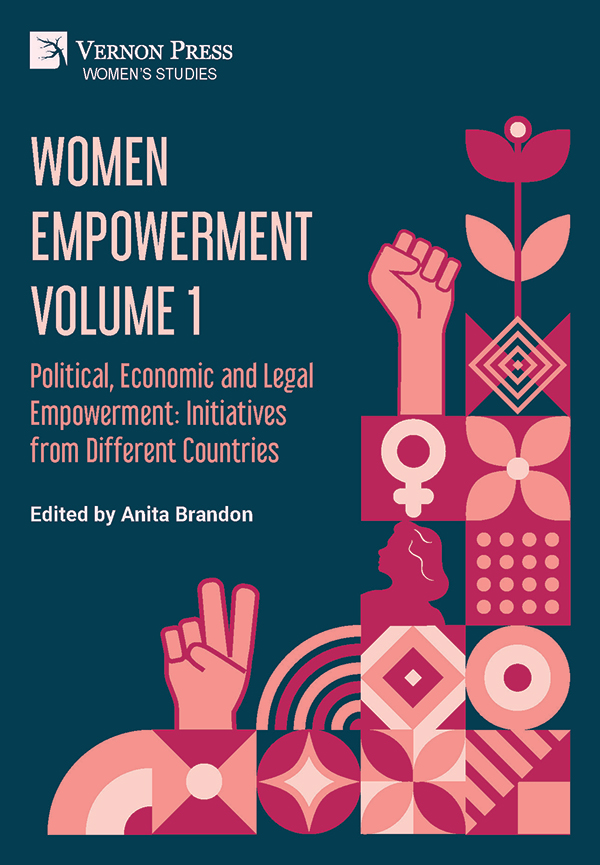
“Women Empowerment Volume 1 - The Political, Economic and Legal Empowerment: Initiatives from Different Countries,” edited by Ms. Anita Brandon and published by Vernon Press, USA, is a collection of eleven articles contributed by authors of repute drawn from Asia, Africa, Europe, North America and South America.
The articles, carefully written, depict the ground reality in patriarchal societies and tell in a compelling manner stories of individual women leaders who have battled against odds and emerged triumphant. These stories of hope are refreshing and inspiring as they chronicle the achievements of women leaders in all walks of life. Contributors have not lost sight of praxis even while analysing different theories of women empowerment and gender equality. The role of institutions, government agencies, civil society organizations and public policy has also been carefully documented and analysed by different contributors.
This compendium of carefully selected and edited articles should be of great interest to women leaders, activists, researchers, as well as lay readers interested in understanding and addressing issues related to women empowerment and gender equality.
Sunil Kumar
Prolific Writer on Policy Issues
Former Secretary, Ministry of Panchayati Raj, Government of India and now Visiting Faculty, Gokhale Institute of Politics and Economics, Pune & Member, Pune International Centre, India
Both volumes represent a range of initiatives and case studies aimed at promoting women’s empowerment and gender equality across different settings in various countries. It starts with where the editor Anita Brandon explains how she contributed in her home State Rajasthan to the reserved minimum of 33% of seats for women in local governments through the 73rd & 74th Constitutional Amendments of 1992 in India. However, translating the Amendments into action turned her lifelong focus. Apart from her own firsthand experiences, it also resulted in searching for how other institutions in and outside India arrive at full participation of women in local institutions. It is amazing how she managed to show and analyse so many cases, and they turn out to be excellent documents for both Practitioners and Researchers interested in deepening their understanding, but also to find practical approaches for Women’s participation at all levels, including the poor and not least of traditional communities. She deserves a love compliment from all the women she managed to reach out to and give them a voice.
Ms. L.M. Maarse
Formerly with SDC, India and also worked with FAO, IFAD and other International Agencies
Team Leader in above International Agencies and now a Retired Rural Development Practitioner, The Netherlands
The development truism that if the SDG 5 gets the attention it deserves, most of the other SDGs would automatically be realized is well illustrated by the beautiful anthology of experiences from diverse countries at different stages of development and even during conflict times, as in the case of Ukraine. It shows how the agency of women gets strengthened through development and social initiatives ingrained in the public policy of nations, with the support of UN agencies and NGOs, complemented by civil society actions mainly through women’s collectives; it captures the multifaceted concept of empowerment in an easy and attractive way. It covers the whole gamut from theory and concept to individual case studies and also ranges from basic livelihoods to more ambitious enterprises to human development, both education and health, social development, especially for elders and marginalized groups, and ultimately, legal and political empowerment, particularly at the grassroots level in Local Governments.
The beauty of these two Volumes is that they expound the concepts in simple language and illustrate them through caselets and experiences, and list out initiatives from a wide range of countries which can strengthen women’s empowerment in different ways. The most fascinating and promising one seems to be the Self Help Groups of Women federated into a larger collective working as equal partners with elected Local Governments and creating a demand for development from below, almost forcing positive responses from different levels of Government. It would not be wrong if the two Volumes are described as textbooks of theory, policy and practice.
S.M. Vijayanand
Former Secretary, Ministry of Panchayati Raj, Government of India, India;
Former Chief Secretary, Kerala, India
Discover books that expand on the themes explored in this work—titles that engage with similar questions, intersecting disciplines, and complementary perspectives to deepen understanding and broaden the conversation.
Browse all titles
Lisa V Mazey (Ed.)
View more
Sandra Trudgen Dawson and Nupur Chaudhuri (Eds.)
View more