Loading...
Please wait while we load the content...

Loading...
Please wait while we load the content...
Stay informed about our latest publications, calls for proposals, and special announcements. As a subscriber, you'll also enjoy exclusive member discounts of 10%-20% on all orders. Join our community of scholars, librarians, and readers today.


Availability
In stock
ISBN
9781622737772
Edition
1
Publication Date
May 5, 2020
Physical Size
236mm x 160mm
Number of Pages
161
Currency
Quantity
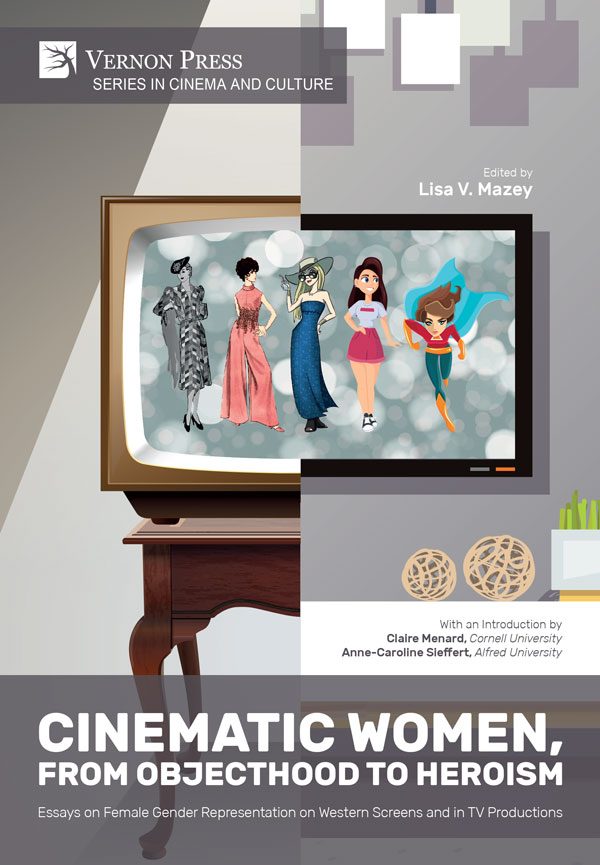
This book is of major interest and high novelty in that it analyses the impact of the “male gaze” – an “old way of seeing” the editor Lisa Mazey says - on the representation of women in cinema and on TV. Our vision of gender roles in films has long been influenced by a male-dominated academic gaze and an industry that totally negated the work of women in the first decades following the birth of this artistic genre. In a post-“#me-too” period, this compilation of cultural essays dealing with the inequalities of treatment imposed for centuries on women in cinema and with the rise of a new female “post-pop culture” voice, is essential. It examines through an intersectional angle – including the presentation of the major role of lesbian actresses and directors - a highly invigorating study of the inertia of a massively static industry – cinema, which actually reproduces all the sexist norms and canons of western phallocratic societies. The book develops the idea that the 2010s have allowed an awakening and a growing awareness of the impact of women on cinematic arts with the arrival of non-Western cinema and the rise of West African directors, online streaming platforms, and the new tastes of young audiences. The emergence of more flexible production methods has also enabled the recognition of a young generation of female movie makers, producers, writers, and more committed actresses, who have brought with them a more progressive outlook to the film and television industries
Organized into three thematic parts (Effects and Consequences of the Male Gaze – an Old Way of Seeing; Stirring Female Roles –a Current Way of Seeing; Imagined and Future Females –a Possible Way to See ) the books presents the different steps of the evolution of the dominant male-gaze on “cinematic women” through eight “chapters” – each being a well-developed essay –, focusing more deeply on “future females” and the mind-opening process at work among the new generations.
What the volume underlines, too, is the recent opening of the academic world and scholars to this changing gaze. The book’s original stance is to decompartmentalize research in human sciences by making gender and sexuality theories overlap and by proposing a complete reshaping of gender representations on screen. To that extent, this study aptly answers the current questioning of younger generations regarding the subaltern social position of women in western societies. It offers in its final part a positive perspective of the power of art and education over all forms of sexism and obscurantism.
Anne Garrait-Bourrier
Professor in Cultural studies, University Clermont Auvergne, France
The essays in “Cinematic Women” reveal the continued importance of feminist film theory as they examine a wide variety of films and tv programs. These scholars uncover the positive (the young protagonists of Debra Granik’s “Winter’s Bones” and “Leave No Trace”; Chanwook Park’s “The Handmaiden”; key female characters in the Fox series “Sleepy Hollow”: Charlize Theron’s Furiosa in “Mad Max: Fury Road”), the negative (Captain Janeway in “Star Trek: Voyager”: ), and the simply intriguing (Kim Novak’s Madeline/Judy in Hitchcock’s “Vertigo”; the negation of women’s physicality in a trio of philosophical narratives; female drone warriors in “Good Kill” and “Eye in the Sky”) that are present not only in the media but also in our world. Through enlightened examinations of women in media, both onscreen and behind it, such as these, we can recognize the triumphs and struggles of women of all ages and ethnicities throughout the world in the face of continued patriarchal and economic oppression. In addition, Claire Menard and Anne-Caroline Sieffert’s “Introduction” provides a valuable and relevant history of women in film. Lisa Masey shows immense energy in gathering these works from a single academic conference, which illustrates the great diversity and vitality in current feminist scholarship. This collection will provide a strong basis for film studies classes for upper-level undergraduate and graduate students.
Prof. Dr. Thomas Slater
Indiana University of Pennsylvania
This is an ambitious if uneven collection of essay. One of its strengths is not in fact reflected in its title, which is its willingness to look beyond Western cinema and discuss non-Western productions, specifically, Chanwook Park’s The Handmaiden. Its range is impressive – from classic film, to contemporary TV, from arthouse to mainstream. Overall, the writing is ambitious and seeks to go beyond the canon of textbook approaches to this topic.
Dr. Ruth Barton
Head of School of Creative Arts
Samuel Beckett Centre
Trinity College Dublin
Discover books that expand on the themes explored in this work—titles that engage with similar questions, intersecting disciplines, and complementary perspectives to deepen understanding and broaden the conversation.
Browse all titles
Eulalia Pérez Sedeño, Lola S. Almendros, S. García Dauder, and Esther Ortega Arjonilla (Eds.)
View more
Vanessa Guignery and Wojciech Drąg (Eds.)
View more