Loading...
Please wait while we load the content...

Loading...
Please wait while we load the content...
Stay informed about our latest publications, calls for proposals, and special announcements. As a subscriber, you'll also enjoy exclusive member discounts of 10%-20% on all orders. Join our community of scholars, librarians, and readers today.


Availability
In stock
ISBN
9781622731961
Edition
1
Publication Date
September 30, 2018
Physical Size
236mmx160mm
Number of Pages
262
Currency
Quantity
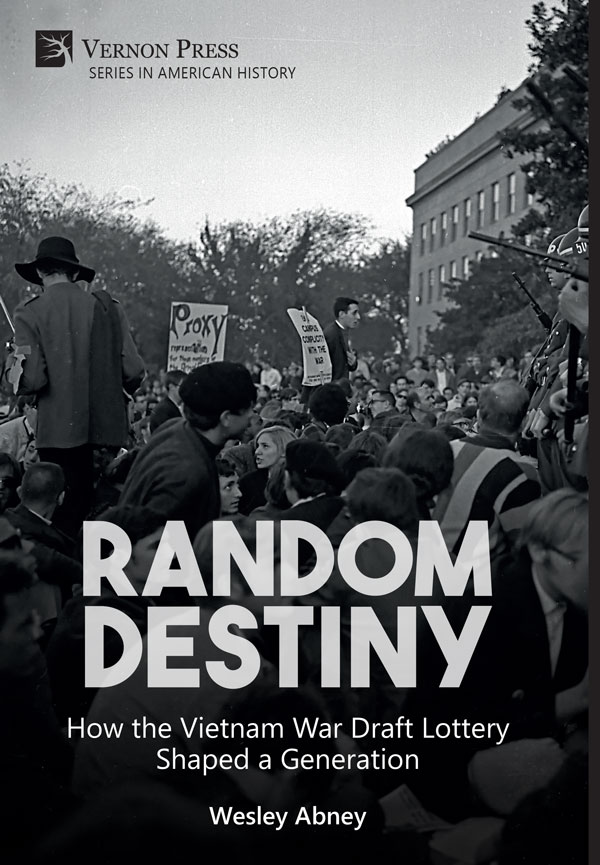
In his scrupulous compendium of facts, Abney rightly faults the deliberately skewed Vietnam war draft system that favored the privileged and doomed others. In this vast generation of 27,000 million men, only 3 million served in the combat zone, so large numbers with deferments were spared. Instead, in 1966, during the largest call-up, and to avoid all out-campus revolt, McNamara’s heinous Project 100,000 lowered the mental test, creating the “Moron Corps” as they were called, who died in Vietnam in disproportionate numbers. The power in this book lies in vivid reminiscences of more than 160 men who answered a website request to recount the effect of the lottery on their lives.
Myra MacPherson
Author of the Vietnam classic, 'Long Time Passing: Vietnam and the Haunted Generation'
This is both a very interesting and very important book. First, it was of particular interest to me as someone who was subject to the first Vietnam-era draft lottery in December 1969 (#206; reclassified 1-A, but not drafted) when I was a 22-year old first-year graduate student. It helped me remember more clearly some of the details of my own experience with the lottery and allowed me to put its impact on my life in the context of other men who went through it. I think that the book will find a receptive audience among of those that generation for whom the lottery was a significant part of our coming of age.
Second, the book’s well-written and well-researched descriptive narratives of the draft, the lottery, and a range of cognate topics, together with the numerous excerpts from the personal recollections of men who were in the lottery pool that appear at the end of all but the first chapter combine to provide an important record of this formative period in modern American history. In constructing this record, the author has done an excellent job of drawing on an impressive variety of sources, including government documents, contemporaneous news reports, and scholarly analyses from several social science disciplines. I might add that I particularly appreciate the book’s sensitivity to the differential racial and socio-economic impact the draft and the lottery had on the young men affected by it.
Much of the factual material covered is available elsewhere, but the book presents it in a particularly thoughtful and refreshingly accessible manner. High school and college instructors (including me) who teach about the Vietnam War or America during the Vietnam War-era should find the book of great value. I would also highly recommend that high school, college, and public libraries add Random Destiny to their collections.
William A. Joseph,
Wellesley College, USA
'Random Destiny' is an important contribution to scholarship on the American Vietnam War. Anyone looking to understand young men’s experiences of the war through personal narratives can turn to excellent oral histories and memoirs of military veterans. Collections chronicling the choices of antiwar activists and men who fled the United States or went to prison are also available. But this book fills a hole by offering the stories of men who, for the most part, neither served nor actively protested. Instead, it uses the Vietnam War draft lottery, first instated in 1969, as a lens to examine the myriad ways Selective Service and the threat of the draft affected young men’s lives.
'Random Destiny' contains more than 160 personal accounts, obtained primarily through a website and arranged based on the draft classification each man received from his local draft board. Their stories are representative of one subset of American manhood. The men were overwhelmingly college educated and from a handful of states. They knew better than most how to work the system to their advantage. Not all succeeded in achieving the outcomes they wanted, but virtually all made or tried to make choices for themselves.
Their stories emphasize the capriciousness of the draft, the lottery that drove it, and the officials who administered it. Their lives changed for reasons beyond their control. Nonetheless, the men in this book worked incredibly hard to exert whatever control they could. Although most framed their stories around their randomly drawn lottery numbers , it’s nevertheless clear that most benefited from a system designed to privilege men just like themselves.
Amy J. Rutenberg
Department of History, Iowa State University
Discover books that expand on the themes explored in this work—titles that engage with similar questions, intersecting disciplines, and complementary perspectives to deepen understanding and broaden the conversation.
Browse all titles
Barry Turner, Daniel Barredo, and Steven James Grattan (Eds.)
View more