Loading...
Please wait while we load the content...

Loading...
Please wait while we load the content...
Stay informed about our latest publications, calls for proposals, and special announcements. As a subscriber, you'll also enjoy exclusive member discounts of 10%-20% on all orders. Join our community of scholars, librarians, and readers today.

Availability
In stock
ISBN
9781622732043
Edition
1
Publication Date
November 10, 2018
Physical Size
236mm x 160mm
Illustrations
11 Color
Number of Pages
154
Currency
Quantity
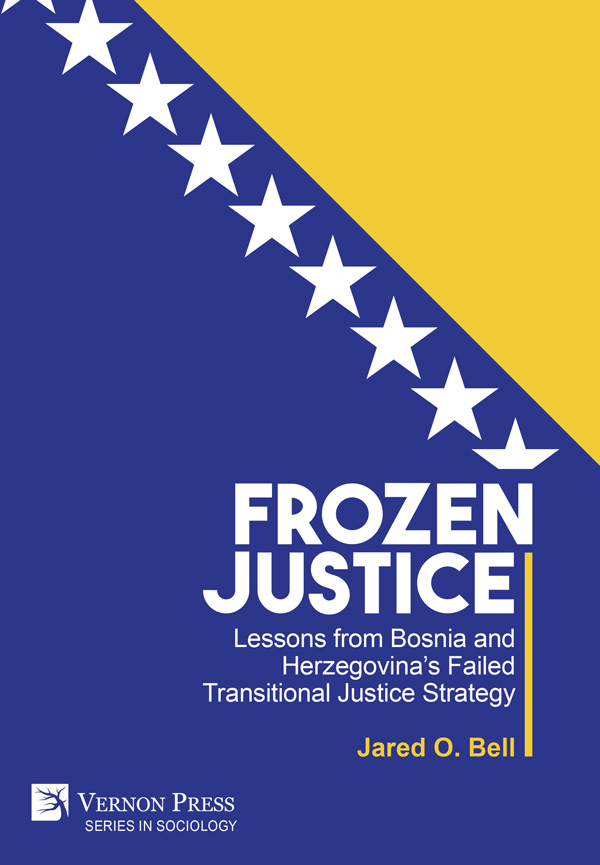
Transitional justice (TJ) has become a sine qua non for societies transitioning from large-scale violence and repression. Whether TJ processes are effective and how the most affected populations perceive them though remains largely unresearched. Jared Bell’s cutting-edge work provides a crucial window into the perceptions of ordinary citizens of Bosnia and Herzegovina on the country’s attempts at TJ.
Dr. Ismael Muvingi,
PhD Program Director, DCRS, Nova Southeastern University
Frozen Justice is a timely, critical account of the challenges to dealing with the past more than a quarter of a century after ethnic conflict and subsequent human rights violations devastated Bosnia and Herzegovina (BiH) in the 1990s. Dr. Jared Bell, Assistant Professor at the International University of Sarajevo, provides an in-depth analysis of transitional justice mechanisms in the post-Dayton Peace era, including retributive and restorative justice strategies, to foster accountability and reconciliation. Despite the decades that have passed, the author soberly demonstrates that the international policy strategies implemented on the ground have only resulted in partial success to promote peace and security. He skillfully uses qualitative interview data from over 450 participants across the country to assess why society has failed to come to terms with its burdensome past. Dr. Bell’s work adds a new, rich layer of empirical data, which helps better understand the perpetual post-conflict stalemate in BiH. He competently guides readers through the intricate political post-war imbroglio of Bosnian institutions and his survey of three major cities, Sarajevo, Mostar and Banja Luka, serve as a compelling stepping stone for future research to delve even deeper into the nuanced transitional justice issues that are not only emblematic for BiH, but that also occur in many post-conflict societies at large.
Prof. Dr. Arnaud Kurze
Montclair State University, USA
Guided by their leaders, societies have the obligation to build the peace after a destructive civil war. Commentators are not convinced that the foundation for that lasting peace has been laid in Bosnia and Herzegovina (Bih). Instead, there is the general feeling that more than two decades after the 1992-1995 civil war, BiH lacks the capability of a functional state that can implement reforms necessary to meet the basic economic and other needs of citizens.
Using the concept of transitional justice and survey of prevalent attitudes in three key communities—Sarajevo, Mostar, and Banja Luka—this new book contributes significantly to that debate. It builds on and updates studies like the one by G. Wilkes et al., “Reconciliation and trust building in Bosnia-Herzegovina: A Survey of Popular Attitudes in Four Cities and Regions,” published in 2012 and included in the book’s bibliography. The work’s other merits include a good background history of BiH and an excursion into transitional justice in other republics in former Yugoslavia like Croatia, Kosovo, Montenegro, and Serbia necessary for a wholesome understanding of BiH, including comparative analysis.
Prof. Dr. Philip C. Aka
Acting Dean and Professor of Law, Faculty of Law, International University of Sarajevo, Bosnia and Herzegovina
Researching elements of transitional justice (as an inherently political process) and analyzing internal socio-political relations in Bosnian plural society, the author concludes, based on the conducted survey, that there is no political will to address the war crimes and to lead the country's reconciliation efforts. Furthermore, the author emphasized that it is impossible to begin to understand the current political system in B&H without understanding why it was constructed this way after the conflict. An unfinished process of implementation of the Dayton Agreement, as well as the non-application of the Decision of the Constitutional Court, contributes and is conducive to further obstruct the reconciliation in Bosnia and Herzegovina.
Prof. Dr. Dženeta Omerdić
University of Tuzla, Bosnia Herzegovina
Discover books that expand on the themes explored in this work—titles that engage with similar questions, intersecting disciplines, and complementary perspectives to deepen understanding and broaden the conversation.
Browse all titles