Loading...
Please wait while we load the content...

Loading...
Please wait while we load the content...
Stay informed about our latest publications, calls for proposals, and special announcements. As a subscriber, you'll also enjoy exclusive member discounts of 10%-20% on all orders. Join our community of scholars, librarians, and readers today.
Availability
In stock
ISBN
9798881900069
Edition
1
Publication Date
November 19, 2024
Physical Size
236mm x 160mm
Number of Pages
318
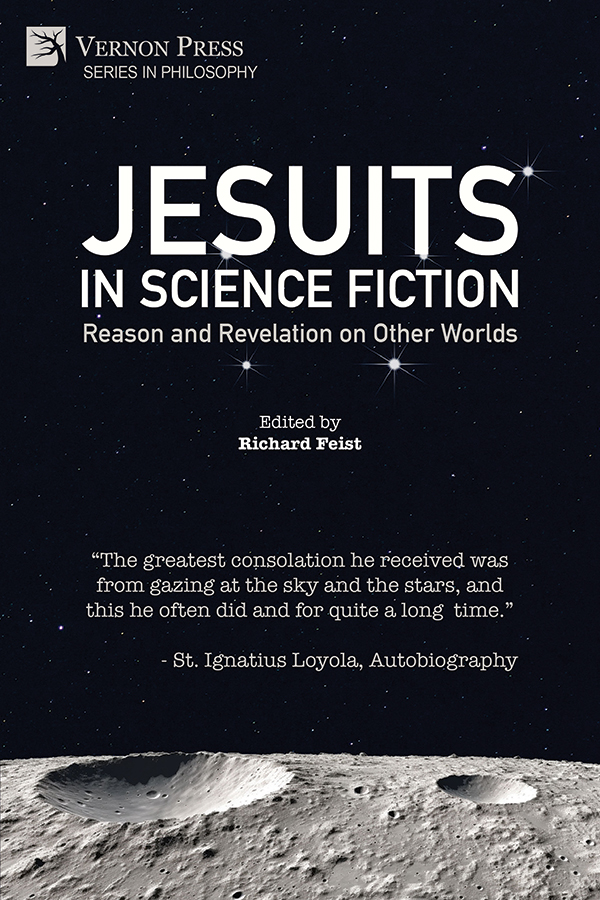
Feist’s volume contests the often-accepted trope of the conflict between religion and science by looking at the presence and representations of Jesuits in modern science fiction. Its 14 discerning essays focus on the otherworldly spirituality, openness, and commitment to reason of the Jesuit priest, whose presence in science fiction is employed to provide insight into imagined future worlds. This volume reveals to the reader not only more about those future worlds, but also about the religious core that often underlies humanity's engagement with science.
Prof. Dr. William Sweet
Membre titulaire, Institut international de philosophie (Paris)
Fellow, Brian Mulroney Institute of Government
Director, Centre for Philosophy, Theology, and Cultural Traditions
Department of Philosophy
St Francis Xavier University
For Ignatius of Loyola, the Founder of the Jesuits, regular contemplation of the night sky was among his most moving experiences of spiritual consolation. Could he have imagined that one day his Order would reach those stars—understood today as suns with orbiting planets—by the engines of the science fiction genre? Guided by the editorial hand of Richard Feist, this book offers essays on Jesuit logic, expositions of “Jesuit themes” in the works of authors like Philip K. Dick and Walter Miller Jr., interstellar missions and First Contact, archeology and the ruins of past civilizations, theology, spiritual practice, and celebrating mass on other worlds. Science fiction speculates on what future history might be, and for any number of reasons, the Jesuits play a conspicuous role in that future.
Rev. Dr. Mark Slatter
Faculty of Theology
Saint Paul University, Ottawa, Ontario
“Jesuits in Science Fiction” is an enthralling vista into an unearthed genre of writing: science fiction narratives that feature Jesuit characters and themes. The Jesuit order, contrary to the medieval Dominicans and Franciscans, was founded in the 16th-century and is thus a pre-eminently modern institution. The Jesuits are very much tied to the major developments of the modern world, from the advancement of natural science in the Galileo affair to the discovery of the New World to the revolutions of philosophical and political thought. But it is their presence in science fiction stories that allows the Jesuits to bring their unique perspective to bear on myriad topics, principally the balance between reason and faith, the natural and supernatural, and the questioning mind of science and the assurance of religious belief. From the popular works of Philip K. Dick to the lesser-known writings of Neil Gaiman and Lino Aldani, this is a book that is revelatory and informative as it sheds light on a generally unexplored terrain. I would definitely recommend it to anybody who is interested in science fiction writing that lies at the intersection of religion and philosophy.
Dr. Nikolaj Zunic
St. Jerome’s University, Waterloo, Ontario, Canada
Discover books that expand on the themes explored in this work—titles that engage with similar questions, intersecting disciplines, and complementary perspectives to deepen understanding and broaden the conversation.
Browse all titles
Adam Bednarczyk and Magdalena Kubarek (Eds.)
View more
Eulalia Piñero Gil and María Laura Arce Álvarez (Eds.)
View more


