Loading...
Please wait while we load the content...

Loading...
Please wait while we load the content...
Stay informed about our latest publications, calls for proposals, and special announcements. As a subscriber, you'll also enjoy exclusive member discounts of 10%-20% on all orders. Join our community of scholars, librarians, and readers today.


Availability
In stock
ISBN
9781622739653
Edition
1
Publication Date
October 6, 2020
Physical Size
236mm x 160mm
Illustrations
21 Color
Number of Pages
285
Currency
Quantity
I have read Emily Williams’ manuscript with unalloyed admiration. It is in more than one sense a monumental undertaking and achievement, bringing together a number of disciplines to elucidate what might at first seem a tangential or minor matter, two family tombstones marking long forgotten burials of African-Americans in 19th c. Williamsburg VA.
That the tombstones had been noticed and ignored twice in the 20th c., once in the construction of a white church on the site, (1925) and again by the Colonial Williamsburg Foundation in reworking a parking lot (1965), suggests the prevailing establishmentarian indifference.
Dr. Williams’ work is erudite, thorough, and exhaustive. She is the master of the fine and magisterial detail, ranges comfortably across a variety of disciplines, and writes with ease and command.
Her extraordinary contextualizing moves from discipline to discipline, taking into account a multiplicity of cultural, racial, historical, biographical, and theoretical considerations.
Terry L. Meyers
Professor of English Emeritus
The College of William and Mary
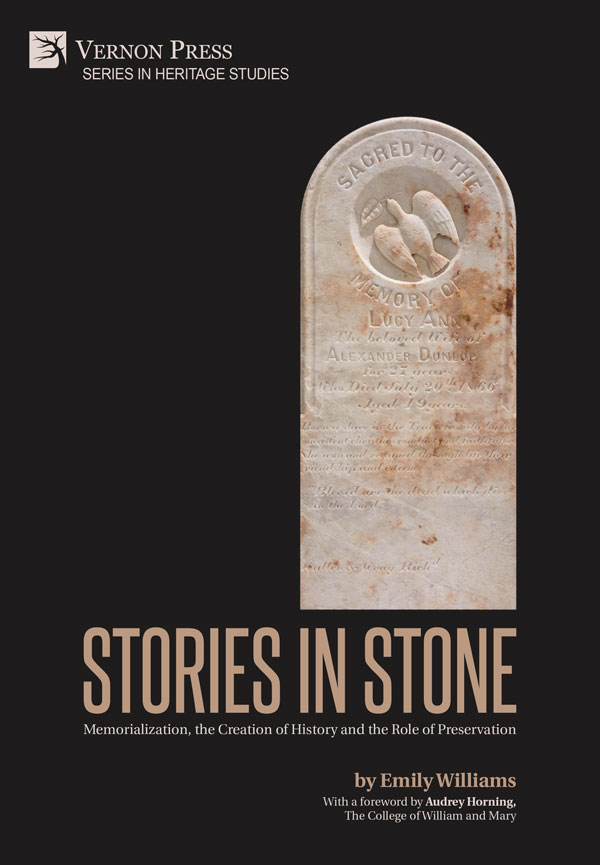
Inspired by the discovery of two intentionally-buried tombstones, Williams presents a thorough analysis that incorporates race, commemoration, and memory across several generations. The author illustrates how various constituencies over time interacted with - even buried - these markers in order to manipulate memory in deliberate and consequential ways.
During the mid-1800s, influential community leader Alexander Dunlop seized the opportunity to proclaim his family’s embodiment of American values as examples of his community’s potential to contribute to the American nation. This occurred during a period in which the paradox of enslavement in American democracy became unsustainable. Dunlop designed his family’s tombstones to communicate their Christian mores and American identity. The markers adroitly broadcast his aspirations for the nation’s future while employing non-threatening messaging through epitaphs, iconography, and material choice.
Williams presents an engaging narrative of memory, commemoration, and agency through object biography, demonstrating that the visibility of the tombstones and their aspirational messages were not passive reflections of the individuals memorialized, but actively communicated a vision of the future in which all Americans – even those formerly enslaved - participated. She deftly relates contemporary dialogues about Confederate monuments and memorial creation, using the Dunlop family gravestones as one case study. Through Williams’ clever, micro-historical analysis, these tombstones demonstrate both the mutability and endurance of their powerful messages over the generations.
Williams’ investigation epitomizes the potential of object biography and microhistory. "Stories in Stone" is enlightening, inspiring, and instructive. Its multidisciplinary approach has broad appeal for a variety of audiences, including those interested in anthropology, history, historic preservation, civics, conservation, linguistics, and race.
Laura J. Galke
Chief Curator
Virginia Department of Historic Resources
This is a sophisticated and highly contextualised study that places a small group of memorials in their various contexts, indicating the ways in which material culture can have complex biographies, which are not only commemorative but also seen as dangerous and subversive by some.
Although working out from very few objects, this study relates to a series of larger issues, both in terms of time and place, and theoretical and methodological issues. It is a valuable contribution to material culture studies, as well as gravestone studies and historical archaeology.
The conservation aspect is particularly welcome; conservation is often portrayed as having ethics regarding authenticity and truth to materials, but not the wider implication so of decisions around conservation (or not).
The Post-Bellum world of Virginia has a social-cultural dynamic of its own but part also of that of the South; this revisited the monument with its burial in the early 20th century. Here the micro-history and object biography combine with larger-scale forces that make the study of wide significance.
Harold Mytum
Professor of Archaeology,
School of Histories, Languages and Cultures, University of Liverpool
Discover books that expand on the themes explored in this work—titles that engage with similar questions, intersecting disciplines, and complementary perspectives to deepen understanding and broaden the conversation.
Browse all titles
Lee Davidson and Leticia Pérez-Castellanos
View more