Loading...
Please wait while we load the content...

Loading...
Please wait while we load the content...
Stay informed about our latest publications, calls for proposals, and special announcements. As a subscriber, you'll also enjoy exclusive member discounts of 10%-20% on all orders. Join our community of scholars, librarians, and readers today.


Availability
In stock
ISBN
9781622732050
Edition
1
Publication Date
April 28, 2017
Physical Size
241mm x 164mm
Illustrations
14 Color, 212 B&W
Number of Pages
428
Currency
Quantity
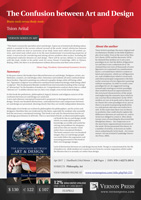
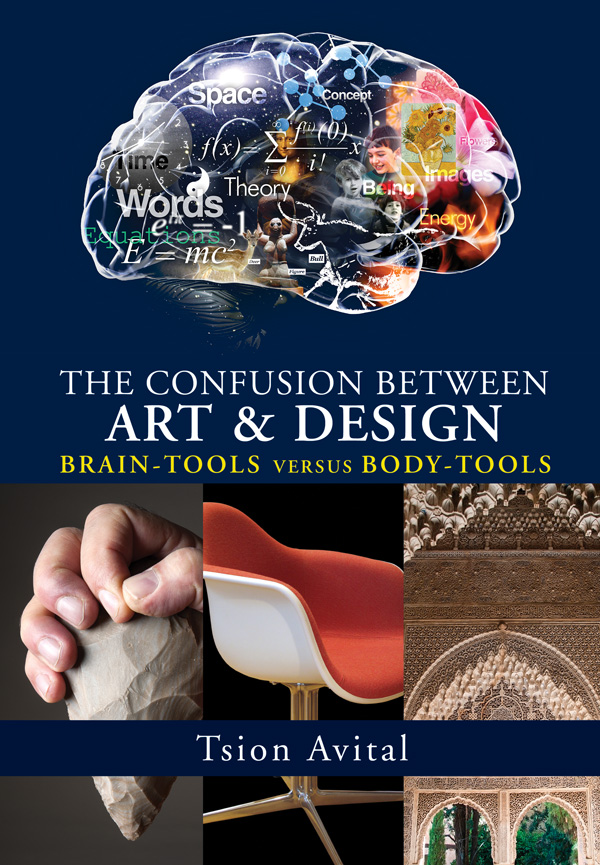
"Since the early decades of the twentieth century art lovers and art historians have realised that something is rotten in the art world. The confusion caused by the rapid succession of many modernist styles in Europe and America was intensified by modernist authoritarians who decided arbitrarily what art is, formulating the slogan that art is what the art world says it is. Tsion Avital rose to the occasion to counteract this fallacy. In his first book, Art versus Nonart (2003) he formulated an extensive theory of mindprints to distinguish art from non-art. He pointed out that the one ancient paradigm of figurative art has run its course, but that its replacement by so-called abstract art is a fallacy because it is neither art nor abstract. In the present publication Avital renews his stance on what art is, but broadens the scope to argue about the manifold differences between art and design. Once again, Avital rises to the occasion to clear up a confusion, as the title of the book clearly indicates: The Confusion between Art and Design. The lucid text is supported by well-chosen illustrations that will hopefully influence readers to differentiate between art and design."
"I admire his courage to change misconceptions about art and design. He is clearly a very original and logical thinker and I hope that the present publication will change conceptions that are detrimental to both art and design."
Estelle Alma Maré, Editor in Chief
The South African Journal of Art History (SAJAH)
"Dr. Avital has been publishing scholarly essays and speaking at conferences for decades on the subject of art versus design. The attempt to isolate the disparate disciplines, if indeed either is a discipline, might be compared to the continuing nature-versus-nurture argument by social scientists. Both have been what-seems-to-to-be-endlessly deliberated. Even though the study of art and of design are theoretical, Dr. Avital has come closer than anyone to approaching them as if they were empirical. His clear and rigorous parsing of the issues in The Confusion Between Art and Design dares disagreement and will do much toward concluding the argument."
Prof. Mel Byars, Design Historian,
author of The Design Encyclopedia
"This book is not just for specialists of art and design. It gives an orientation for finding values, which is essential in the current cultural turmoil of the world. Avital's distinction between body-tools which are tools or extensions of our body, brain-tools which are all symbols systems, and mind-tools which seem to be the most fundamental structuralizing properties of mind, is instructive for considering and solving various problems that we face, including the widespread confusion between art and design. There will be various debates in connection with this book, similar to his earlier work Art versus Nonart (Cambridge, 2003; in Chinese, Beijing, 2009), but there is no development without discussions and then some actions."
Dénes Nagy, President
International Symmetry Society
<I>"Avital’s book is a beam of light into the murkiness and confusion characterizing modern art in general and the relations between art and design in particular. This is no doubt the first book which thoroughly clarifies the numerous differences between art and design, thus reestablishing each as independent cultural domain. Because of this, it is very likely that this book will become an indispensable handbook for art and design education at all levels, and also as an illuminating book for those interested in visual culture at all levels. This book like his previous one “Art versus nonart,” has far reaching implications on our understanding of the nature of culture because it points out its structural properties which are constant beyond space and time.
Most investigators: philosophers, psychologists, anthropologists, sociologists, specialists in cultural studies, etc. – will accept this book with enthusiasm, because of its interdisciplinarity, quite contemporary functional approach, and encyclopedic embracing of the entire Artistic Universe. Moreover, we are waiting impatiently for next books of this inspiring author."</I>
Vladimir Petrov,
Principal Researcher at the State Institute for Art Studies, Moscow;
Professor at the State University of Social Sciences, Moscow;
Honorary Professor at the Perm State Institute of Arts and Culture
Discover books that expand on the themes explored in this work—titles that engage with similar questions, intersecting disciplines, and complementary perspectives to deepen understanding and broaden the conversation.
Browse all titles
Enrico Attila Bruni, Laura Lucia Parolin, and Cornelius Schubert (Eds.)
View more