Loading...
Please wait while we load the content...

Loading...
Please wait while we load the content...
Stay informed about our latest publications, calls for proposals, and special announcements. As a subscriber, you'll also enjoy exclusive member discounts of 10%-20% on all orders. Join our community of scholars, librarians, and readers today.


Availability
In stock
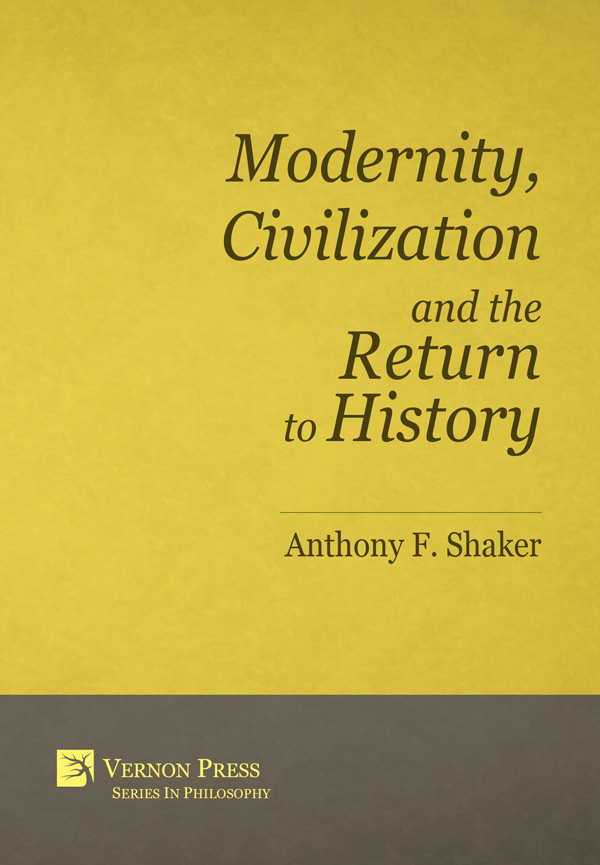
ISBN
9781622731848
Edition
1
Publication Date
January 3, 2017
Physical Size
236mm x 160mm
Number of Pages
586
Currency
Quantity
"A truly innovative and original work, comprehensive, balanced, and relevant to any investigation into and understanding of modernity. The author does a remarkable job of drawing from Western and Islamicate philosophy in a comprehensive and rigorous manner that exposes the reader to an intense, descriptive analysis of the problems encountered in interpreting history. His methodology is cohesive, and the evidence adds to the high quality of his argument...[O]ne of the most scholastic and ambitious undertakings I have ever encountered, extremely well-written...I stand in admiration of this work. The students of history, philosophy, theology, and religious studies would have a deep interest in this book."
Geran F. Dodson
University of North Georgia
"Anthony Shaker is doing philosophy in the way it should be...[A] philosophical project of global scope, and contemporary relevance...[He] argues that modernity, with all its good and ill, was in the making long before anyone had conceived the 'West' or 'Europe' as we know it today. Islamicate civilization was already flourishing as a globalized, universal cultural milieu in which the tradition of hikma [philosophy] reached its maturity...[O]ne of Shaker's primary objectives...is to lay the ground for a new conception of history and modernity...[that] requires maintaining a philosophical stance that avoids deteriorating into the kind of ideological polemic and positions of sectarian and cultural identity to which our current modernity tends. This seems to be the reason his takes care to avoid use of the terms 'Islamic' to qualify philosophy, culture, civilization, etc. He wants to criticize modernity philosophically, but with a view to the future rather than some habitually recalled, imaginary non-Western golden age. Shaker makes a compelling argument, and his grasp of philosophy, history, and the social sciences is both deep and broad. Furthermore, he has convinced this reader that he is doing something important here, that gets to the heart of the current human condition..."
Reviewed by Edward Moad, Assistant Professor of Philosophy (University of Missouri-Columbia)
Journal of Islamic Studies [Oxford University Press, 2017]
"This fascinating book adopts a radically interdisciplinary approach in order to sort out modernity by questioning that which we call philosophy...delighted by the wealth of insights and connections unraveled by the author...genius."
Mohammad Azadpur, Professor of Philosophy
San Francisco State University
"Anthony Shaker has written an extraordinary rich book exploring modernity, tradition and civilization. Drawing on the learned tradition of Islamdom as well as the work of Qunavi, but also many others, Shaker identifies the pitfalls of thinking about tradition and modernity in isomorphic terms. There is more to Islam than merely text. He draws our attention to personhood, history and the project of civility and shows a hopeful path forward. This is compulsory reading for anyone who agonizes about the world we are living in and seeks inspiration from the past that can be usefully used in the present."
Ebrahim Moosa, Professor of Islamic Studies
Keough School of Global Affairs, University of Notre Dame
"Digging deep into the roots of our modern ideas of civilization..., Shaker says “what we call modernity cannot be fathomed without making [the] historical connection” between our times and “the spirit of scientific investigation associated with a self-conscious Islamicate civilization"...This is not a book for casual reading. [But] despite some of the material being beyond my own scholarship, it is not at all difficult to see that the approach of the book is unique, that the level of inquiry and argument is clear, concise, and well-supported by source material. It’s certainly clear enough for me that I was able to follow the argument...I recommend it highly...This truly is a monumental work, and so far as I know there is no comparable work. I really do think this is a work of genius."
Paul Richard Harris, Editor
Axis of Logic
Discover books that expand on the themes explored in this work—titles that engage with similar questions, intersecting disciplines, and complementary perspectives to deepen understanding and broaden the conversation.
Browse all titles