Loading...
Please wait while we load the content...

Loading...
Please wait while we load the content...
Stay informed about our latest publications, calls for proposals, and special announcements. As a subscriber, you'll also enjoy exclusive member discounts of 10%-20% on all orders. Join our community of scholars, librarians, and readers today.
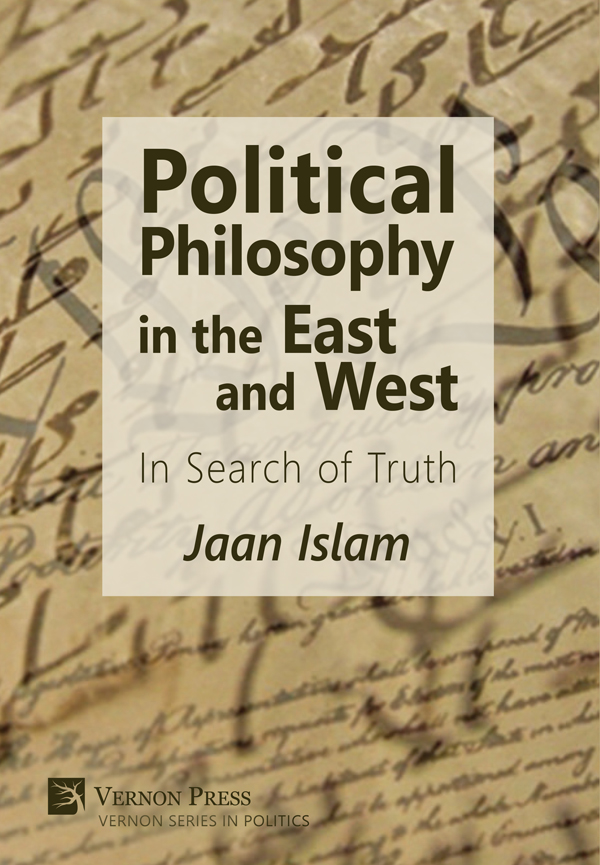


Availability
In stock
ISBN
9781622733071
Edition
1
Publication Date
January 10, 2018
Physical Size
236mm x 160mm
Illustrations
16 Color
Number of Pages
240
Currency
Quantity
“With an impressive combination of grand ambitions and punctilious insights, Jaan S. Islam identifies, confronts, and overcomes the reasons for our 21st-century crisis of certainty. Locating the causes at the very core of the Western tradition, and particularly its approach to the Good and the True (which is, of course, the nexus of action and thought, politics and philosophy), Islam radical-ly critiques the intellectual inheritance of the Enlightenment as well as its an-cient antecedents to expose its inherent contradictions…Yet Islam does not leave us abandoned, floating above the ocean’s abyss surrounded by the wreck-age of a broken tradition. In an analytical turn that takes full advantage of emerging decolonial perspectives, Islam guides us to a distant, subaltern shore: the Chinese and Islamic political and philosophical traditions, with their distinct approaches that circumvent the contradictions at the base of our crisis of cer-tainty: approaches that Islam categorizes as ‘knowledge-based cognition’”
E. T. Dailey, University of Amsterdam Press, Amsterdam.
“Throughout history, only a handful of writers dare bring out the truth. Rarely such writers are recognized in their lifetime as being truth-tellers, and are al-most never celebrated in a society controlled by an establishment that has invested in keeping the truth away from the general public that it controls. In this revolutionary work, Jaan Islam challenges the core definition of truth in western philosophy – something that has not been done for many centuries. As he compares Western with Eastern political philosophy, he gives us a criteri-on for discerning the Truth from falsehood. The book is a breathtaking read. At the same time, arguments and logic used are airtight, devoid of any logical loopholes. It is no exaggeration to say that this is the first book in modern times that reads like poetry while offering logic of an engineering design. One can only wish this line of work catches on and we have a paradigm shift in the way our scholars communicate with the general mass.”
Prof. M. Enamul Hossain, Statoil Research Chair, Memorial University, St. John’s, Canada.
“The Information Age is synonymous with an overflow of “infor-mation”. Information is necessary for traveling the path of knowledge, leading to the truth. Yet, here a horrific contradiction leaps out to grab one and all by the throat: of all the characteristics that can be said to define the Information Age, neither freedom nor peace is one of them. It is reasonable to conclude that ‘information’ or ‘knowledge’ in the modern era has not been in line with peace, creating contradictions in all aspects of cognition. Nothing is more contradicto-ry than Dogmatic cognition and its modernized form that has been accepted as ‘enlightenment’ without scrutiny. In this book, Jaan Islam calls out the incoher-ence of the western philosophical tradition and demonstrates that a new ap-proach must be taken in order to unearth the true nature of philosophy. With such empowerment, western and eastern philosophies are contrasted at the core of fundamental premises, thus showing the existence of entirely different paradigms. The author identifies the Roman Catholic Church’s cognition pat-terns as the driver of modern cognitive tools. He shows how western philoso-phy is based on illogical assertions and premises that remained unchallenged from the enlightenment era to the Information Age. Islam identifies the 'ele-phant in the room’, i.e., ongoing prejudice and colonial hubris that has prevent-ed modern scholars from seeing the hollowness of Orientalist philosophy that has only morphed into a more toxic form manifested through the two extremes of false cognition, viz. neo-liberalism and neo-conservatism.”
Kutluk Özgüven, Professor of Management Information Systems (Former Dean of the Faculty of Communication), Faculty of Communication, Zirve University, Gaziantep, Turkey.
"The most important application of the law of the excluded middle is the de-termination of the truth, i.e., something cannot be true and false at the same time. Yet, today we have arrived at a time when truth is being called subjective, as if it is a function of perception of an individual. This is a very significant de-parture from millennia of philosophical tradition. Every civilization recounted in history other than post-Roman Catholic church’s Eurocentric era had a clear vision of what constitutes the truth. Plato understood it as synonymous with real that doesn’t change with time (the physical world being fleeting or a func-tion of time is not ‘real’). Aristotle understood it as what really ‘is’. Obviously, the modern notion of truth as being subjective amounts to eliminating the essence of the criterion of the truth. Today, western philosophy is synonymous with 'enlightenment' and knowledge of the truth, while any other philosophy is con-sidered to be religious mumbo jumbo. Yet, the same society has accepted Islam-ic thinkers, such as Averröes, Ibn Khaldun, and others as the father of respec-tive fields and not a single modern philosopher disputed their philosophical stance. In modern era, Edward Said was the first one to call out this contradic-tion and attributed such attitude toward the East as Orientalism – an euphe-mism for Eurocentric racism. Jaan Islam goes further and shows us how western philosophers in essence plagiarized eastern thought (most notably Islamic thought), twisted it and packaged it as ‘enlightenment’ after adding layers of logical fallacies. As the author points out, notwithstanding the longstanding general acceptance of the distinction that Thomas Aquinas is the father of doctrinal philosophy and Averröes the father of secular philosophy, regardless of the claim to be operating on an entirely secular basis utterly dis-connected from ‘religious bias’ of any kind, all aspects of scientific (social sci-ence as well as hard science) developments in modern Europe have been based on doctrinal philosophy. This is indeed a profound discovery with revolutionary implications. Because philosophy is the root of all cognition, the finding of this book can have an extraordinary impact for many generations to come."
Saad Dabbous, Ph.D, Geologist and Imam.
Discover books that expand on the themes explored in this work—titles that engage with similar questions, intersecting disciplines, and complementary perspectives to deepen understanding and broaden the conversation.
Browse all titles