Loading...
Please wait while we load the content...

Loading...
Please wait while we load the content...
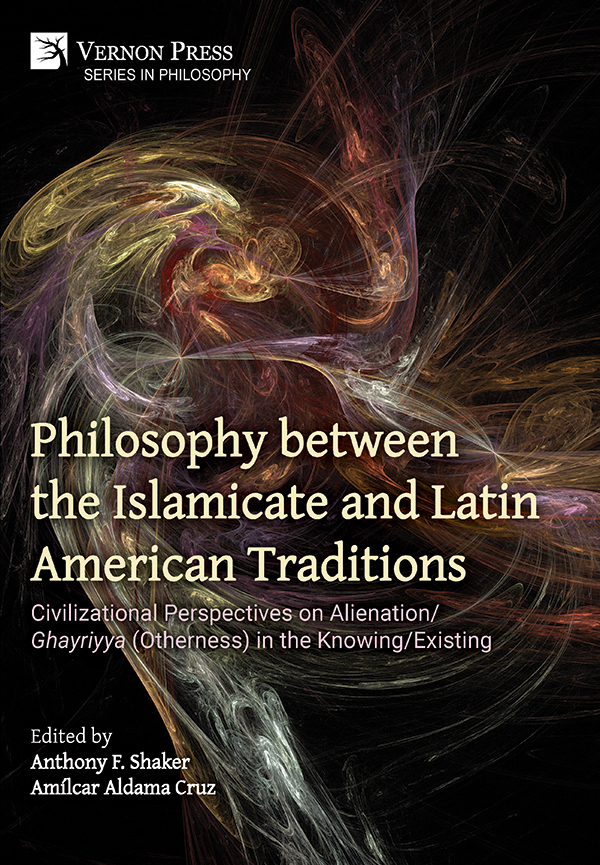
Civilizational Perspectives on Alienation/Ghayriyya (Otherness) in the Knowing/Existing
Anthony F. Shaker, Amílcar Aldama Cruz, Hilal Oytun Altun, Hamidreza Ayatollahy, José Antonio Antón Pacheco, Luce López-Baralt, Ángel Horacio Molina, James Maffie, Omneya Ayad, Mahdi Saatchi, and Hamedeh Rastaei
Latin America is a diverse mosaic of cultures that trace their origins back to Indigenous, African, Spanish, Portuguese and Islamic sources. Its philosophies, eloquently expressed by a long line of thinkers, are found not just in departments of philosophy, but also in its rich literature and art, which are given treatment in this volume. The Islamicate world is a unique, fourteen-century-old cultural mosaic that covers much of the known world. Despite its long civilizational experience, it too faces the challenge of emancipation from foreign domination and the chaotic cacophony of monologues afflicting our time. The papers collected here cover various aspects of the philosophies of these two constantly interacting traditions and how they impinge on an old problematic: “ghayriyya” (otherness) and “alienation”. Their themes include key figures like Ibn ʿArabī, Suhrawardī, Aḥmad b. Muṣṭafa al-ʿAlawī, Rudolfo Kusch, José Martí, Spain’s Moriscos, and contemporary Argentine philosophers; and expanding areas of research like the philosophy of the Nahua (popularly known as the “Aztec”) and the language reforms in Türkiye, both of which provide excellent examples of cultural self-alienation.
According to contemporary, Islamicate and ancient sources
Anthony F. Shaker
That we are now entering a post-Western world is no longer merely a thesis in international studies. But what does the dissolution of “Western” hegemony signify for humanity’s rich learning traditions and the civilizing quest for wisdom? How can this human inheritance assist us today? "Reintroducing Philosophy" seeks a more realistic framework for discourse on these questions than offered by the Western-centric worldview, which continues to be taught in schools almost by rote. It analyzes themes from several world traditions in logic, knowledge and metaphysics connected with the quest for completeness of thinking and practice. Its examination of the relation of knowing and being is based on sources as varied as Leibniz and Frege, Qūnawī and Ṣadrā, ancient Greek and classical Indian and Chinese thought. Shaker brings into the discussion the paradigm (unmūzaj) that Ṣadrā presented as that of man’s being in the world, encapsulating philosophy’s longstanding view of thinking as the gathering of civilization. "Reintroducing Philosophy" is based on a concentrated reading of all these sources, simply because human civilization had already been global and advanced before the present age.
Anthony F. Shaker
The modern concept and study of civilization have their roots, not in western Europe, but in the spirit of scientific investigation associated with a self-conscious Islamicate civilization. What we call modernity cannot be fathomed without this historical connection. We owe every major branch of science known today to the broad tradition of systematic inquiry that belongs to a “region of being”—as Heidegger would say—whose theoretical, practical and institutional dimensions the philosophy of that civilization played an unprecedented role in creating. This book focuses primarily on the philosophical underpinnings of questions relating to civilization, personhood and identity. Contemporary society and thinking in western Europe introduced new elements to these questions that have altered how collective and personal identities are conceived and experienced. In the age of “globalization,” expressions of identity (individual, social and cultural) survive precariously outside their former boundaries, just when humanity faces perhaps its greatest challenges—environmental degradation, policy inertia, interstate bellicosity, and a growing culture of tribalism. Yet, the world has been globalized for at least a millennium, a fact dimmed by the threadbare but still widespread belief that modernity is a product of something called the West. One is thus justified in asking, as many people do today, if humanity has not lost its initiative. This is more a philosophical than an empirical question. There can be no initiative without the human agency that flows from identity and personhood—i.e., the way we, the acting subject, live and deliberate about our affairs. Given the heavy scrutiny under which the modern concept of identity has come, Dr. Shaker has dug deeper, bringing to bear a wealth of original sources from both German thought and Ḥikmah (Islamicate philosophy), the latter based on material previously unavailable to scholars. Posing the age-old question of identity anew in the light of these two traditions, whose special historical roles are assured, may help clear the confusion surrounding modernity and, hopefully, our place in human civilization. Proximity to Scholasticism, and therefore Islamicate philosophy, lent German thought up to Heidegger a unique ability to dialogue with other thought traditions. Two fecund elements common to Heidegger, Qūnawī and Mullā Ṣadrā are of special importance: Logos (utterance, speech) as the structural embodiment at once of the primary meaning (essential reality) of a thing and of divine manifestation; and the idea of unity-in-difference, which Ṣadrā finally formulated as the substantial movement of existence. But behind this complexity is the abiding question of who Man is, which cannot be answered by theory alone. Heidegger, who occupies a good portion of this study, questioned the modern ontology at a time of social collapse and deep spiritual crisis not unlike ours. Yet, that period also saw the greatest breakthroughs in modern physics and social science. The concluding chapters take up, more specifically, identity renewal in Western literature and Muslim “reformism.” The renewal theme reflects a point of convergence between the Eurocentric worldview, in which modernism has its secular aesthetics roots, and a current originating in Ibn Taymiyyah’s reductionist epistemology and skeptical fundamentalism. It expresses a hopeless longing for origin in a historically pristine “golden age,” an obvious deformation of philosophy’s millennial concern with the commanding, creative oneness of the Being of beings.