Loading...
Please wait while we load the content...

Loading...
Please wait while we load the content...
Stay informed about our latest publications, calls for proposals, and special announcements. As a subscriber, you'll also enjoy exclusive member discounts of 10%-20% on all orders. Join our community of scholars, librarians, and readers today.

Availability
In stock
ISBN
9781648898082
Edition
1
Publication Date
January 16, 2024
Physical Size
236mm x 160mm
Illustrations
27 Color
Number of Pages
318
Currency
Quantity
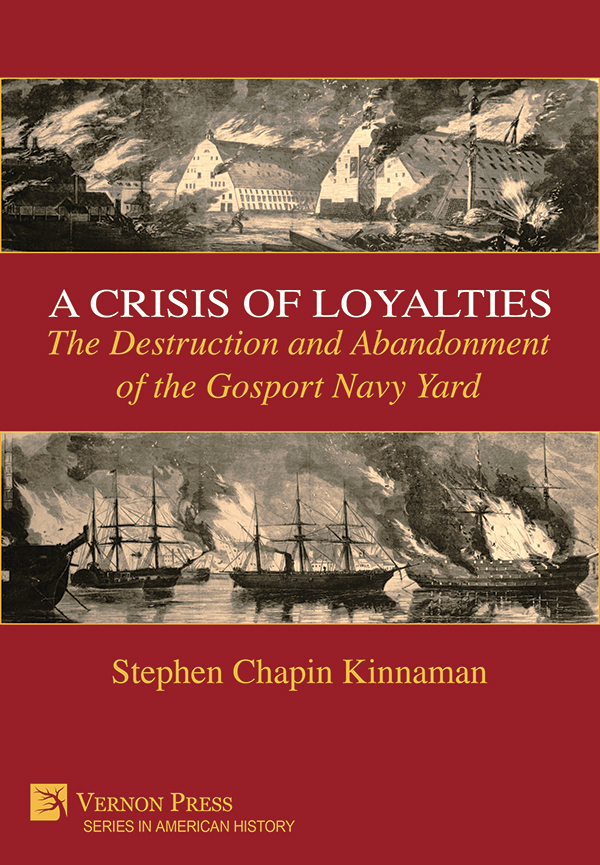
Charles Stewart McCauley had the misfortune of being commandant of the Gosport Navy Yard in Virginia as America rushed headlong into its crippling Civil War. His deliberate scuttling of six of its warships on 20th April 1861, including the powerful steam frigate, U.S.S. Merrimack, deprived the secessionists of an easy prize. However, blame for the yard’s subsequent destruction by his erstwhile rescuer, Commodore Paulding, was placed squarely but unfairly on the shoulders of the hapless Charles Stewart McCauley.
In ‘A Crisis of Loyalties’, Stephen Kinnaman has put the record straight. He has rigorously employed primary sources to uncover evidence not previously made public. His erudite analysis of Commodore McCauley’s situation provides the reader with many new insights into the events leading up to the abandonment of Gosport and the consequences that followed. Most importantly, evidence is offered which clearly shifts some of the blame onto shoulders further up the naval hierarchy.
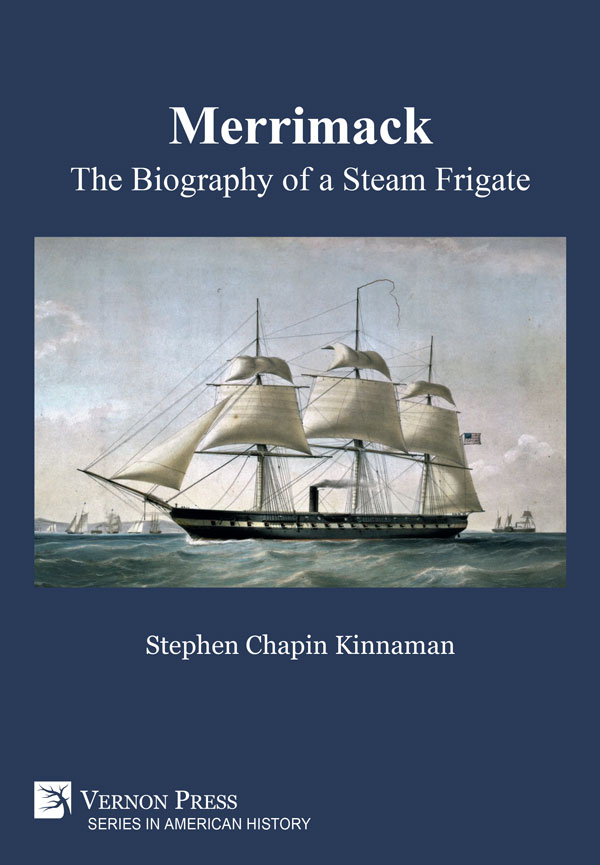
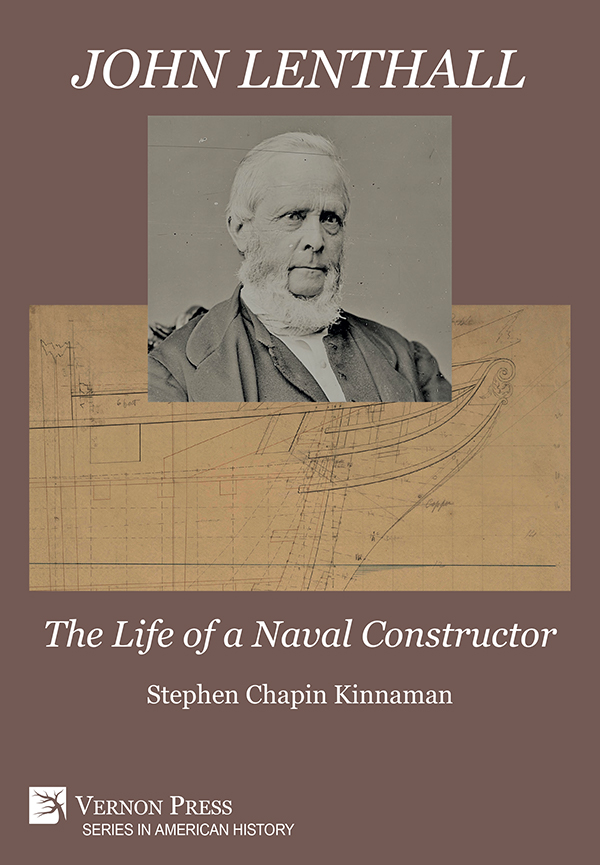
The book is superbly researched and is written in Stephen Chapin Kinnaman’s familiar engaging style. It is an easy read that should be enjoyed by professional historians and amateur Civil War enthusiasts alike. The main text covering 20 chapters is supplemented with six appendices, copious end-notes, an extensive bibliography, and includes numerous maps and illustrations. This is an important addition to the history of the Civil War that would grace any bookshelf. It sits well beside his two earlier works: ‘John Lenthall – The Life of a Naval Constructor’ and ‘Merrimack – The Biography of a Steam Frigate’, both published by Vernon Press in their Series In American History.
Robert Thorp
Author of ‘Mersey Built – The Role of Merseyside in the American Civil War’
Kinnaman’s “A Crisis of Loyalties” is the first complete treatment of a seminal event of the Civil War, the burning of the Gosport Navy Yard in April 1861. Kinnaman makes extensive use of contemporary deck logs, correspondence and reports to paint a compelling account of how events unfolded on an almost hour-by-hour basis. He has a clear eye for where individual leadership and responsibility lived up to its call, or fell short, all while the entire fabric of the United States and its military was collapsing in real time. This book will certainly become required reading for both academic and military curricula and professional reading programs about the Civil War.
Dr. Larrie D. Ferreiro
George Mason University, Fairfax, VA
This book is excellent. Stephen Chapin Kinnaman has an unparalleled understanding of the U.S. Navy before and during the Civil War, and it is on full display in this book. He expertly discusses all the various forces pressing in on Commodore McCauley, while correctly indicating that others shared some blame for the disaster. This book greatly increases our understanding of the human aspect of the secession crisis, and the impact of decisions made in haste or with imperfect information. It is a case study for today's naval leaders. Highly recommended.
Christopher L. Kolakowski
Director of the Wisconsin Veterans Museum
Naval historian and author of 'Last Stand on Bataan, The Defense of the Philippines' and other books
I truly enjoyed reading “Crisis of Loyalties.” The six appendices, which include lists of the yard’s officers, tables of those present, resigned, or dismissed during the key six-day period of the yard’s pending destruction, the fate of warships present, and destinations of the seized guns, were extremely well organized and informative and clearly supported all of the author’s opinions. The text guided through all of the people and events in a compelling manner that prompted me to read the book in one setting. The work also contained 27 illustrations, including nine maps. The conclusions enable readers to clearly understand that the loss of the Gosport Navy Yard was due to the ineptitude of leadership manifested in those days in April 1861. I highly recommend this book to students and scholars seeking to understand how one of the major Union failures during the war unfolded.
[Extract from book review on the 'Civil War Navy—The Magazine', Summer 2025, p .69. Reviewer: John V. Quarstein (Director, Emeritus of the USS Monitor Center, Mariners’ Museum & Park, Newport News, VA), https://civilwarnavy.com/ ]
Discover books that expand on the themes explored in this work—titles that engage with similar questions, intersecting disciplines, and complementary perspectives to deepen understanding and broaden the conversation.
Browse all titles
Barry Turner, Daniel Barredo, and Steven James Grattan (Eds.)
View more