Loading...
Please wait while we load the content...

Loading...
Please wait while we load the content...
Stay informed about our latest publications, calls for proposals, and special announcements. As a subscriber, you'll also enjoy exclusive member discounts of 10%-20% on all orders. Join our community of scholars, librarians, and readers today.


Availability
In stock
ISBN
9781648891038
Edition
1
Publication Date
March 1, 2022
Physical Size
236mm x 160mm
Illustrations
56 Color
Number of Pages
200
Currency
Quantity
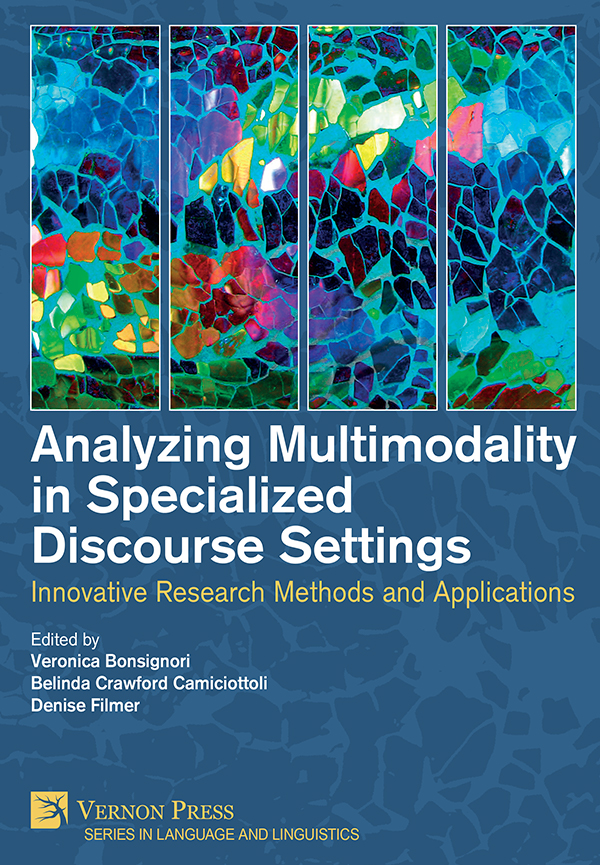
This volume collects a series of cutting-edge contributions devoted to different research strands whose unifying theoretical framework is represented by multimodality. This background has been adopted to explore different examples of specialized discourse and genres not all of which have yet been deeply analyzed.
As the editors themselves claim in their preface, “the contribution of non-verbal forms to meanings in specialized discourse is likely to assume an increasingly prominent role thanks to ongoing technological advances that facilitate the creation and reproduction of multimodal texts across domains of usage” (page 2). This is also confirmed by a marked preference of contemporary society for communicating through the visual medium, which has become a privileged instrument in our age, the era of the image.
This volume intentionally assembles essays that analyze different genres and discourse types, with the common purpose of showing how communication fully exploits all semiotic channels in the process of meaning-making. As the chapters show, multimodal affordances can be exploited to communicate information, disseminate research results, and attract potential customers in a vast array of genres. At the same time, another merit of this volume is that it features practically-oriented investigations with flexible and engaging tools to be employed in learning environments. These examples could be used to make students fully aware of the instruments, resources and strategies to communicate effectively in specialized settings.
The wide coverage and the currently relevant topics make this volume a precious instrument for academics and students alike.
Dr. Silvia Bruti
Director of the University language Centre (Cli)
Full Professor of English Language and Translation
Dept. of Philology, Literature, Linguistics
University of Pisa, Italy
This is a very interested and highly relevant volume. It is based on two premises: multimodality and specialized discourse analysis. Starting from the works by Swales (1990) on how to analyse texts according to the recurring linguistic and rhetorical features, this field of research has incorporated the ideas by Gotti (2003) on the application of specialized discourse in two spheres: communication between experts and communication from the expert to the non-expert. Moreover, Kress’s (2010) studies revolutionized the study of discourse by opening the researchers’ eyes to the multimodal dimension, and studies such as those by Prior (2013) and Plastina (2013) have developed this idea and have advanced towards the multimodal analysis of specialized texts.
The topics and approaches are varied, including academic, economic, legal, medical and political domains. Moreover, the several chapters focus on different perspectives, some focus on the research method (chapter 1), other on the application of freely available materials to ESP teaching (chapter 4), on the features of certain website sections in corporate and law firms (chapters 5 and 6), on genres teaching (lecture in chapter 3) and research genres (video abstracts in chapter 2), or on the political discourse of British female Prime Ministers (chapter 7).
Multimodality and multimodal discourse analysis are becoming more and more relevant these days. This book is relevant and updated; it consists of interesting and varied chapters in terms of topics and approaches, which, even so, form a cohesive volume. The research is well-founded, and the results in each of the chapters are robust and conclusive. For all these reasons, I recommend the publication of this book.
Dr. Inmaculada Fortaneti
Professor and researcher
Universitat Jaume I, Spain
“Analyzing Multimodality in Specialized Discourse Settings: Innovative Research Methods and Applications” collects some original articles and includes a rich preface by the editors. The focus of all contributions is on the use of English for Specific Purposes in higher education and on specialized discourse at large. Although the topic is not new in its own right, the approach adopted by the authors and the editors is quite innovative. The underlying idea is that meaning-making in specialized discourse relies as much on the verbal component of language as on non-verbal communicative resources. For this reason, instances of specialized discourse in educational settings are investigated from a multisemiotic perspective through different methodological approaches, ranging from corpus linguistics to critical discourse analysis, both synchronically and diachronically. The discourse domains tackled are also varied and include tourism, economics, medicine, and the academia. Given the growing role played nowadays by non-verbal communicative strategies in meaning-making in specialized communication, including in educational settings, the studies collected in the volume offer a pioneering way to tackle the many questions raised by the evolution of discursive practices in different sectors. They propose methodological suggestions for the investigation of such practices and the exploitation of this knowledge in ESP teaching. Consequently, the volume has the merit of being a useful resource for both linguists and ESP teachers alike, especially for those interested in understanding the mechanisms behind effective and appropriate professional communication and wishing to bring action research to the language classroom.
Dr. Gloria Cappelli
Professor, Dipartimento di Filologia, Letteratura e Linguistica
Università di Pisa, Italy
Discover books that expand on the themes explored in this work—titles that engage with similar questions, intersecting disciplines, and complementary perspectives to deepen understanding and broaden the conversation.
Browse all titles
Csilla Szabó, Rita Besznyák, and Márta Fischer (Eds.)
View more
Christopher Pountain and Bozena Wislocka Breit (Eds.)
View more