Loading...
Please wait while we load the content...

Loading...
Please wait while we load the content...
Stay informed about our latest publications, calls for proposals, and special announcements. As a subscriber, you'll also enjoy exclusive member discounts of 10%-20% on all orders. Join our community of scholars, librarians, and readers today.


Availability
In stock
ISBN
9781648891939
Edition
1
Publication Date
July 6, 2021
Physical Size
236mm x 160mm
Illustrations
49 Color
Number of Pages
305
Currency
Quantity
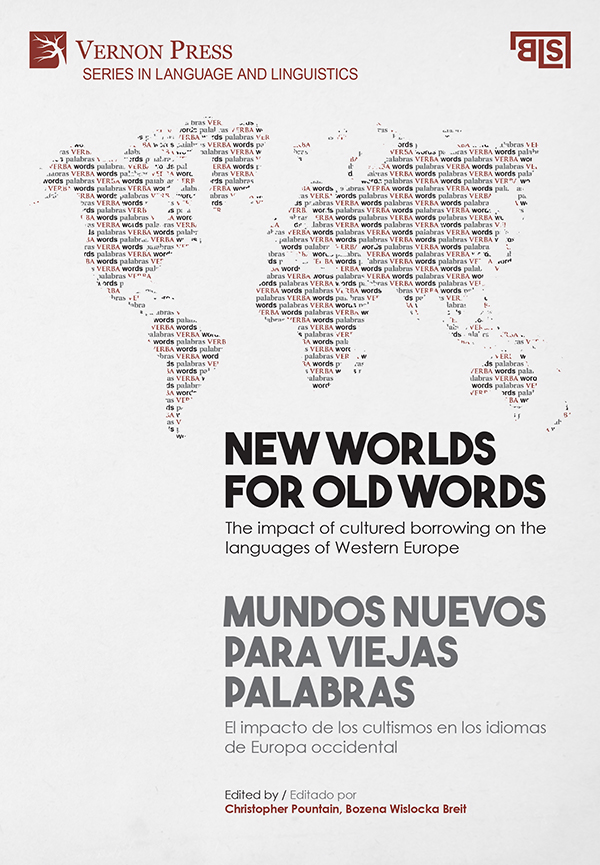
This volume contains an introduction by the editors and thirteen scholarly studies, half of them in English, half of them in Spanish. The common topic concerns the adoption of words from the past into a later context. The source language is usually Latin, the more modern language is usually Spanish.
The contributors include both established and younger scholars. Steven Dworkin, Gloria Clavería Nadal and Christopher Pountain are among the best-known scholars in this field, and their chapters are comprehensive and wide-ranging: Steven Dworkin concentrates on fifteenth-century borrowings from Latin that came to replace synonymous inherited words; Gloria Clavería considers how such words have been treated in Academy dictionaries; Christopher Pountain shows how mass borrowings of verbs in the -ir conjugation affected the morphological nature of that conjugation itself. There are historical studies of individual words, including síntoma and a couple of Arabisms which survived in Granada (almofia, ‘a shallow cooking vessel’, and tarquín, ‘mud’); of the use of Latinisms by the sixteenth-century author Delicado; and there are studies based in the present day, including two on newspaper journalism (Latinisms in sports headlines, often invariant, such as in Los alter ego de Rafa Nadal, and the use of neological compounds such as necroturismo, ‘graveyard tourism’) and a report from a modern classroom. There is one study of Italian noun-noun compounds, concerning changes over time in the order of the constituents, and one Europe-wide discussion on the survival of ancient words for ‘magic’ and ‘magician’.
The book is consistently scholarly and informative, often original, and at times entertaining. Gloria Clavería Nadal hits the nail on the head as to why the topic is of interest: “Old words have actually become the most natural way for modern languages to name these new worlds created on a daily basis” (p.29), most obviously, but not only, in non-linguistic fields such as science and medicine. Thus this book will make clear why ‘cultured borrowings’ should not be dismissed as irrelevant, as they have tended to be in the past.
Roger Wright
Emeritus Professor of Spanish
University of Liverpool
The book is a collection of 13 original contributions on cultural borrowing. The languages of the book are English and Spanish (6 contributions), and the languages treated are in first place Spanish and other Romance languages (Italian). Several of the contributors are well-known scholars and authorities in the field of historical lexicology.
The issue – what traditionally used to be called “learnèd borrowing” – is an important one also in the light of more recent theoretical contributions that consider language dynamics not just as a homogeneous process of evolution but rather as a differentiated composite history of discursive traditions between “immediacy” and “distance” (a view explicitly mentioned in several of the contributions). The contact of modern European languages (mainly Spanish, but also other European languages) with classical languages via cultural contact and translation is treated in this volume from a wide range of perspectives: from medieval to contemporary borrowings, from philological, psycholinguistic to didactic approaches and including not only purely lexical, but also morphological aspects. The book is particularly of interest for advanced students and scholars in Romance linguistics.
Dr. Johannes Kabatek
University of Zurich
This book comprises a set of works presented at a colloquium that took place in London in September 2019.
It consists of 13 chapters, the common thread of which is the past and present influence of words borrowed from Latin and Greek. They are known as "cultured borrowings". What is transcendent and makes the present studies a source for further research, is that, in many cases, by process of metaphorization, the lexical piece taken from the classical language becomes a term of the common language, and its oral version.
This is the first strength of this publication. The second is that much of the research presented is part of ongoing research, developed not individually, but by team members of recognized quality.
The third strength is the origin of the data handled. They have either arisen from surveys carried out in order to have accurate data or from consulting existing databases. Or, likewise, they come from lexicographic information. Explanations are not ventured but are given with the support of reliable sources.
There is a fourth strength, and it is the volume and quality of the bibliographies that each author has provided at the end of their chapter.
For the specialized reader, there is a fifth strength: almost all the authors mention that theirs is an open investigation, which will be outlined in future works.
Dr. Emma Martinell
Professor Emeritus
University of Barcelona, Spain
The central idea of the contributed volume, edited by Christopher Pountain and Bozena Wislocka Breit is that the concept of "learned borrowing" - regardless of the definition that the authors have provided in their respective chapters - should be seen as a palpable linguistic consequence of one of the best-documented cultural contacts ever in the history of Western Europe. This idea, as a common thread, (re-)appears cunningly through the book, showing that learned borrowing - regardless of the source and target languages - has been very productive either in earlier or in the present states of the studied languages of Western Europe. Thus, each of the 13 chapters addresses the linguistic as well as the extralinguistic causes and mechanisms contributing to its output, seen from different linguistic perspectives.
Dr. Andrzej Zieliński
Instytut Filologii Romańskiej
Uniwersytet Jagielloński, Krakow, Poland
Every student of the history of a Romance language learns the distinction between popular words inherited from Latin that changed over time, like Spanish “delgado” ‘thin’, and learnèd words borrowed from Latin later, like “delicado” ‘delicate’. Despite the crucial nature of this distinction and students’ interest in it, this topic is rarely addressed in textbooks or even in the scholarly literature. The thirteen chapters in New Worlds for Old Words take a welcome step toward filling this gap by providing an in-depth look at “cultured borrowings”. An outstanding feature of the book is the range of topics and approaches applied to the study of these borrowings. The authors consider the role of cultured borrowings, and in some cases borrowings from Arabic, English, or other languages, in orthographic, lexical, semantic, and morphological changes in Spanish, and in the formation of compound words in Italian, such as “terremoto” and “scuolabus”. Furthermore, the information is gleaned from a wide variety of sources, such as dictionaries, newspapers, literary works, translations from Latin to four Romance languages, and corpora of written Spanish and English. The reader comes to appreciate the changes in cultured borrowings since their introduction, such as the semantic changes in the word “síntoma” ‘symptom’, and the changes in the frequency of use of terms for modern and classical languages. Especially interesting are the cases where cultural borrowings like “elegir” and “adquirir” led to even greater irregularity in the paradigm of “-ir” verbs and where they ousted inherited words, like the triumph of “ejército” over “hueste” and “masticar” over “mascar”. By considering the changes in cultured borrowings since their adoption and their impact on modern languages, this volume gives them the attention they deserve.
Dr. Diana Ranson
Professor of French and Spanish
University of Georgia
[...] Se trata, en términos generales, de un monográfico de gran valor para el estudio de la historia del léxico culto, sobre todo, pero no solo de la lengua española, ya que se plasma en él una visión conjunta de la situación actual en la que se halla la investigación en los campos de la lexicología y la morfología léxica, entre otras. El carácter bilingüe de la obra, en tanto que recoge contribuciones en inglés y en castellano, ayuda, por otro lado, a internacionalizar un campo de estudios que solo en pocas ocasiones suele traspasar las fronteras lingüísticas del castellano u otras lenguas románicas. [...]
Extract from book review published in the journal 'Revue de Linguistique Romane' (vol. 86, 2022/1). ISSN: 0035-1458. Reviewer: Matthias Raab
The chapters in the volume address a wide range of topics from a variety of perspectives. The use of corpora, dictionaries, literary works, translations and newspapers, both as sources for examples and as a basis for analysis, significantly enhances the volume, and makes for a well-documented and informative work. Twelve of the chapters are each at least 16 pages long, and
the longest chapter is 28 pages. This enables the in-depth development of the topics in each chapter. Chapter 6, only 8 pages long, breaks the mold, and does not reach the level of detail of the other chapters.
This book should be of particular interest to academics, scholars, and advanced students in Historical Linguistics and Romance Linguistics, and will also appeal to specialists in Hispanic Studies and Cultural History.
Extract from book review published in the journal 'Hispania', Volume 105, Number 2, June 2022, pp. 325-327. Reviewer: Carlos Benavides (University of Massachusetts Dartmouth)
El mayor beneficio que ofrece el presente libro es la gran variedad de perspectivas y metodologías empleadas en el análisis del léxico de origen culto, en principal en las lenguas románicas, pero también fuera de ellas. La multitud de enfoques pone de relieve la versatilidad de los latinismos y grecismos, su enorme capacidad de englobar, en su área conceptual, nuevas realidades, así como las implicaciones que su adopción en las lenguas modernas tuvo en la conceptualización del mundo, a lo largo de la historia.
La mayoría de los autores admiten los límites de las variantes presentes de sus estudios, formulando la promesa de aclaraciones futuras a medida que se completen los datos. Lo importante, sin embargo, no son necesariamente los resultados, sino las vías de investigación que se abren.
Extract from book review on the magazine 'RILI' (Revista-Internacional-Linguistica-Iberoamericana), Year XXIII (2025). No. 45., pp. 244-248. Reviewer: Simona Georgescu (Universitatea din București, Romania)
Discover books that expand on the themes explored in this work—titles that engage with similar questions, intersecting disciplines, and complementary perspectives to deepen understanding and broaden the conversation.
Browse all titles
Isabelle Fernandes (Ed.)
View more
Brandon M. A. Rogers and Mauricio A. Figueroa Candia (Eds.)
View more
James G. Mitchell
View more
Gregory L. Thompson and Scott M. Alvord (Eds.)
View more