Loading...
Please wait while we load the content...

Loading...
Please wait while we load the content...
Stay informed about our latest publications, calls for proposals, and special announcements. As a subscriber, you'll also enjoy exclusive member discounts of 10%-20% on all orders. Join our community of scholars, librarians, and readers today.


Availability
In stock
ISBN
9781622736096
Edition
1
Publication Date
September 1, 2020
Physical Size
236mm x 160mm
Number of Pages
250
Currency
Quantity
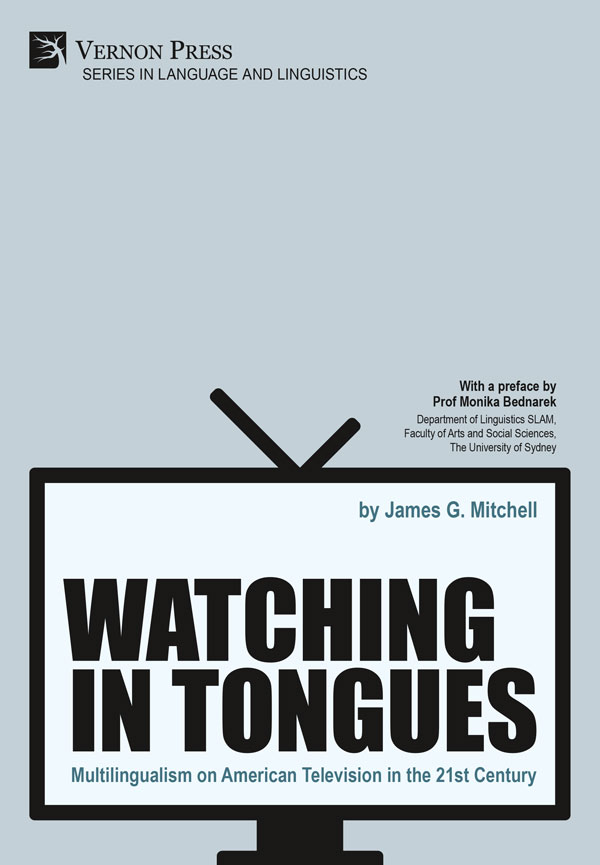
James Mitchell's 'Watching in Tongues: Multilingualism on American Television in the 21st Century', is an original and innovative study that offers a valuable research contribution. It analyzes second language speakers and second language use on television, which is a promising research area, and it will help spark further work in the area. Arguing for the usefulness of studying applied linguistics on television, Mitchell deploys textual analysis to explicate how the television programs sometimes critique and sometimes reinforce stereotypes about second-language speakers, depending on the context. The book engages a multidisciplinary audience and would interest scholars and students in applied linguistics, such as second language acquisition and sociolinguistics, as well as in television studies, media studies, popular culture studies, and intercultural communication. Watching in Tongues is accessible and engaging and would be a useful textbook for an introductory linguistics course.
Leigh H. Edwards
Professor, Department of English
Florida State University
In “Watching in Tongues”, James Mitchell always offers thoughtful and sometimes provocative analyses of how ESL and second-language learning are portrayed in dozens of popular U.S. television shows, from “Law & Order” and “Lost to The Big Bang Theory” and “Modern Family”. His considerations of how characters speak their languages (both native and L2), the attitudes conveyed by other characters about these languages and the speakers who use them, and what these shows reveal about the place of language learning in American culture provide readers with insights both well-grounded in interdisciplinary scholarly research and accessible to a diverse audience: language-learning specialists, language professionals in a variety of other areas, researchers in popular-culture areas like television and entertainment studies, and even well-read members of the general public.
Mitchell is an engaging writer, using amusing examples and his own humorous take on topics to reinforce his substantive and serious observations and conclusions about language issues portrayed in popular TV shows. Chapter titles like “I Will Not Sugar-Jacket How Much of a Cheapsteak You Are! Second Language Use at the Crossroads of Humor and Social Commentary” and “How I Met Your Foreign Boyfriend: What Primetime TV Tells Us About Popular Attitudes Toward L2 English Speakers” nicely illustrate the mix of pop-culture appeal and linguistic concerns presented in this book.
While the material is thus engaging to both language-lovers and TV watchers, Mitchell often draws pointed conclusions about specific interactions portrayed in his quoted excerpts. To take just one example, in Chapter One, he labels one dialogue in which the writers appear to be making fun of a non-fluent English speaker “mean-spirited” and accuses them of “pick[ing] the lowest hanging fruit on the humor branch,” concluding that “[t]his example demonstrates one of the dangers of employing ethnic humor using L2 English or non-English-speaking characters” (p. 26).
Each chapter is clearly structured to facilitate readers’ comprehension and evaluation. In most cases, after an introductory section setting the stage, Mitchell reviews the relevant background literature, either separately or integrated into the next section; presents data in the form of quotes from various TV shows, with plot summaries and other background as needed and often incorporating helpful analysis; discusses the broader implications of the data and specific analyses covered in the previous section; and concludes the chapter by wrapping up its key findings. The introductory and concluding chapters, of course, serve to set up Mitchell’s focus, goals and approach to the studies included in the book and emphasize the major take-aways from his research, respectively.
My own take-away from reading Mitchell’s book: researchers and others interested in the intersection of language learning, attitudes toward native and non-native language use and its portrayal, and television’s representation of language-related social phenomena will find much food for thought, as well as considerable enjoyment, in this volume.
Dr Deborah Schaffer
Professor of English
Montana State University Billings
Discover books that expand on the themes explored in this work—titles that engage with similar questions, intersecting disciplines, and complementary perspectives to deepen understanding and broaden the conversation.
Browse all titles
Gregory L. Thompson and Scott M. Alvord (Eds.)
View more
Csilla Szabó, Rita Besznyák, and Márta Fischer (Eds.)
View more