Loading...
Please wait while we load the content...

Loading...
Please wait while we load the content...
Stay informed about our latest publications, calls for proposals, and special announcements. As a subscriber, you'll also enjoy exclusive member discounts of 10%-20% on all orders. Join our community of scholars, librarians, and readers today.


Availability
In stock
ISBN
9781622738564
Edition
1
Publication Date
April 2, 2020
Physical Size
236mm x 160mm
Illustrations
10 Color
Number of Pages
241
Currency
Quantity
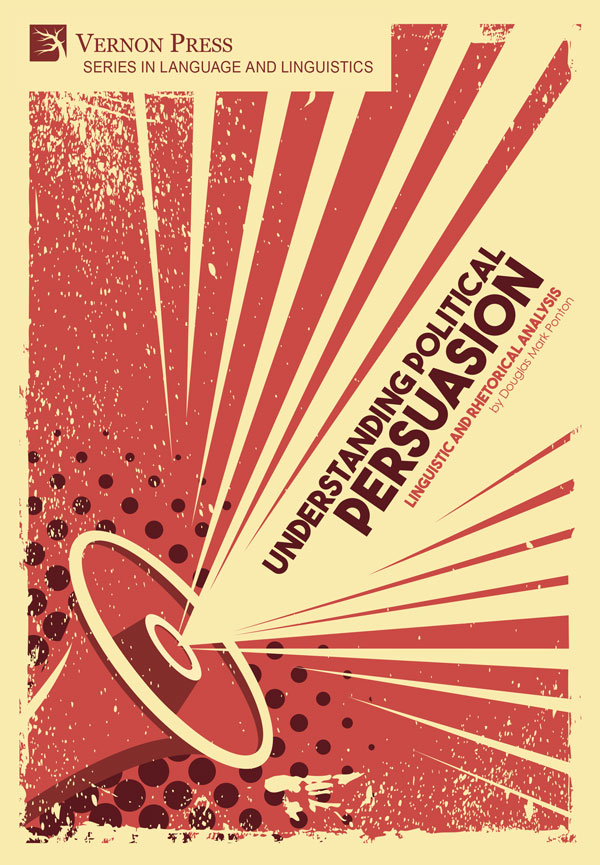
Dr. Ponton's concise book provides a valuable introduction to a broad landscape of political discourse analysis. Especially for newcomers to this complex and sprawling field of inquiry, Ponton’s book will provide a useful synthesis of existing scholarship along with his own cogent case studies. Beginning with a comparative look at the 18th and 21st centuries, his book argues that crucial elements of political rhetoric such as alliteration, litotes, and metaphor, which Ponton locates in Edmund Burke's great speeches of the 18th century, have been under-appreciated in contemporary scholarship. Ponton then examines argumentative strategies in the 19th century, centered on Disraeli's speech about the Suez canal, and proceeds to the 20th century with a look at Churchill's use of mass media to amplify his appeal. Chapter five then moves to an American context to contend with the ways that community is imagined in the speeches of Martin Luther King and Malcolm X. The postwar period receives further treatment in chapters six and seven, where IRA leader Gerry Adams, the US Republican Party, and UKIP's Nigel Farage are explored (Ponton's analysis of Farage's speech in particularly revealing). The book concludes with a thorough bibliography that will be quite useful to readers. In sum, Dr. Ponton has provided a clear and original path through the world of rhetorical analysis, and students will have no trouble following his examples and analysis. No doubt, the author is very well versed in the relevant literature and has a clear manner of explicating the key issues under consideration—something whose real world importance (e.g., the way that politicians are able to mobilize voters in the contemporary world) cannot be underestimated.
Randolph Lewis
Professor, American Studies Dept, University of Texas at Austin
Building on established theoretical perspectives on political discourse, this book insightfully applies such theories to a sweep of historical/social contexts and political actors as diverse as Disraeli, Malcom X, Churchill and Farage.
One of the strengths of this book is the author’s ability to deliver sound and thorough analysis and yet to make for an accessible and engaging reading that will appeal to students of linguistics and academics alike.
Ponton skilfully draws from the linguistic toolbox - from Aristotle to multimodality - to deconstruct a number of political speeches, convincingly demonstrating the usefulness of analysing metaphors, stance, framing, modal verbs and other rhetorical devices and, ultimately, pointing to the importance of persuasive language in political discourse. This critical exercise could not be timelier.
Dr. Franco Zappettini
University of Liverpool
This is exactly the kind of book I wish I had been able to use in some of my university teachings. It provides an overview of all kinds of discourse analytical tools, with concise explanations and clear examples. Each chapter is based on a different political speaker, from a range of historical periods. It is designed with the student in mind, assuming a basic knowledge of modern linguistics, but this is not pitched too high, and most specialist terms are explained. It develops a model of argumentation in political language which is both convincing and extremely useful, that can be applied not just to political discourse but across other discourse types as well (to indicate just a few, it would work for the discourses of advertising, education and service encounters).
What I particularly liked was the way the book begins with the basics of political rhetoric in the Greek period, and progressively incorporates insights from modern linguistics, developing a clear, concise and original model of political argumentation. What we have is a work that will interest the specialist, but above all provide the would-be discourse analyst or student of linguistics with usable tools, explained in a readable style. The book will be a source of inspiration and encouragement to all students of persuasive discourse.
Dr. Małgorzata Sokół
Institute of Linguistics, Faculty of Humanities
University of Szczecin; Poland
An engaging and accessible volume, Understanding Political Persuasion seeks to provide a comprehensive overview of the rhetorical and argumentative strategies deployed by politicians in their speeches, with the aim of showing how such strategies can play an essential part in political success. Bringing together a range of illustrative examples of famous speeches, delivered by a variety of British and American politicians over the last two and a half centuries, the book explores them in the light of current theoretical principles and research findings. Thus, it analyses the rhetorical and argumentative strategies in terms of concepts such as evaluation, engagement and alignment, as well as focusing on linguistic features like deontic modality and the use of visual and verbal metaphors. It makes a useful contribution to the existing body of research on this fascinating topic and is likely to prove a valid resource for all those interested in learning more about how politicians use and deploy language.
Prof. Dr. Martin Solly
University of Turin, Italy
Discover books that expand on the themes explored in this work—titles that engage with similar questions, intersecting disciplines, and complementary perspectives to deepen understanding and broaden the conversation.
Browse all titles