Loading...
Please wait while we load the content...
Loading...
Please wait while we load the content...

Explore peer - reviewed titles across the humanities and social sciences - rigorous research, fresh perspectives, and scholarship that inspires dialogue across disciplines.
Stay informed about our latest publications, calls for proposals, and special announcements. As a subscriber, you'll also enjoy exclusive member discounts of 10%-20% on all orders. Join our community of scholars, librarians, and readers today.

From special discounts and global distribution partners to downloadable catalogs, flyers, and high-resolution covers, we make it easy to enrich your library’s collection. Access bibliographic data, explore subject-specific listings, and stay updated on forthcoming titles.
Become part of our librarian network and access dedicated tools, discounts, and resources to support collection development and promote new titles to your patrons.

Partner with Vernon Press to provide your customers with high-quality, peer-reviewed scholarship. We offer flexible ordering options, reseller agreements, and promotional materials to support your sales and outreach.

Vernon Press provides dedicated resources to help instructors adopt our books for courses and to support students with affordable access to high-quality scholarship. From desk and examination copies to tailored student editions, we aim to make our titles accessible in the classroom.
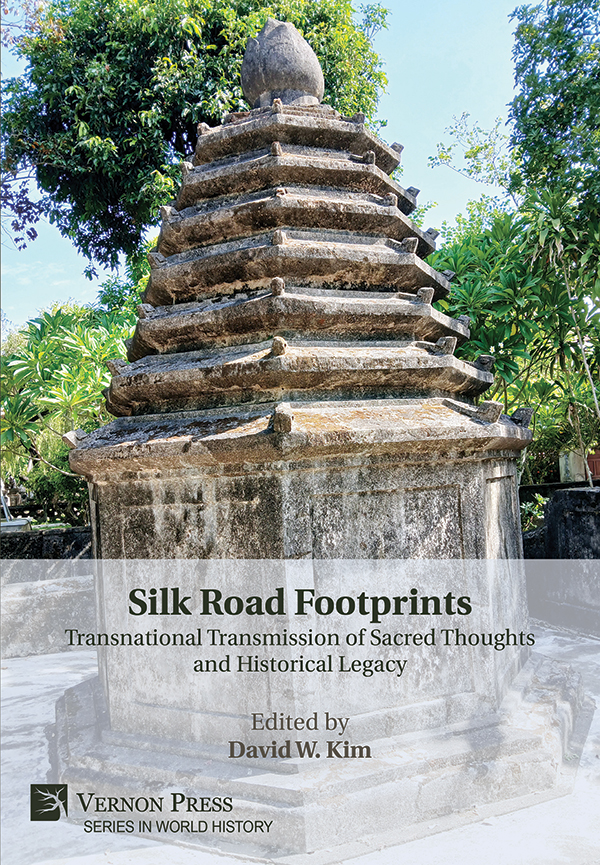
Suvro Parui, Mohamad Zreik, Mukesh Shankar Bharti, Subhadra Mitra Channa, Abby Fryman, Faiza Mazhar, James D. Seymour, Iain Sinclair, and Gökhan Tekir
The Silk Road generally evokes images of places, cultures and peoples linked by the exchange of exotic goods and fabled treasures. The notion of the subject, however, often disregards the historical fact that the Silk Road routes functioned as a unique channel for spreading religious ideas, culture and literature. The personal or community beliefs of the Silk Road were changed radically as a result of the impact of external influences. 'Silk Road Footprints: Transnational Transmission of Sacred Thoughts and Historical Legacy' demonstrates that sacred communities interacted, coexisted, competed and influenced each other over long periods. These include those local traditions that evolved in ancient China, the Middle East, Africa, Central Asia, Korea and Japan and the subsequent larger traditions that arose in the region—Judaism, Buddhism, Christianity and Islam—as well as the shamanistic and animistic traditions of various nomadic peoples. The history of religions along the Silk Road is a remarkable illustration of how beliefs and civilisations often reflect a broad pattern of synthesis rather than clash. This book indicates that Asia (South, Southeast, East Asia and China), one of the most pluralistic religious regions in the world, has become a center of attention as a bridge between cultures. Ultimately, the creative study of the Silk Road and religious transnationalism evidences the implication that the local groups have been developed under the new environment of sacred principles and traditions as well as political influence.

Reagan Fancher
Through U.S. President Franklin D. Roosevelt’s Lend-Lease program, American leaders sought to keep Joseph Stalin’s Red Army in the field and fighting Adolf Hitler’s forces in the Second World War from 1941 forward. Delivered by the Anglo-American Arctic naval convoys, overland through the Iranian deserts and mountains, and through the skies from Alaska to Siberia, this much-needed material aid helped Stalin’s Red Army to continue fighting and thereby prevented a separate peace with Hitler’s Germany and a mechanized repeat of the First World War’s Brest-Litovsk fiasco. Yet Roosevelt and other U.S. officials, due to their severe underestimation of Stalin’s character and his rigid and fanatical devotion to exporting Communism at gunpoint, gambled incorrectly that they could win the Soviet premier’s heart and mind through several excessive wartime aid gestures, including the furnishing of atomic bomb materials to the Soviet regime. By 1945, American leaders had succeeded in their strategic goal of keeping Stalin and his Red Army in the war and hastening victory but failed in their efforts to purchase the Soviet premier’s goodwill and commitment to postwar peace, heralding the global Cold War, and setting the stage for later U.S. martial aid programs to those resisting aggression abroad. In addition to its primary focus on the American leadership’s perceptions of Stalin’s strategic importance to the Allied war effort in the Second World War, this work also includes a detailed assessment of Roosevelt’s Soviet Lend-Lease program alongside U.S. President Ronald Reagan’s later support for the Afghan Islamic guerrillas resisting Soviet occupation during the Soviet-Afghan War of the 1980s and a comparison of both martial aid programs with Washington’s recent revival of Lend-Lease aid for the Ukrainian war effort. It offers today’s American leaders and policymakers a chance to consult the lessons of history and apply them in the present.
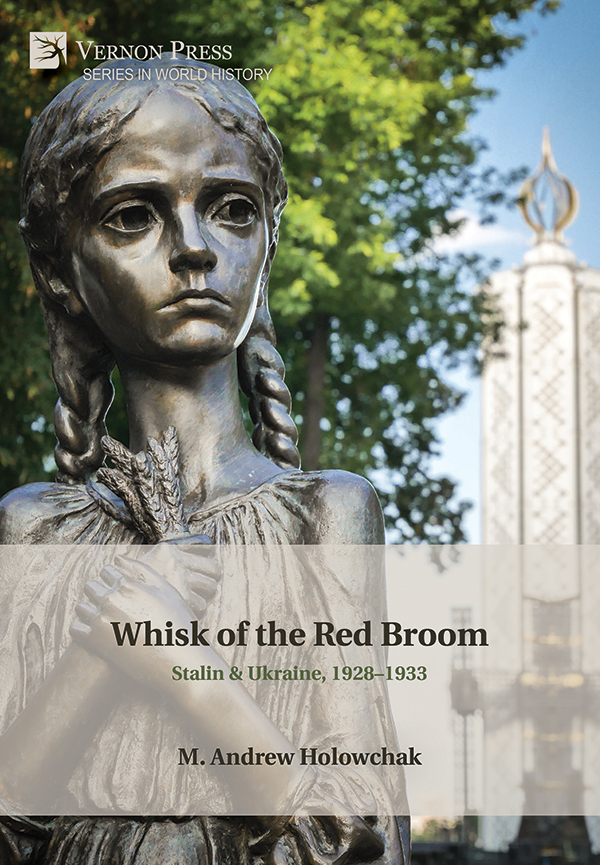
M. Andrew Holowchak
Once Joseph Stalin took the lead of the Soviet Bolshevists after the death of Vladimir Lenin, he quickly turned away from Lenin’s New Economic Policy, with its many concessions to capitalism, to a policy of one-country socialism, driven by his first Five Year Plan (1928) and a plan that other Bolsheviks like Lenin and Trotsky thought impossible. That shift, radical, forced Stalin to “urbanize” the USSR’s vast rural areas—that is, to impose a factory-like model on the Soviet countryside to maximize its efficiency. That required collectivizing the numerous Soviet farms—making large farms of the numerous small farms. Ukraine was to be the model republic due to its vastness and black, fertile lands. Not only were the republics to be collectivized, they were also to be Russified for the sake of model efficiency and centralization of control. And so, while Stalin, early in his political life, preached respect for the cultural diversity of its many republics and the right of secession of any republic, the need to collectivize the Soviet farms for the sake of one-country socialism demanded compliance. Ukrainian peasant-farmers were non-compliant, for they readily saw that the State was asking them for everything and giving back nothing but the pledge of efficient farms to benefit the State, and non-compliance forced Stalin’s authoritarian hand. He imposed laws that brutally punished non-compliant peasants, called “kulaks.” The plan was dekulakization. The intransigents were dispossessed of their property, alienated from other villagers, exiled, and exterminated. The result in Ukraine was the gross inefficiency of both collective and individual farms. That led to intolerance of Ukrainian culture and theft of Ukrainian grain, and even all other findable foodstuffs, to punish Ukrainians. The end was a great famine in 1932 and 1933 in which some four million Ukrainians died. Did Stalin believe that he could urbanize the Soviet countryside? Did Stalin think that socialism could take root in the backwater Soviet Union without the aid of Western succor? Did Stalin hate Ukrainians because many pressed for a cultural identity separate from that of Russia? Had Stalin’s plan of dekulakization from the beginning been a policy of political genocide? Those are some of the many questions I aim to answer in this book. I focus much on Stalin’s writings in the efforts to ascertain his mindset as a dictator.
Human Capital, a Global Mindset, and Missionary Work in Japan and Peru during the Sixteenth and Seventeenth Centuries
Frank Jacob
This book discusses the role of human capital and a global mindset for a successful intercultural management of the Society of Jesus in the geographical contexts of Japan and Peru during the sixteenth and seventeenth centuries. Historical data for more than 200 Jesuits has been evaluated and analyzed according to modern management theory. The work is, therefore, an interdisciplinary study related to the history of religious orders, European expansion, and trans- or intercultural management and shows how the Jesuit missionaries in Japan and Peru were able to achieve and stimulate a successful expansion of their order’s influence in these regions of the world. While analyzing a historical topic, the book is also of interest to modern day managers and those who are interested in creating a successful strategy for intercultural management.
2nd Edition
Reagan Fancher
Fought between 1979 and 1989, the Soviet-Afghan War provided vital combat experience for Osama bin Laden and his senior lieutenants in al-Qaeda, allowing them to hone their newly acquired skills in guerrilla warfare to later support Islamist insurgencies worldwide. Yet the ruthless al-Qaeda chief’s success depended on the Soviet leadership’s reluctant prolonging of its military occupation out of fear of leaving Afghanistan in hostile hands. As relative latecomers to the ferocious Afghan frontlines, the inexperienced Arab fighters benefitted militarily from the combat training unwittingly provided by their Soviet foes. After skillfully obtaining this command and battle experience by working within the wartime atmosphere, bin Laden channeled al-Qaeda’s efforts in a global jihadi campaign targeting a second superpower and its allies. While allegations of U.S. support for the Arab jihadis have contributed to a popular image of bin Laden and al-Qaeda as C.I.A. creations, the historical facts appear to demonstrate that the combat opportunities provided by the Soviet occupation forces played a far larger role in transforming them into seasoned guerrilla fighters. In this second edition, Reagan Fancher updates and expands his monograph in an Afterword elaborating on the contemporary U.S.-U.K. perceptions of bin Laden's wartime actions and their results as he applied his battle-honed guerrilla tactics, judo skills, and recruitment capabilities in tactically helping Yemen's anti-communist Salafi guerrillas to emerge victoriously in their country's 1994 Civil War before concluding with an assessment of the founding al-Qaeda leader's impact on history. It offers an opportunity for today's decision-makers to learn from history and avoid creating new generations of Osama bin Ladens.
Sandra Trudgen Dawson, Mary Laurents, Laurie S. Stoff, Andrew Orr, Allison Scardino Belzer, Michelle Tusan, Patrick José Dawson, Gina Benavidez, Mark J. Crowley, Suzanne Dunai, Kenneth Mouré, Marianne Junila, and Tiina Kinnunen
Europe was in turmoil during the first half of the twentieth century. The political stability that emanated from nineteenth-century political liberalism began to break down, reaching climaxes in the Great War, the Spanish Civil War, and the Second World War. Revolutions in Russia and Spain threatened parliamentary governments, and the Armenian genocide that began in 1915 foreshadowed the systematic destruction of European Jews in the 1930s and 1940s. Dictators seized power and established authoritarian regimes that stymied democratic expression and censored the press. Much of the scholarship on each of the conflicts has tended to focus on the military (male) and the civilian (female) binary. Women and children experienced every conflict during this tumultuous period as civilians, consumers, victims, exiles, and combatants. As histories of women and war suggest, there are exciting new areas of research and scholarship that resist simplistic binaries. Women were not simply civilians or victims. They were actors in the minutiae of wars, revolutions, dictatorships, and genocides. Children were present in these conflicts and not invisible, as many histories suggest. They too were actors and often politicized by propagandist literature and sectarian education through their own experiences and the politics of their families. This collection seeks to complicate the child/ adult distinction and examine the experiences of women and children as lenses to view a more collective face of conflict. While the volume brings to attention conflicts in Europe, the editors acknowledge the global ramifications of the revolutions, wars, and genocides, as well as the multitude of individual experiences. This collection seeks to expand understanding of the personal as the political in European conflicts from 1900-1950. We believe the focus on women and children offers a diverse perspective on five tumultuous decades of European history.
Roberto Echavarren
The details of the Jewish Holocaust have become part of our history through the testimony of those who survived the death camps. The details of Lenin’s and Stalin’s reigns of terror are far less known because they took place behind a wall of secrecy, and survivors have been reluctant to speak about them for fear of retribution. This is an encompassing volume presenting an intense display, as complete as can be, of testimonies, gathered between 2001 and 2005 of actors implicated in different aspects of Russian life roughly through the period 1917-1956. They were people who had lived under the Soviet regime in times of peace and in times of war, from the Red Terror through the Great Terror. One must bear in mind the political and economic conditions in which those lives developed: the one-Party rule placed above both the government and the citizens, the abashment of the division of powers, the suppression of private property and private economic initiative, the political police, and the GULAG. Russian Nights offers a wide and detailed perspective of what we call “the Russian Century”: Lenin’s takeover, the all-powerful Party, the GULAG, and the Second World War.
With an edition of Madrid MS 2908
Janis C. Bell, Elisa Ruiz Garcia, Silvio Leydi, and Stefano Bruzzese
Soon after celebrating the appointment of Federico Borromeo to Archbishop, the city of Milan began planning elaborate festivities to celebrate the betrothal of Prince Philip, future King of Spain, to the niece of the Holy Roman Emperor, Gregoria Maximiliana. She was scheduled to travel through Milan in 1597 on her journey to Spain. Guido Mazenta, a private citizen, planned for the erection of five triumphal arches in strategic locations throughout the city. This volume includes studies of the author and his previously unrecognized importance in turn-of-the-century Milan, presents an analysis and transcription of his illustrated manuscript for the program (Biblioteca Nacional Ms. 2908), and fully examines the scope and expenses of the festivities in honor of royal visitors in the second half of the sixteenth century. Although Gregoria died before the planned celebration, many of its features were transferred to the entry in 1598 of her sister, Margherita, who married Philip soon after he ascended to the throne as Philip III of Spain. This celebration left a permanent mark on the city of Milan through the construction of the Porta Romana. Scholars of early modern European art and history will find a richness of new archival documentation, particularly those interested in the history of book and art collecting and in economic history. The essays in this volume bring to light the important role of a private citizen whose reputation was later deliberately obscured to cover the ignominy that led to his exile from Milan. Janis Bell and Stefano Bruzzese discuss the author and his activities, Silvio Leydi discusses the many elaborate festivities conducted for royal visitors to the city of Milan during the Hapsburg reign and the expenses involved in hosting their courts, and Elisa Ruiz Garcia presents a detailed examination of the program and the sources used by the author.
Alfonso J. Garcia-Osuna
'The Atlantic as Mythical Space' is a study of medieval culture and its concomitant myths, legends and fantastic narratives as it developed along the European Atlantic seaboard. It is an inclusive study that touches upon early medieval Ireland, the pre-Hispanic Canary Islands, the Iberian Peninsula, courtly-love France and the pagan and early-Christian British Isles. The obvious and consequential ligature that runs throughout the different sections of this text is the Atlantic Ocean, a bewildering expanse of mythical substance that for centuries fueled the imagination of ocean-side peoples. It analyzes how and why myths with the Atlantic as preferential stage are especially relevant in pagan and early-Christian western Europe. It further examines how prescientific societies fashioned an alternate cosmos in the Atlantic where events, beings and places existed in harmony with communal mental structures. It explores why in that contrived geography these societies’ angels and monsters were able to materialize with wonderful profusion; it further analyzes how the ocean became a place where human beings ventured forth searching for explanations for what is essentially unknowable: the origins of the universe and the reason for our existence in it.