Loading...
Please wait while we load the content...

Loading...
Please wait while we load the content...
Stay informed about our latest publications, calls for proposals, and special announcements. As a subscriber, you'll also enjoy exclusive member discounts of 10%-20% on all orders. Join our community of scholars, librarians, and readers today.


Availability
In stock
ISBN
9781648896224
Edition
1
Publication Date
May 29, 2023
Physical Size
236mm x 160mm
Illustrations
14 Color
Number of Pages
281
Currency
Quantity
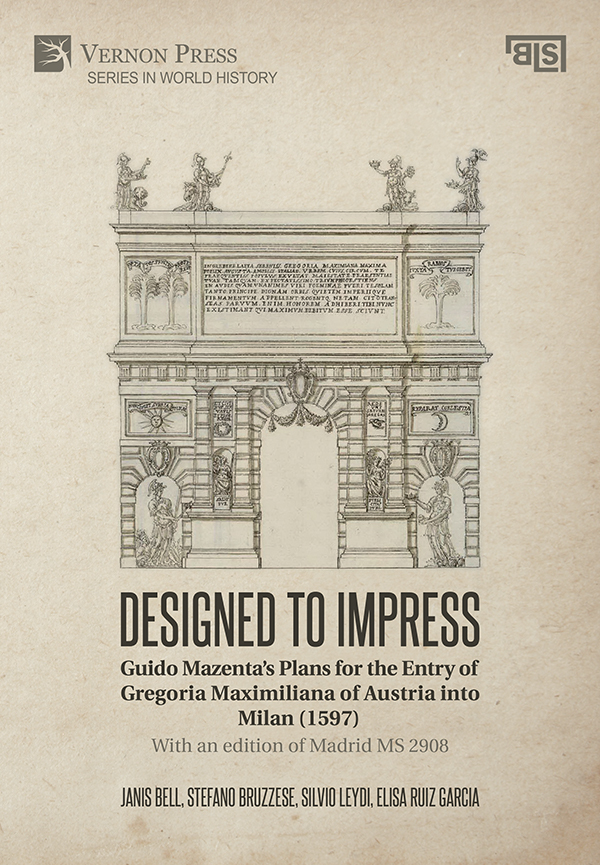
The book is a clearly-structured and well-written account of the sources and context in which the Milanese Guido Mazenta planned the Triumphal Entry of Gregoria into Milan. It offers a transcription of MS 2908 made by Elisa Ruiz Garcia, an extremely interesting source material, with a useful introduction on the iconography of the project identifying the emblematic and allegorical sources used by to construct the program for the welcoming of Gregoria Maximiliana into Milan, a failed project by Mazenta.
Janis Bell, Stefano Bruzzese and Silvio Leydi, in the first three chapters of the monograph, offer insight into this intriguing sixteenth-century figure and on his contribution to the artistic and intellectual life of Milan. Mazenta is considered a minor figure in sixteenth-century Milanese life nowadays, but his achievements are vastly underrated: he studied at the Borromeo college in Pavia, graduating in 1584 and being admitted to the college of jurisconsults of Milan in 1586. He became prefect of the Basilica of San Lorenzo building in Milan, actively dealing with the project drawn up for the dome by Martino Bassi. In 1600 he was elected among the sixty decurions of the Milanese administration, and in 1605, he was chosen to fill the position of vicar of provision. The authors succeed in doing justice to this figure, examining Guido’s reputation as one of the central figures of the intellectual life of the city.
Milan itself, among the Renaissance cities (Florence, Rome, Venice, for instance), is still an underrated place of study considering its dynamic artistic life, especially for what concerns decorative and ephemeral arts. As Bell rightly states in the introduction, “Milan had a history of welcoming illustrious visitors with processions, decorations, and theatrical spectacles. When Milan was an independent state ruled by Ludovico Sforza before the French invasion, Sforza ordered his court artists—including Leonardo da Vinci and myriad armorers, goldsmiths, textile weavers, and carpenters—to transform the urban space into a grand theater displaying his dynastic power” (p.21). However, works such as the present monograph constitute a praiseworthy (and successful) attempt in order to re-evaluate both the city and the figures who inhabited it.
Janis Bell focuses on the role of Mazenta as collector and on his engagement in the life of the city. She mentions his association with the ‘Accademia dei Facchini della Val di Blenio’, which is testified by the painter and writer Gian Paolo Lomazzo who published a sonnet dedicated to him.
Stefano Bruzzese consequently explores a different side of Mazenta, that of the architect and, in a way, “self-made-man”, who had a general education and different interests: his knowledge is versatile and diversified, though not specific. This is emblematic of many of the men animating the cultural life of the city at the time (including the aforementioned Lomazzo).
The three first chapters shed light on the artistic life of Milan and how the project by Mazenta fits into this dynamic landscape. As Bell stated at the very beginning: “The project of 1597 occupies a transformative place as one of the first major projects undertaken after Federico Borromeo was appointed Archbishop of Milan and began to reconstruct the city as a center of modern art and architecture to rival Rome.” (i) This topic is eloquently developed by Silvio Leydi, in the third chapter, who focuses on the triumphs and festivals of the city of Milan, offering an insightful discussion on the effort of the whole city (including the various workshops) to achieve the projects.
The fourth chapter, written by Eliza Ruis Garcia, focuses on the iconography of the 1597 project.
The final transcription of the ‘Apparato’ (in Italian) is of extreme interest as it presents new sources which will certainly be very useful for researchers of the period.
Few comments on the possible public of this excellent work: the monograph can (and will) be of extreme interest to a fairly wide audience of scholars, as it is original and significant in its content. It is primarily directed to scholars of the Renaissance and Early Modern periods, historians, art historians and students of the sixteenth century. The book will also interest universities worldwide, especially in Europe and the United States, museums, libraries, booksellers, collectors and cultured readers.
Prof. Dr. Barbara Tramelli
Department of Humanities
Ca' Foscari University of Venice, Italy
La Biblioteca Nazionale di Spagna a Madrid conserva un manoscritto (segnato MS 2908) che fino a oggi è stato oggetto di scarsa attenzione. Si tratta del programma iconografico che nel 1597 il nobile milanese Guido Mazenta (1561? – 1613) presentò al governatore spagnolo della città meneghina per l’imminente passaggio in città (e conseguente entrata trionfale) di Gregoria Massimiliana (1581-1597), cugina dell’imperatore Rodolfo II (appartenente al ramo austriaco degli Asburgo). [...] , il punto forte del libro è quello di partire da un documento per sviluppare un contesto, indagando in più direzioni. [...]
[Extract from book review (Italian) at 'Letteratura artistica.' Reviewer: Giovanni Mazzaferro. January 2024. https://letteraturaartistica.blogspot.com/2024/01/guido-mazenta.html]
Discover books that expand on the themes explored in this work—titles that engage with similar questions, intersecting disciplines, and complementary perspectives to deepen understanding and broaden the conversation.
Browse all titles
Matthew Jones, Louis Rice, and Fidel Meraz (Eds.)
View more
Carmela Cucuzzella and Sherif Goubran (Eds.)
View more
Serra Akboy-Ilk
View more
Carmela Cucuzzella, Jean-Pierre Chupin, and Georges Adamczyk (Eds.)
View more