Loading...
Please wait while we load the content...

Loading...
Please wait while we load the content...
Stay informed about our latest publications, calls for proposals, and special announcements. As a subscriber, you'll also enjoy exclusive member discounts of 10%-20% on all orders. Join our community of scholars, librarians, and readers today.
Availability
In stock
ISBN
9798881901257
Edition
1
Publication Date
February 28, 2025
Physical Size
236mm x 160mm
Number of Pages
218
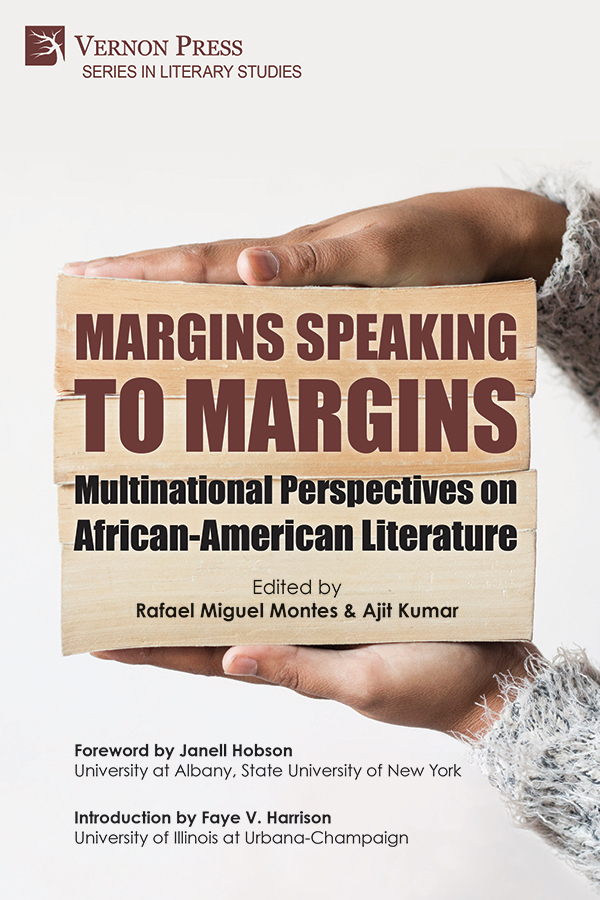
At a time when late capitalism grasps (and gasps) towards fascism globally and white supremacist anti-immigration grievance is on the rise, “Margins Speaking to Margins: Multinational Perspectives on African American Literature," edited by Dr. Rafael Miguel Montes and Dr. Ajit Kumar, is right on time as it audaciously considers, rightly, the humanity of Black diasporic people through the lens of Black women’s literary production from Harriet Jacobs to Toni Morrison and Jamaica Kincaid to Wangari Maathai and Rita Dove. The title itself is a deft trickster move by the editors (Drs. Montes and Kumar), for these creatives on both sides of the Atlantic (or page) have centered Black peoples’ expansive and varied experiences and stories that have reshaped the literary landscape and redirected across waters and nations academic discourse from enslavement to the Harlem Renaissance (New Negro) and Black Arts movements to literatures produced from the African, Caribbean, and South Asian diasporic imaginary. What emerges from this acute academic treatment is an abundant, scholarly anthology of an ever-evolving transnational discourse on Black humanity and the necessity of its centering. The scholars herein do not approach their subjects from the white gaze holding us in the periphery but provide adroit multidimensional literary analyses, the scope of which is global and as varied and interconnected as the first-world peoples are vis-à-vis our contiguous histories and struggles.
Professor Tony Medina
Howard University
In her seminal work, “Can the Subaltern Speak,” Gayatri Spivak raised the question of whether the marginalized can have a voice of their own and speak against the dominant power structure. “Speaking Margins to Margins” attempts to answer Spivak’s question by focusing on black American women’s experiences. These women of colour have long been marginalized within both mainstream literary and African American literary circles. Their experiences as Black, African American women have often been overlooked or misrepresented, forcing them to develop unique perspectives and strategies for self-expression. Hence, the collection of essays allows the reader to be aware of the exclusionary nature of margins and the marginalized and the central white canonical discourse that confines authors of colour and ethnic minorities to the margins and devoices them. The importance of the book in hand lies in manifesting as a possibility to understand that the margins to which Black American women were relegated are also often times simultaneously a site of empowerment and utterance, a subversive position that provides an alternative to main stream literature. By writing from the margin, they have been able to challenge dominant narratives, expose societal injustices, and offer alternative visions of the world.
When exploring the intersection of race, gender, and class to illuminate the complex experiences of Black women, the selected authors highlight the unique challenges faced by Black women, such as sexism, racism, and economic inequality. In their resistance to marginality, they were armed with powerful tools for social critique, including humor and satire, a strong spiritual stamina conveyed through the use of magical realism and myths to challenge linear, male writing, and a strong bond of sisterhood and support to overcome marginalization.
The virtue of the book organized around a dominant concept such as marginalization elicits fresh and multiple ways from different texts and experiences of looking at the dialogic and discursive paradigms of marginality. Each of the chapters attests to the richness of the dialogue of margins and the mechanisms of defying and speaking from marginalization. By speaking from the margin, Black American women writers have made significant contributions to American literature and culture. Their work continues to inspire and challenge readers, and their legacy of resistance and innovation will endure for generations to come.
Overall, the book underscores the role of a selection of Black American women authors in redefining African American literature by addressing complex issues and discussions of identity, community, personal growth and other social and cultural concerns.
Professor Dr. Cyrine Kortas
MECAM
Researcher at the LAD unit at FLSHS
Merian centre for advanced studies in the Maghreb
University of Gabes, Tunisia
Just a look at its table of contents assures the reader that this is an extraordinary book, both in its surprisingly wide range of perspectives and the seriousness with which its authors approach the critical task. Clearly this is a volume which should be on a shelf in every academic library, casting new light on African American literature from widely various directions.
Professor Emerita Marilyn Nelson
University of Connecticut
Discover books that expand on the themes explored in this work—titles that engage with similar questions, intersecting disciplines, and complementary perspectives to deepen understanding and broaden the conversation.
Browse all titles
Eva Darias-Beautell (Ed.)
View more
Oliver Bock and Isabel Vila-Cabanes (Eds.)
View more
Eulalia Piñero Gil and María Laura Arce Álvarez (Eds.)
View more


