Loading...
Please wait while we load the content...

Loading...
Please wait while we load the content...
Stay informed about our latest publications, calls for proposals, and special announcements. As a subscriber, you'll also enjoy exclusive member discounts of 10%-20% on all orders. Join our community of scholars, librarians, and readers today.


Availability
In stock
ISBN
9781648897726
Edition
1
Publication Date
January 2, 2024
Physical Size
236mm x 160mm
Illustrations
3 Color
Number of Pages
378
Currency
Quantity
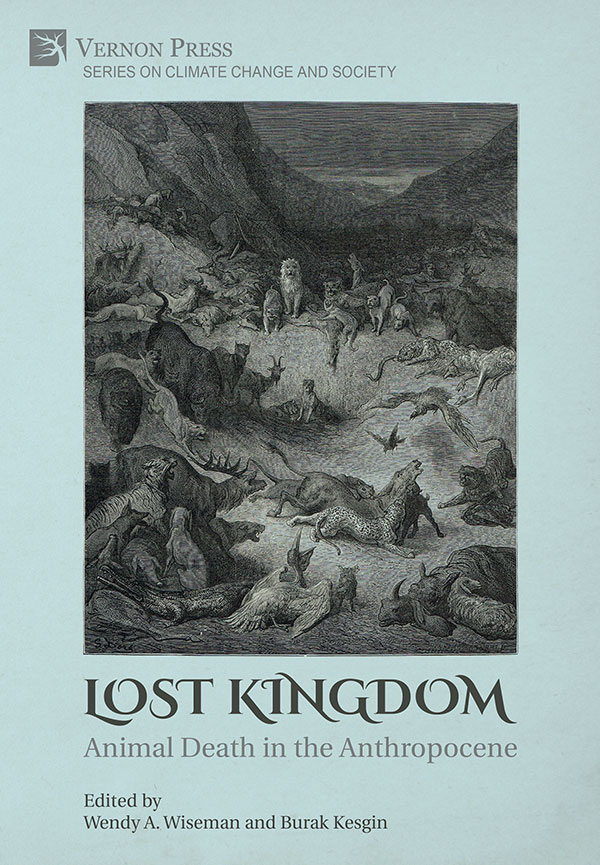
I am incredibly excited about the imminent publication of “Lost Kingdom: Animal Death in the Anthropocene.” The editors Wendy A. Wiseman and Burak Kesgin have gathered together an international collective of leading scholars to address the various registers of ongoing massification of death whose roots lie tangled underneath the ground we now walk. It goes without saying that the topic of our current death-driven metaphysics and practices should be both at the center of academic and public concern. This volume succeeds in situating itself within a pressing conversation, but it does so in a wildly original way, reimagining what is at stake as we blithely exterminate life around us and within us.
Taken together, the original and wide-ranging essays and array of topics broached in “Lost Kingdom” are a bracing call for us to acknowledge our complicity in the making of this hell-hole of modernity. This is a crime scene. A burning building. A time-bomb. What on earth will it take to wake us up to a situation of our own making? How might we reimagine the defining mark of the human not as rationality or control or even dominion but rather indeterminacy, imagination, friendship, empathy, flourishing, love . . . ? In that respect, the book is a deft reframing of the current conversation revolving around the Anthropocene, animal extinction, philosophy, and ethics. For it argues that the human-generated crises must be addressed from a perspective that decenters the human from the cosmos or even, perhaps, the ecology of political debate. In attempting to harness the “spectral power of animality that is indistinguishable from divinity,” the editors make a bold and successful wager that the language of (negative) theology is the last, best hope to gain interpretive leverage on a dreadful situation.
“Lost Kingdom” is the best book, to my knowledge, that puts Anthropocene studies and questions concerning animality in conversation with theological currents of Continental Philosophy—from Nietzsche and Freud to Derrida and Haraway. This rich tapestry voices, both poetic and urgent, a compelling indictment of the theological roots of our increasingly organized proclivities for extraction and extermination. I very much appreciated this clarion call to recognize the theological registers of colonialism, capitalism, and algorithmic abstraction. For the killing fields of modernity have long been places of perverse religious worship.
Prof. Dr. John Modern
Author of 'Neuromatic: A Particular History of Religion and the Brain'
Department of Religious Studies
Franklin & Marshall College
Reading this was a galvanizing, eye-opening experience. I could not put it down. This book makes a compelling case that climate change is more than just a human problem, and that we cannot solve it without addressing the conditions of animal life on the planet. After reading this volume, it is impossible to look at the standard Western lifestyle in the same way, because humans are not external to the earth system. We are merely one animal, alongside our animal neighbors, in a natural system that can kill us as well as them. The book shows that animal welfare and climate change are intricately intertwined: from the perspective of animal life, even gradual human extinction could appear to be a good thing, something the planet needs to do to retain its balance so that life can continue.
The authors portray their animal neighbors with moving empathy and critical insight into the social and political forces, and the specific human decisions, that have caused their life on the planet to diminish. The use of storytelling as a way to present knowledge allows a deeper and richer approach to the problems and their possible solutions. The animals emerge as actors and central figures in their own stories. Tigers, bull trout, chimpanzees, monarch butterflies, and chickens appear as agents and actors. They are no longer data points and statistics, but sources of knowledge and communication. Reading the book made me feel more connected to all lives on our planet.
As suggested above, the strengths are the subject matter, which is of existential importance; the variety of topics treated in the individual chapters; the interdisciplinary nature of the varying approaches; and the compelling use of narrative alongside theory. The theoretical basis is also rich, including indigenous, black, queer, and post-colonial perspectives as angles from which to view the catastrophe of mass animal death. The reader can understand that human minoritization and animal suffering are closely linked and overlap.
Each chapter broaches a significant topic, each chapter is informative, each chapter offers a constructive perspective. The variety of topics is one of the volume's strengths. And the volume as a whole is cohesive. It strikes me that it was probably difficult to find this number of contributors, with such consistently high quality in the contributions, in an emerging field such as critical animal studies. The editors are to be commended for the high quality of the individual chapters and the coherence of the volume. And the publisher is to be commended for taking on this important project.
Prof. C. M. Thomas
Cordano Endowed Chair
Department of Religious Studies
UC-Santa Barbara
[...] “Lost Kingdom” is a worthwhile book, challenging readers to recognize the material and ideological forces behind the mass extinctions of animals in the Anthropocene. The book asks us to bear witness to the loss of animals’ life, to empathize with non-humans, and to work towards a radical relationality with the animal world. [...]
[Extract from book review on the 'Journal for the Study of Religion, Nature and Culture', Vol. 19 (2025) 1-3. Published online: 2025-11-03. Reviewer: Steven E. Silvern (Salem State University). DOI: https://doi.org/10.1558/jsrnc.33043 ]
Discover books that expand on the themes explored in this work—titles that engage with similar questions, intersecting disciplines, and complementary perspectives to deepen understanding and broaden the conversation.
Browse all titles
Carmen Flys-Junquera and Alejandro Rivero-Vadillo (Eds.)
View more
Blaž Bajič and Ana Svetel (Eds.)
View more