Loading...
Please wait while we load the content...

Loading...
Please wait while we load the content...
Stay informed about our latest publications, calls for proposals, and special announcements. As a subscriber, you'll also enjoy exclusive member discounts of 10%-20% on all orders. Join our community of scholars, librarians, and readers today.


Availability
In stock
ISBN
9781648896934
Edition
1
Publication Date
September 26, 2023
Physical Size
236mm x 160mm
Illustrations
18 Color
Number of Pages
216
Currency
Quantity
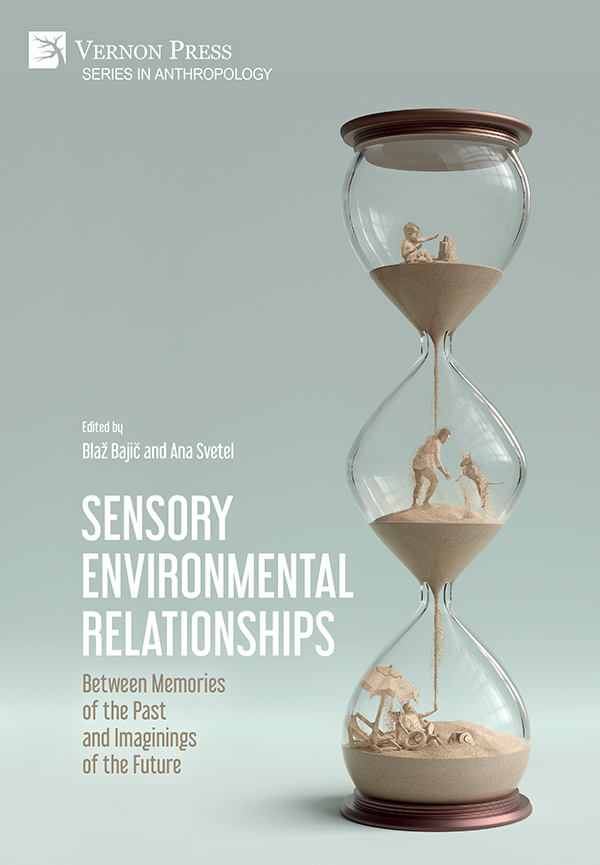
Ecological approaches growingly meet sensory issues, as both are closely related to experience and world-making. Concomitantly, ecology overpasses strict nature-culture divisions, being a mode of relationship to the worlds we not only live in but create. The contributions of this book explore different cases showing how environments are performed rather than given, with a focus on the sensory dimensions, be it through sight, hearing, touch, smell, taste or walking. They address different issues such as memory, embodiment, landscape, urban modernity, and situated knowledge, through objects ranging from a marsh, city art, urban smells, a park, pastoralism, burning tires, sauerkraut and dung, a lockdown and even shoes. By this heteroclite series, one can apprehend the everchanging and always contextual affordances which make environments continuously lived experiences, situations but also imaginations. Indeed, ecologies of perceptions are creative imaginations as much as they are anchored in materialities. In this sense, they challenge ordinary linear perspectives by showing how dynamic and processual are our beings-in-the-world, not only configured by the past and attuned to the present but oriented toward the future. The essays explore sensory situations and experiences, allowing one to grasp the cognitive, physiological, material, cultural, social, and symbolic dimensions of environmentalization. They underline the continuous co-construction of human and non-human entities, as well as the heterogeneity of our worlds of experience, not only marked by symbiosis and fluidity, but by tension and even conflict. In this respect, environments are as multiple, plural and transformative as bodies and “cultures” are and address core questions: which world(s) do we create and share? Which world(s) do we (and can we) afford?
Dr. Olivier Givre
Université Lumière-Lyon 2, France
Seeing, touching, hearing, tasting, and smelling are the incredible sensors of the Human body and anthropologists, who dedicate their lives to finding out what makes a human. This meandering volume takes us to the pivotal questions of the newly emerging field of sensory anthropology, bringing up personal memories, experiences, and imaginations, and giving insight not only into the factual lives of people but into how they feel their lives. And, undoubtedly, it also shows us how we, anthropologists, perceive and describe multiconnected human relations and environmental issues through our lenses.
Gábor Máté, ethnologist, geographer
Department of European Ethnology – Cultural Anthropology
University of Pécs, Hungary
“Sensory Environmental Relationships: Between Memories of the Past and Imaginings of the Future” is an anthology investigating questions of transforming spatialities, distinct temporalities and sensory modalities. The book brings forth encounters between the diverse methodologies, theoretical and practical starting points in different cultural contexts in Europe. Drawing from recent anthropological research on sensory studies and sensobiographies the book presents assorted approaches including walking as a method. The chapters lead the reader to diverse ethnographic directions such as defining the human-environment relationship, addressing the problem with environmental losses and artistic creativity in living environment and urban sensory transformations including methodological approaches to the act of listening and social theory. The book's strong points and originality reside in its ability to combine diverse theoretical and conceptual approaches such as affordances, grieving, memory, the act of remembering, public infrastructure and sensorium, pastoralism and olfactory landscapes related to the practices of othering. This collection of scholarly texts is a welcomed addition to contemporary sensory studies and will appeal to anyone interested in theoretical pondering and methodological choices in context of carrying out fieldwork on individual sensory phenomena and/or the whole sensorium.
Dr. Heikki Uimonen
Professor, Cultural Studies
University of Eastern Finland; Finland
Discover books that expand on the themes explored in this work—titles that engage with similar questions, intersecting disciplines, and complementary perspectives to deepen understanding and broaden the conversation.
Browse all titles
Abubakar Danladi Isah and Isa Bala Muhammad (Eds.)
View more
Carmen Flys-Junquera and Alejandro Rivero-Vadillo (Eds.)
View more