Loading...
Please wait while we load the content...

Loading...
Please wait while we load the content...
Stay informed about our latest publications, calls for proposals, and special announcements. As a subscriber, you'll also enjoy exclusive member discounts of 10%-20% on all orders. Join our community of scholars, librarians, and readers today.


Availability
In stock
ISBN
9781622733729
Edition
1
Publication Date
January 31, 2020
Physical Size
236mm x 160mm
Number of Pages
244
Currency
Quantity
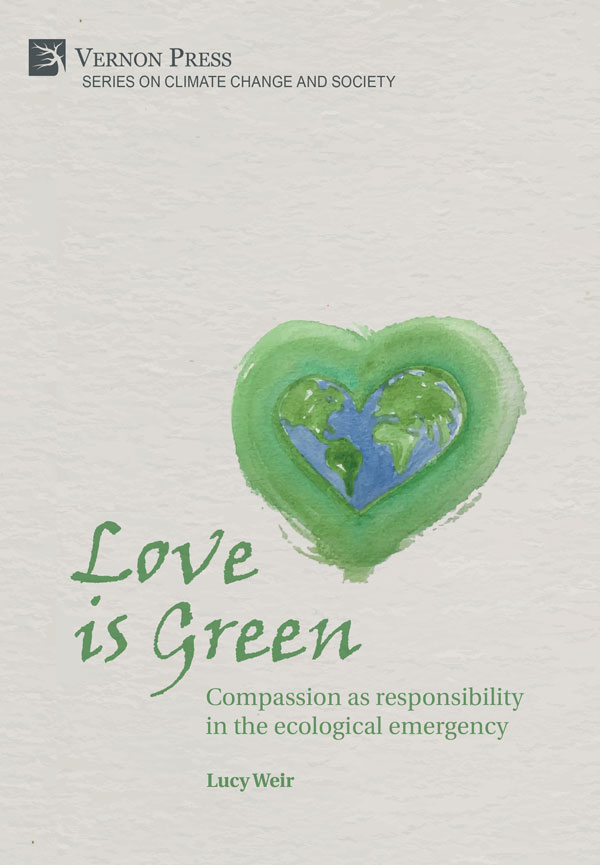
In 'Love is Green', Weir develops a sophisticated and sympathetic response to our ecological problems. By attuning ourselves to our enmeshed nature and allowing ourselves to see with compassion, we realize alternatives ways of responding to our surroundings. Weir argues that this is one of the only ways to carry us beyond humanity’s era of ecological destruction. This book brings together philosophies of East and West, and as such is of greater contemporary relevance than most philosophical books on this topic. The book is written in clear, non-jargon language, and should be accessible to readers even if they haven’t previously studied much philosophy. Weir’s emphasis on expressing compassion or love as a response to the ecological crisis is inspiring.
Dr. Cara Nine
University College Cork
This book is unique. It combines pieces of well-developed philosophical thought (analytic ethics, ecological theory, continental philosophy, and Buddhist thought, especially Dōgen) into a novel, coherent, and quite compelling vision.
This highly original work reconsiders the problem of ethical agency within an ecological context. In so doing, it provocatively argues that we cannot act on the ecological systems that comprise us as if we were outside of them. What emerges is a profound account of agency as realization that marries contemporary ethics to Zen practice in a manner that understands the roots of the ecological crisis deeply enough to be able to address them.
Jason M. Wirth,
Professor of Philosophy, Seattle University
Very interesting and worth looking at. [...] I hope that people can have a dip in ... and get involved in the movement.
Des Derwin, SIPTU (Services, Industrial, Professional and Technical Union) ‘Just Transition’
Since reading it and realising what the work is here, I was really lucky.... I think it's a very important work and relates to how we communicate, how we understand this existential leap we have to make to address the ecological crisis.
When it's sold in colleges across the world, which I think it will be...
It's readable in a way that anyone would understand, and it's important we all try to get an understanding of the questions and the theory that Lucy is expounding on. [...] It doesn't shy away from the science; it brings the science in."
Eamon Ryan, Leader of The Green Party, Ireland (Comhaontas Glas)
[It] wants to take evolutionary biology to what is seen as its logical conclusion.
[The book] is also reminiscent of Dewey's work in that it offers hope, even as it acknowledges the unpredictability of the future, and names the deeply troubling fundamental threat of our time. [...] I thoroughly enjoyed engaging with this really very skillful way of making the case.
Dr Eileen Brennan, DCU Institute of Education
Discover books that expand on the themes explored in this work—titles that engage with similar questions, intersecting disciplines, and complementary perspectives to deepen understanding and broaden the conversation.
Browse all titles
John K. M. Kuwornu (Ed.)
View more
Suiven John Paul Tume and Vincent Itai Tanyanyiwa (Eds.)
View more
Chi P. Pham, Chitra Sankaran, and Gurpreet Kaur (Eds.)
View more