Loading...
Please wait while we load the content...

Loading...
Please wait while we load the content...
Stay informed about our latest publications, calls for proposals, and special announcements. As a subscriber, you'll also enjoy exclusive member discounts of 10%-20% on all orders. Join our community of scholars, librarians, and readers today.


Availability
In stock
ISBN
9781648892882
Edition
1
Publication Date
March 15, 2022
Physical Size
236mm x 160mm
Illustrations
20 Color
Number of Pages
373
Currency
Quantity
The new book by Henry Hoffmann further strengthens his unique position among American authors writing about the history of American cinema. Hoffmann’s books have been consistently unique in the way they trace the literary presence of great stars of the silver screen. By carefully and painstakingly tracing literary references made to specific actors in the process of close reading of hundreds of books (a process I find hard to imagine in its sheer magnitude of required work and focus,) Hoffmann manages to illuminate the culture of 20th-century America by pointing to the pervasive, rich presence of film icons in everyday lives and imaginations of Americans.
In the latest volume, Hoffmann focused on Gregory Peck, Robert Mitchum and William Holden – all embodying the Hemingway ideal of “grace under pressure,” all bringing to mind the strictly American trope of the “strong, silent type” that was so key to American masculinity. By evoking the myriad of ways in which these male icons infused the imagination of writers and readers, Hoffmann offers a unique insight into the landscape of American films and literature. I applaud his steady research, great scholarly passion and film lover’s dedication to his task.
Michał Oleszczyk
University of Warsaw, Poland
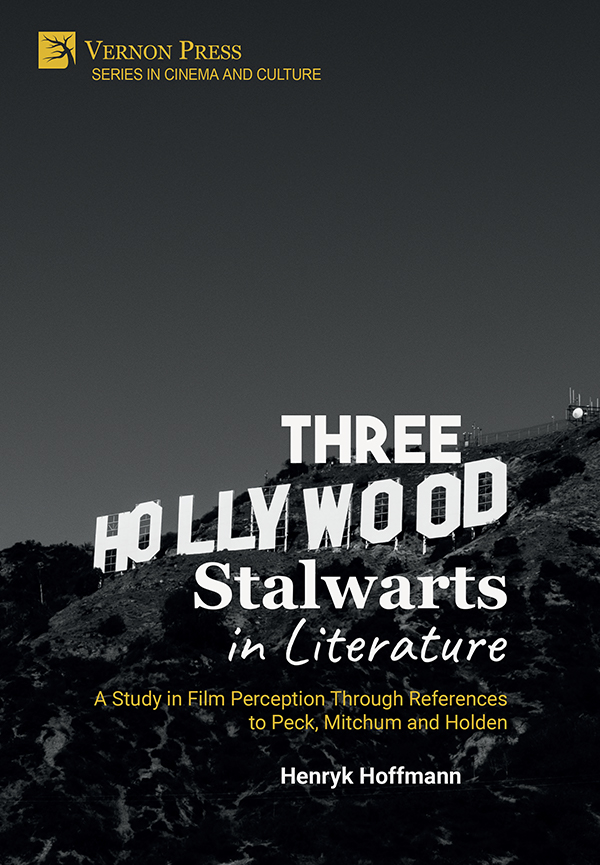
Henryk Hoffmann’s “Three Hollywood Stalwarts in Literature. A Study in Film Perception Through References to Peck, Mitchum and Holden” is a solid reference book in which the author documents the cultural importance of three major American actors – Gregory Peck, Robert Mitchum and William Holden, and of the movies they played in. The volume is a continuation of Hoffmann’s previous books, where the author studied the impact on American culture of such movie stars as Humphrey Bogart, Burt Lancaster, Kirk Douglas, and others. In the present volume, the author undertakes the difficult task of showing how American and European writers reference the three actors and the movies in which they were starring in their works. Hoffmann discovers that, surprisingly, many authors have their literary characters discuss or mention Peck, Mitchum and Holden and the films they helped to make artistically relevant and famous. In his work, the author is painstakingly looking for all the movie references in the novels by the writers he has chosen for analysis. He shows that Peck, Mitchum and Holden hold a particular attraction for the literary characters in those works in a way that enriches their literary lives. While Hoffmann’s volume is basically a study of Hollywood movies’ impact on American and European culture, it also includes many important encyclopedic details concerning the film careers of the three discussed actors. That is why the book should certainly prove interesting to readers interested in film perception and those whose interest in the three Hollywood stars goes beyond mere trivia.
Prof. Dr Hab. Jerzy Durczak
Maria Curie-Sklodowska University, Lublin, Poland
Once again, Henryk Hoffmann shines a light on the fascinating relationships and effects on our culture that movies and their stars have had over the decades. Film – its stories, actors, celebrities, and power to influence - has touched the viewing audience worldwide and is presented on these pages, giving the reader much more to think about than just the plot of a good story or how charismatic and sexy its stars are. The book shows how interwoven the arts are and how the various areas of creativity communicate directly and indirectly.
The three marvelous actors of this book, Gregory Peck, Robert Mitchum, and William Holden, represent such a different facet of their art. I found it fascinating to read how the author weaves together influences and inspirations that transcend time and space. Whether the readers of this book are cinephiles or an average movie-goer or a young person just becoming acquainted with the science and the art of filmmaking, to delve into “Three Hollywood Stalwarts in Literature” will, I believe, open up new worlds even for those who think they’re well versed in cinematic history. Thank you again Mr. Hoffmann, for helping us expand our horizons.
Maria Cooper Janis
Artist in New York
[…] Clearly, both the scope of the project and the amount of the collected and examined data is impressive. Hoffmann offers a convincing contextual interpretation and explanation of the reasons for the uses of the movie references in modern literature. At the same time, he proposes a specific method of investigating the interrelations between film and literature based on the study of film-and-actor references in the works of modern writers. Three Hollywood Stalwarts in Literature is addressed to a wide range of readers, such as average filmgoers, movie buffs, film students, film historians and literary scholars. […] A good read with indisputable educational values, the book should also encourage readers to reach for some of the films and literary works discussed in it. […]
[Extract from book review on the 'Film Journal' (Online) 11 | 2025. Reviewer: Roman Kopytko. https://doi.org/10.4000/15gwj]
Discover books that expand on the themes explored in this work—titles that engage with similar questions, intersecting disciplines, and complementary perspectives to deepen understanding and broaden the conversation.
Browse all titles