Loading...
Please wait while we load the content...

Loading...
Please wait while we load the content...
Stay informed about our latest publications, calls for proposals, and special announcements. As a subscriber, you'll also enjoy exclusive member discounts of 10%-20% on all orders. Join our community of scholars, librarians, and readers today.


Availability
In stock
ISBN
9781648892257
Edition
1
Publication Date
September 20, 2022
Physical Size
236mm x 160mm
Number of Pages
205
Currency
Quantity
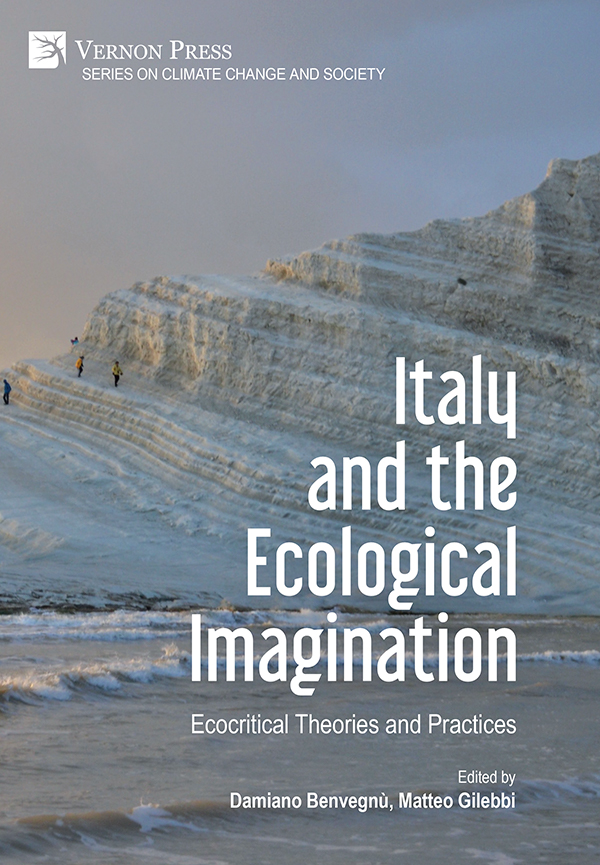
Damiano Benvegnù and Matteo Gilebbi, both leading thinkers in ecocritical Italian studies, have convened a lively and wide-ranging collection that confirms the vital relevance of the Environmental Humanities in Italy. Their introductory essay lays out in extraordinarily clear and insightful terms the current state of the evolving interdisciplinary field, both regarding theoretical trends and in light of contemporary Italian legislation. The essays that follow, in a spiraling voyage through landscapes, materials, philosophies, and artistic practices, chart a new map of the Italian peninsula: a map of environmental atrocities but also of profoundly hopeful, creative responses. From the gritty surfaces of Turinese sidewalks to the dioxin-laced lungs of women in the Land of Fires, and from the imploring gaze of a young buffalo to the embracing arm of a land artist, the subjects are compelling, quirky, and have important lessons to impart about environmental pasts and futures.
Dr. Elena Past
Professor of Italian
Classical and Modern Languages, Literatures, and Cultures
Wayne State University
This is an eminently timely and theoretically sophisticated volume that does justice to the disciplinary and ethical complexity of the ecological impetus currently animating the Humanities. Targeting the theoretical and practical entanglements of nature and culture, the introduction sets out an engaging case for the centrality of the imagination in charting responses to our planetary crises. Nothing is taken for granted here as the editors provide lucid definitions of terms and references, from ecocriticism and the environmental humanities to the notion of Italy itself.
The bi-partite division of the volume into “theories” and “practices” is a happy one, allowing for echoes to emerge across the two sections, designed, as the editors indicate, to “converse” and “converge.” The volume offers a truly impressive range as multiple forms of expression (film, literature, philosophy, sculpture, documentary) are placed in dialogue with an equally impressive range of environmental questions. In this, the volume embodies the spirit of the environmental humanities, characterized precisely by a truly transdisciplinary posture.
This text will have broad appeal, attracting a readership of not only Italianists but also scholars with interests in animal studies, posthumanism, ecofeminism, and new materialism, to name just a few fields. Though rooted within Italian studies, a field central to the environmental humanities, this volume is not at all limited by its national focus. Indeed, multiple chapters explicitly broach global questions through a local Italianist lens. From this perspective, there are some truly stand-out essays, in particular, those by Iovino, Cannamela, and Saporito. The volume’s appeal also lies in its activist engagement with the Anthropocene. Rejecting a posture of despair in the face of our planetary crises, the editors point to the capacity of imaginative thinking to reveal and safeguard our more-than-human planet.
Prof. Dr. Deborah Amberson
University of Florida
[...] it successfully addresses and explores a broad range of artistic and ecocritical dimensions,possibilities that, through the multi-faceted and interdisciplinary approaches taken by the authors, can surely inspire further scholarship, perhaps motivating present and future art and research to address the ongoing ecological crisis.
[Extract from book review on 'Journal of Ecohumanism'. Vol. 3 No. 2 (2024), pp. 285–287. Reviewer: Luca Gambirasio. DOI:10.33182/joe.v3i2.3160]
Discover books that expand on the themes explored in this work—titles that engage with similar questions, intersecting disciplines, and complementary perspectives to deepen understanding and broaden the conversation.
Browse all titles
Evandro Oliveira, Ana Duarte Melo, and Gisela Goncalves (Eds.)
View more
Chi P. Pham, Chitra Sankaran, and Gurpreet Kaur (Eds.)
View more
Alan March et al.
View more
Carmen Flys-Junquera and Alejandro Rivero-Vadillo (Eds.)
View more