Loading...
Please wait while we load the content...
Loading...
Please wait while we load the content...

Explore peer - reviewed titles across the humanities and social sciences - rigorous research, fresh perspectives, and scholarship that inspires dialogue across disciplines.
Stay informed about our latest publications, calls for proposals, and special announcements. As a subscriber, you'll also enjoy exclusive member discounts of 10%-20% on all orders. Join our community of scholars, librarians, and readers today.

From special discounts and global distribution partners to downloadable catalogs, flyers, and high-resolution covers, we make it easy to enrich your library’s collection. Access bibliographic data, explore subject-specific listings, and stay updated on forthcoming titles.
Become part of our librarian network and access dedicated tools, discounts, and resources to support collection development and promote new titles to your patrons.

Partner with Vernon Press to provide your customers with high-quality, peer-reviewed scholarship. We offer flexible ordering options, reseller agreements, and promotional materials to support your sales and outreach.

Vernon Press provides dedicated resources to help instructors adopt our books for courses and to support students with affordable access to high-quality scholarship. From desk and examination copies to tailored student editions, we aim to make our titles accessible in the classroom.
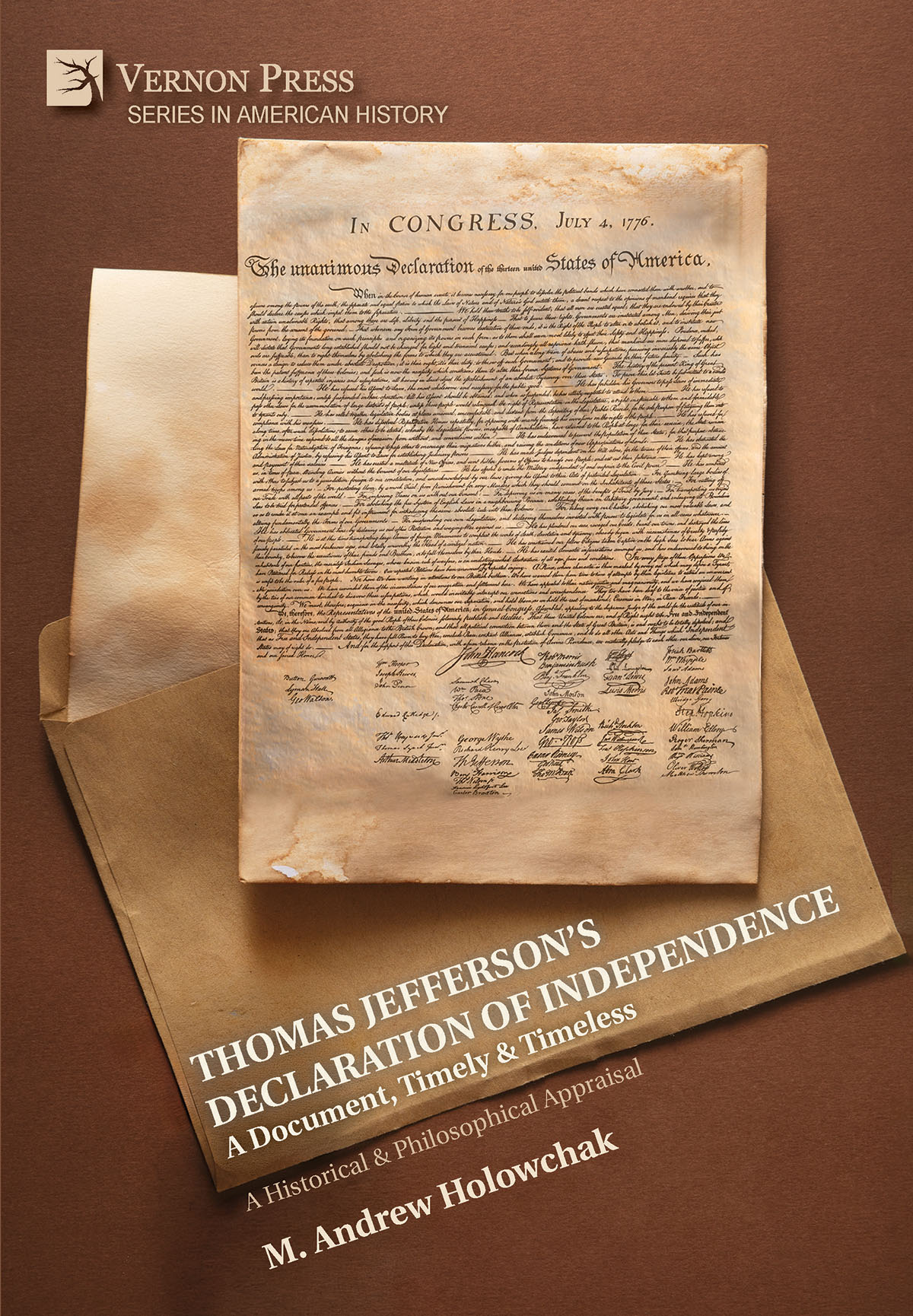
A Historical & Philosophical Appraisal
M. Andrew Holowchak
The Declaration of Independence is alive, because its sentences are crafted with elegance and concision—and the Congress much contributed to its concision—and because the author, not just the drafter, of the document captured things commonly known, yet profound, concerning human nature and human wellbeing. The Declaration of Independence, thus, is not just a proclamation to the world, of Americans’ independence and of the reasons for it, but it is also, and most singularly, a moral document that grounds a rich and robust liberal political philosophy. The bedrock of that political philosophy, argues Holowchak, is human equality, not human liberty.
Kamila Midor
How do people put into words the experience of losing someone they love? This book offers a systematic, cross-cultural linguistic analysis of how loss and grief are conceptualized in American and Polish contexts, revealing both shared human patterns and culturally specific ways of expressing and processing bereavement. Drawing on qualitative data from nearly eighty participants who had lost a loved one to five years before participating in the study, the study examines the metaphors and conceptual blends through which individuals articulate their experiences of grief. Using the frameworks of conceptual metaphor theory and conceptual integration theory, the book identifies recurrent conceptual structures—such as absence, emptiness, pain, inanimate physical object, and journey—that speakers draw on to make sense of profound emotional disruption. While many of these schemas appear across both cultural groups, the analysis reveals important differences in their subtypes, linguistic realizations, and cultural meanings. Notably, some patterns challenge the dominant view of grief as exclusively negative, including personifications such as grief as a guest in American narratives and grief as a teacher in the Polish data. The book fills a significant interdisciplinary gap between linguistic research on metaphor and psychological scholarship on grief. It is the first work to develop empirically grounded conceptual models of loss and grief for American and Polish speakers based on qualitative linguistic data, offering a novel, culturally sensitive perspective on bereavement. Accessible yet theoretically rigorous, the book will be valuable as a research reference, a methodological model for qualitative metaphor analysis, and a resource for classroom use. It will appeal to scholars and students in cognitive linguistics, cultural studies, psycholinguistics, and cross-cultural communication, as well as to psychologists, therapists, counselors, social workers, and others working professionally with grief and loss.
Embodiment and the Recovery of Resonance
Ágata Walek
This monograph examines ‘Only Revolutions’ (2006) by Mark Z. Danielewski and ‘Becoming Animal‘ (2010) by David Abram to ask whether contemporary literature can articulate a viable alternative to the radical pluralism and fragmentation associated with postmodern aesthetics. What was once described as the postmodern condition—decentred subjectivity, proliferating interpretations, the dispersal of grand narratives—has intensified in the twenty-first century into algorithmic hyperreality, digital abstraction, and ecological disconnection. Within this landscape, reading and thinking risk dissolving into endless circulation without orientation. Positioned at the intersection of post-structuralism, phenomenology, and embodied cognition, the study proposes not a return to unity but a re-materialization of experience through resonance. It develops an interdisciplinary framework drawing on phonosemantics, conceptual metaphor theory, and sound studies in order to foreground dimensions often marginal in literary criticism: rhythm, vibration, and embodied perception. Language is approached not as a merely representational system but as materially expressive and affectively generative. In a final chapter, the memoir of David Goggins is read alongside these literary and philosophical analyses to explore how discipline, pain, and self-formation enact a comparable structure of re-attunement. Across literary experimentation, ecological phenomenology, and embodied practice, the book argues that meaning does not simply signify—it resounds. By reconceptualizing language as resonant and ontologically expressive, the study offers a constructive response to postmodern fragmentation and contributes to debates in contemporary literary theory, continental philosophy, and embodied cognition. It will be of interest to researchers in literary and cultural studies, philosophy of language, affect theory, and ecophenomenology, and may serve as a methodological resource for interdisciplinary work on materiality, sound, and subjectivity.
Volume 2: Representations
Author information not available
No description available
An exercise in post-nation-state worlding
Madina Tlostanova
The book is an open-ended, meta-critical reflection on the discrepancy between the nation-state as an institution and contemporary and future (geo)political, social, enviro-climatic, technological and onto-epistemic challenges, written primarily from the position of the systematically excluded from the identification frameworks of the nation-state. Epistemically, the work stems from the decolonial and indigenous critique of coloniality of knowledge and from feminist skepticism towards objectivist, rationalist thinking modes. The author invites the readers to imagine other possible ways of political organization that would contribute to extending life on Earth, and the paths to their implementation. Without aiming at an exhaustive overview of the existing opinions on this vast topic or offering a single correct recipe for the emerging post-state political development, the book experiments instead with various tools, stimulating the readers to relearn how to imagine politically. The established methods, such as thinking together and arguing with authors from different areas and disciplines - from postcolonial studies, decolonial feminist positions to indigenous and libertarian anarchist stances, from critical environmental humanities to techno-fix pseudo-solutions and neo-imperial geopolitical accounts, are intertwined with engaging conversations with political/social/cultural activists, artists and thinkers and with experimental speculative fiction using creative writing as a mode of inquiry. Through its co-creative interactive style, this trans- and post-disciplinary work invites the audience to engage in praxis beyond the actual reading of the book. The book can be used in undergraduate and graduate elective courses in migration studies, critical security studies, human geography, decolonial and postcolonial studies, environmental humanities. It will be of interest to social, political and cultural activists, artists and writers and to broader audiences concerned with the question of whether and how it is possible to live politically beyond the nation-state, without sliding into (neo)imperial, totalitarian or corporate specters.
The Political Economy of the SDGs and Mispricing of the Future
Author information not available
The economics of sustainability begins with how the global economy assigns value. The global pricing system is structurally misaligned with sustainability imperatives. Sustainability is a macroeconomic coordination problem. Sustainable investment constitutes the primary economic transmission mechanism through which sustainability becomes operational. This study defines sustainability as a global culture, understood as the internalisation of sustainability in economic preferences. Sustainability transforms firms’ cost structures, with profound implications for cash-flow dynamics and risk exposure, thereby influencing the valuation of investment. Do we recognise sustainability not merely as a constraint, but as a meaningful and permanent way of life? Do we see ourselves as part of this global culture? The analysis integrates insights from political economy, behavioural economics, and corporate finance to develop a political-economic framework of sustainable investment, addressing topics such as carbon pricing, alternative measures to GDP, nudges, and real options. Designed for researchers, students, policymakers, practitioners, and general readers, the book combines analytical rigour with accessibility through dual chapter summaries that translate complex ideas into intuitive insights. It offers both a diagnostic framework and a pathway for aligning economic systems with planetary limits and human well-being.
Texts, Scholarship & Research
Paolo Costa, Andrea Balbo, Matteo Barbato, Anna Motta, Marie Humeau, Kayla Jutzi, Simon Whedbee, Raffaele Luiselli, Joel Christensen, Giacomo Fedeli, Fabio Stok, Sara Fascione, Juan Fancisco Mesa Sanz, Victor Udwin, and Arlene Holmes-Henderson
'Teaching and Learning Classics at the University Level, Vol. 4' focuses on the teaching of literature, digital approaches, and research methodologies in Greek and Roman antiquity. The 14 chapters examine the approaches to teaching key topics, including Digital Humanities, the use of digital tools in the study of antiquity, academic research in ancient history, ancient philosophy and rhetoric, as well as palaeography, codicology, papyrology, and textual criticism. They also explore the teaching of major literary traditions, including Homer, Roman epic poetry, Late Antique Latin literature, and Medieval and Modern Latin drama, as well as innovative approaches such as mapping and employability within Classics. Presenting teaching as a reflective and research-informed activity, this volume is intended for university lecturers, teacher trainers, and graduate students interested in classical literature, digital humanities, and research-based approaches to the study of antiquity in higher education.
Mythology, Arts & Archaeology
Cristóbal Macías-Villalobos, Minerva Alganza Roldán, Debosmita Biswas, Valeria Riedemann, Bartosz Awianowicz, Valentina Famari, Massimo Vidale, Elizabeth C. Robinson, Katia Savrami, and Giorgos Sampatakakis
‘Teaching and Learning Classics at the University Level, Vol. 3’ focuses on the teaching of mythology, arts, and archaeology in Greek and Roman antiquity, with a particular emphasis on cultural expression, visual and material culture, and interdisciplinary approaches. The 9 chapters examine the approaches to teaching key topics including Greco-Roman astrology, classical and comparative mythology, Greek art, numismatics, experimental archaeology, and the study of ancient topography and landscapes, as well as performance and reception through the ancient dramatic chorus and Greek tragedy. The volume also addresses the role of artistic, archaeological, and comparative perspectives within the Humanities, highlighting how visual, material, and performative sources contribute to a broader understanding of antiquity and its reception. Presenting teaching as a reflective and research-informed activity, this volume is intended for university lecturers, teacher trainers, and graduate students interested in mythology, art in its broader sense, archaeology, and the reception of Classical antiquity in higher education.
Martyrs, Narratives and Social Change in 20th Century Latin America
Marisol Lopez-Menendez, Fortunato Mallimaci, Oscar A. Castro Soto, Amilcar Carpio, Julia Young, Kristina Boylan, Andrew R. Murphy, María del Carmen Moreno-Cardenas, Paula Tesche, Yves Solis, Prepa Ibero, Boris Hau, Iliana Moreno Téllez, Gregory Swedberg, Paula Tesche Roa, Loreto Chandia Jara, Gabriel Figueroa Montero, and Eduardo Gusmao de Quadros
In a century stained by revolution, dictatorship, and neoliberal violence, ordinary men and women became extraordinary witnesses—dying so that others might live free. From the bullet-riddled Cristero battlefields of Mexico to the bloodied streets where Óscar Romero fell, from Chico Mendes’s Amazonian stand to the unmarked graves of Chile’s forgotten priests and the deadly migrant trails of today’s Via Crucis—this collection rewrites the meaning of martyrdom for our time. Edited by Marisol Lopez-Menendez, 'Dying for the Dawn' brings together leading scholars to reveal how martyrial stories are not relics of the past but living weapons: shaping politics, igniting social movements, redefining gender and memory, and challenging the very border between faith and resistance. Here you’ll meet worker-martyrs, children saints, environmental prophets, disappeared priests, and the “neo-liberal martyrs” dying at the hands of borders and cartels—figures whose deaths still fuel protests, pilgrimages, and demands for justice across Latin America and its diaspora. Blending riveting history, sharp sociology, and unflinching cultural analysis, this is the book that finally connects the dots between ancient sacrifice and today’s struggles for human rights, migration justice, and democratic dignity. Perfect for readers of liberation theology, Latin American history, religious studies, and anyone who believes that courage can outlast bullets.