Loading...
Please wait while we load the content...

Loading...
Please wait while we load the content...
Stay informed about our latest publications, calls for proposals, and special announcements. As a subscriber, you'll also enjoy exclusive member discounts of 10%-20% on all orders. Join our community of scholars, librarians, and readers today.


Availability
In stock
ISBN
9781622738182
Edition
1
Publication Date
June 2, 2020
Physical Size
236mm x 160mm
Illustrations
1 Color
Number of Pages
402
Currency
Quantity
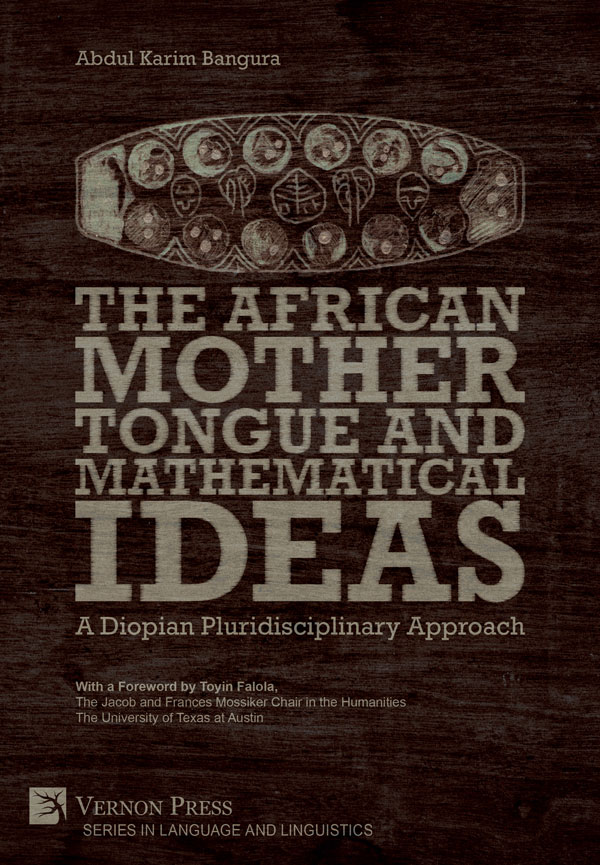
Abdul Karim Bangura’s new text has its roots deep into the socio-cultural science that has eluded Africa for so long. The colonial legacy has shattered the dreams and aspirations of African students on the continent who aspire to relate the study of mathematical science to their cosmological realities. The book demonstrates that the study of mathematics in Africa should be informed by, and anchored in the socio-cultural linguisticity of the continent since Mathematics as we know it was birthed in Kemet/Egypt. Without the marriage of linguistics and mathematics, computational science as we know it today will continue to be a pseudo-science for Africans because of the paucity of Afrocentricity in them.
Prof. Dr. Kehbuma Langmia,
Department of Strategic, Legal and Management Communication (SLMC), Cathy Hughes School of Communications
author/editor of Black/Africana communication theory
"The African Mother Tongue and Mathematical Ideas" uniquely and distinctly focuses on two very important points with a plethora of evidence. It eloquently appeals for the use and applicability of African languages in Mathematics education and the dire and urgent need for more sociopolitical research on language, teaching and the learning of mathematics.
Dr. Bangura challenges the exclusion of African languages in mathematics education. He provides a variety of ideas and critical perspectives of African languages in mathematics education and how the application of these languages in mathematics education will impact sustainable development in Africa.
The book goes beyond exploration. It illustrates, presents, highlights, and offers Africancentric perspectives in the understanding of and education of mathematics. The author methodically illustrates the important role of linguistics by outlining: Africancentricity research, Study of Linguistics and Mathematics, Semanticity, Cultural Transmission, Arbitrariness Discreteness Displacement, and The Role for Mathematicians in African Rennaissance.
This is a must read book and highly recommended for various practitioners, mathematics educators, teachers, students in various disciplines, and policy makers whose decisions impact educational curriculum.
This is a fascinating, invaluable and intriguing resource for mathematics education.
Dr. Onimi Wilcox
Lee College
Discover books that expand on the themes explored in this work—titles that engage with similar questions, intersecting disciplines, and complementary perspectives to deepen understanding and broaden the conversation.
Browse all titles
Jonathan O. Chimakonam and Fainos Mangena (Eds.)
View more
Jonathan O. Chimakonam and Edwin Etieyibo (Eds.)
View more
De-Valera NYM Botchway, Awo Sarpong, and Charles Quist-Adade (Eds.)
View more