Loading...
Please wait while we load the content...

Loading...
Please wait while we load the content...
American University Center for Global Peace
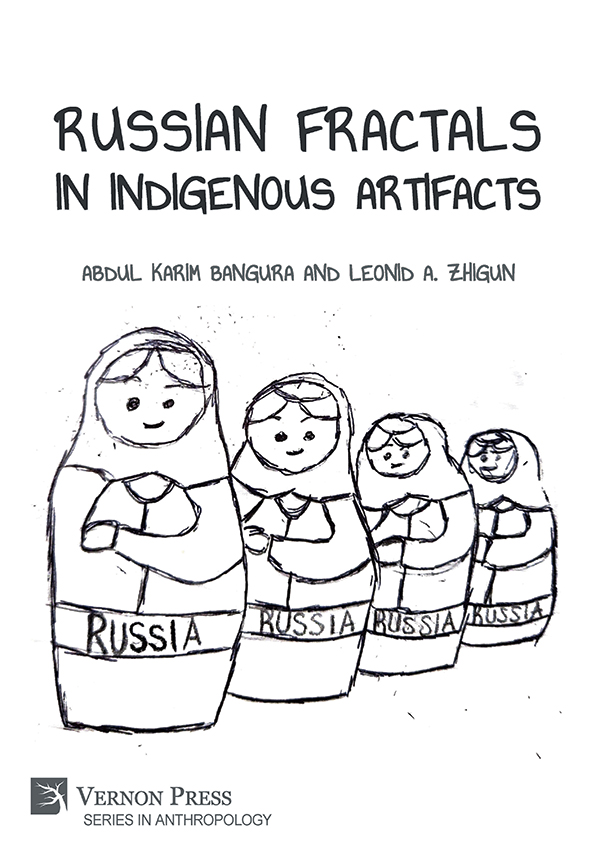
Abdul Karim Bangura and Leonid A. Zhigun
This book is the first comprehensive work on Russian Fractals in indigenous artifacts. While existing works focus on universal phenomena, such as liquid crystal or finance, none explore the intersection between Fractals and Russia. 'Russian Fractals in Indigenous Artifacts' therefore investigates how indigenous Russian cultures have a wonderful Fractal heritage that was originally tied to socially just and ecologically sustainable social practices, including those of indigenous northern groups such as the Yakut. Fractal designs originally allowed unalienated value, both human and nonhuman, to be visible, thereby enabling just and sustainable living. This book also examines how the tsarist elite encouraged the creation of unique creative masterpieces, developing and strengthening traditional crafts and art of indigenous people—hence, Fabergé, or imperial architecture. Today, the challenge for contemporary Russia is to reestablish the relationship between the social and ecological sustainability of indigenous cultures and practices, for which we can now provide modeling and analysis. Lay attempts at this have only limited success, as they have based the attempts on a purely religious basis, which recognizes the ecological aspects but often succumbs to authoritarian nationalism. However, the freely accession of indigenous peoples to Russia for the sake of national liberation has had a positive effect on enriching them with spirituality and creativity by Fractal artifacts through friendly exchanges with one another. In 'Russian Fractals in Indigenous Artifacts,' Bangura and Zhigun express why there is a need for a forward-thinking Fractal renaissance in Russia, bringing together contemporary computational and scientific analyses with these ecologically and socially sustainable traditions.
A Diopian Pluridisciplinary Approach
Abdul Karim Bangura
This book by renowned scholar Dr Abdul Karim Bangura combines linguistics and mathematics to show how and why African-centred mathematical ideas can be a driving force in Africa’s development efforts. Bangura explores the concept that Africa has been the centre of the History of Mathematics for thousands of years, as the civilizations that emerged across the continent developed contributions which would enrich both ancient and modern understanding of nature through mathematics. However, scholars and other professionals working in the field of mathematics education in Africa have identified a plethora of issues in carrying out their tasks. This is highlighted by one of the most compelling arguments in the book, which is that a major reason for these problems is the fact that the African mother tongues has been greatly neglected in the teaching of mathematics in the continent. Bangura asserts that a change has to be made in order for Africa to benefit from the exceptional opportunities mathematics offer, showing that, even if there is a great body of work connecting linguistics and mathematics, few analyses have been performed on the link between African languages and mathematics—and the ones that have been made are not theoretically-grounded on linguistics. Thus, the book begins by identifying the objects of study of linguistics and mathematics, and delineates which ones they have in common. Next, since the object of study of linguistics is language, the nine design features of language are employed to examine each of the objects as it pertains to African languages. After that, mathematical ideas of sustainability and those of tipping points are suggested as means to help Africa’s development efforts.