Loading...
Please wait while we load the content...

Loading...
Please wait while we load the content...
Stay informed about our latest publications, calls for proposals, and special announcements. As a subscriber, you'll also enjoy exclusive member discounts of 10%-20% on all orders. Join our community of scholars, librarians, and readers today.


Availability
In stock
ISBN
9781622736232
Edition
1
Publication Date
September 3, 2019
Physical Size
236mm x 160mm
Number of Pages
144
Currency
Quantity
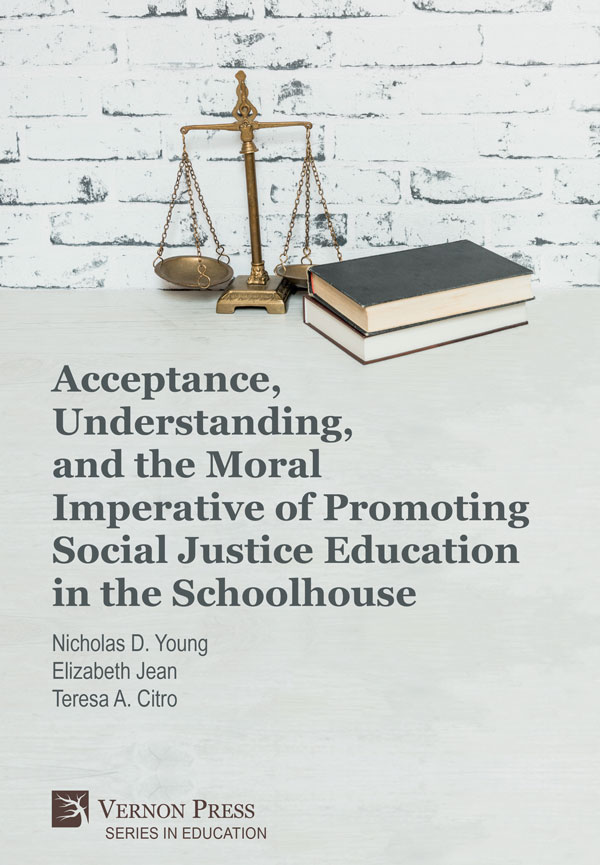
The term ‘social justice’ has become cliché and overused. 'Acceptance, Understanding, and the Moral Imperative of Promoting Social Justice Education in the Schoolhouse' offers a fresh look at the concept of equity between students regardless of race, ethnicity, gender, and other defining characteristics. The book takes a brief look at the fundamentals of social justice as well as federal law before turning to the more important job of identifying students and the benefits that social justice can bring to each and every individual. Strategies and approaches are included for the educator, parent, and professor alike, leaving the reader with an understanding of how social justice education can change the next generation of student.
Richard B. Holzman, Ed.D.
Senior Advisor for External Affairs
University of Massachusetts-Amherst and Springfield, MA
Superintendent of Schools, retired, Ware Public Schools, Ware, MA
'Acceptance, Understanding, and the Moral Imperative of Promoting Social Justice Education in the Schoolhouse' offers a solution to the daunting and sometimes overwhelming problems of discrimination and inequity in the classroom. The importance of home-school partnerships as a means to increase family buy-in as well as how educators can improve their personal craft using a social justice lens are addressed. The authors discuss how to use both the Common Core and social justice simultaneously in the classroom as well as how assessment bias plays a role in student performance. This book is of benefit to all educators who wish to dig in a bit deeper into social justice and begin to include more equitable strategies in the classroom.
Judith L. Klimkiewicz, Ed.D.
Senior Consultant for K-12 College/Career Education and Workforce Development
Commissioner's Office
Massachusetts Department of Elementary and Secondary Education
Superintendent of Schools, retired, Nashoba Valley Technical School District, MA
Social justice education is still somewhat in its infancy in America despite the diversity that has existed for hundreds of years. To that end, 'Acceptance, Understanding, and the Moral Imperative of Promoting Social Justice Education in the Schoolhouse' offers a close look at the possibilities that exist for students who find themselves in the classroom with a teacher who believes in teaching fairly despite the innate difficulties that come with that curriculum. The authors especially look at students who have academic and social challenges, those who are ethnically different, and those whose families may have come together by choice not chance. Equally as important are the students who may have differences in gender or sexual orientation; yet, the authors are clear – all children matter, all children deserve to learn, and all children can benefit from a curriculum rich with equity and understanding.
Anne E. Mead, Ed.D.
Director of Family, School, and Community Partnerships
Danbury Public Schools
Discover books that expand on the themes explored in this work—titles that engage with similar questions, intersecting disciplines, and complementary perspectives to deepen understanding and broaden the conversation.
Browse all titles
Nicholas D. Young et al.
View more
Elizabeth J. Bienia and Teresa A. Citro
View more
Nicholas D. Young et al.
View more