Loading...
Please wait while we load the content...

Loading...
Please wait while we load the content...
Stay informed about our latest publications, calls for proposals, and special announcements. As a subscriber, you'll also enjoy exclusive member discounts of 10%-20% on all orders. Join our community of scholars, librarians, and readers today.


Availability
In stock
ISBN
9781622735327
Edition
1
Publication Date
May 2, 2019
Physical Size
236mm x 160mm
Number of Pages
226
Currency
Quantity
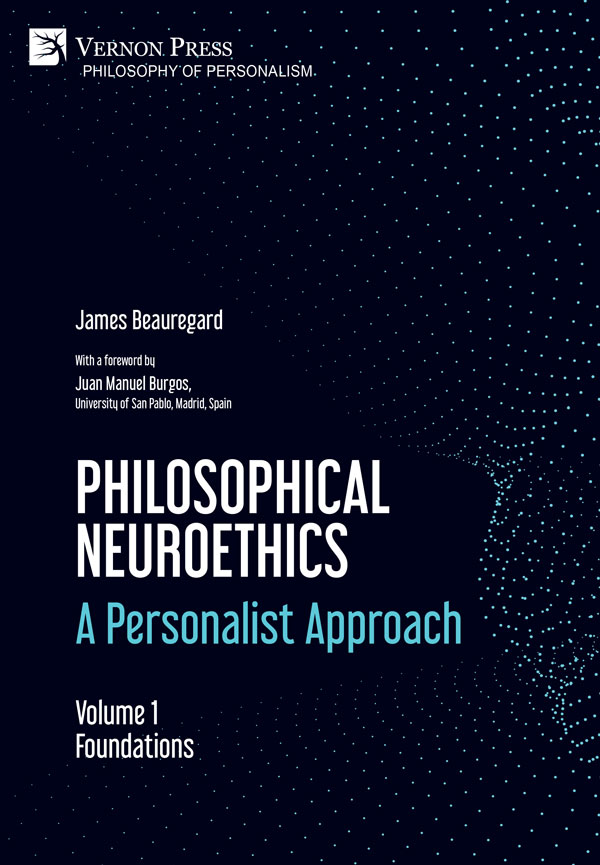
'Philosophical Neuroethics: A Personalist Approach' is an essential and interesting book. It deals with a topic that is in the center of attention of the contemporary scientific community but at the same time raises many questions in humanities. James Beauregard presenting neuroethics in the light of philosophy helps us to understand that this theme concerns the whole human being and not only part of it (i.e., brain, neurons, and neural systems). He points out that neuroethics is about the human person and an adequate grasp of the latter may lead us to understand the proper role of the former. In the book, the author tries to reconcile sciences and humanities, at least to a limited extent. By doing that he saves from a continually expanding gap between what sciences informs us about and what we know about ourselves from thinking and deliberation. Looking from the other side, Beauregard’s book makes us realize that the philosophy of the human person is very promising and may offer us new perspectives when it is conducted in a close relationship with exact sciences. 'Philosophical Neuroethics: A Personalist Approach' broadens our perception of who we are, and hence I highly recommend it.
Grzegorz Holub
Professor of Philosophy, The Pontifical University of John Paul II, Cracow, Poland
James Beauregard’s book "Philosophical Neuroethics" offers a refreshing and original perspective on contemporary neuroethics. Arguing that the empiricist philosophy and consequentialist ethics which form the basis of much current neuroethics are inadequate to the task, Beauregard sets out to develop a more adequate philosophical foundation drawing on personalist philosophy and virtue ethics.
Beauregard sets out to advocate this personalist approach to a wide-ranging readership, including general readers and those whose training is predominantly neuroscientific rather than philosophical. In order to do so, he presents a broad sweep of Western philosophical history from antiquity to the present and does so clearly and accessible.
As Beauregard persuasively argues, this offers an attractive alternative to an often philosophically impoverished contemporary neuroethical discourse.
Neil Messer BSc, MA, PhD, FHEA
Professor of Theology, Department of Theology, Religion and Philosophy, University of Winchester, UK
In “Philosophical Neuroethics: A Personalist Approach”, James Beauregard exposes the fundamental philosophical knowledge that is required to understand the main neuroethical issues and concerns. Beauregard advocates for a Personalistic posture and thus addresses the human person as a unity and as a bio-psycho-socio-cultural-philosophical being with transcendental dimensions and capabilities. The author analyzes the risks of alienating neuroethics from personalism, and the caveats of utilizing a centered materialistic neuroethics that many times, could infer neuro-determinism and neuro-reductionism, among others. This book acknowledges the importance of an interdisciplinary and conciliatory approach (beyond the material and organic) to embrace the person as a correlational being and not as a being of causality, inclusive of transcultural differences -which is of utmost importance in an era of globalization-. It also focuses on the philosophical reflections of development, risks, harms, limits, and potential of current neuroscience and neurotechnology, as well as our relationship as human beings, with these advanced tools and techniques.
Neuroethics, as a field in constant development dedicated to the understanding of crescent neuroscientific data and the implications for medicine, human life and human flourishing, ethically sound methods and methodologies are needed. Beauregard’s agenda is directed towards this aim.
Dr. Karen Herrera Ferrá
Founder and President of the Asociación Mexicana de Neuroética, Mexico; Neuroethics Studies Program- PCCB, Georgetown University Medical Center, USA
Discover books that expand on the themes explored in this work—titles that engage with similar questions, intersecting disciplines, and complementary perspectives to deepen understanding and broaden the conversation.
Browse all titles
Simon Smith and James Beauregard (Eds.)
View more
Simon Smith and Anna Castriota (Eds.)
View more