Loading...
Please wait while we load the content...

Loading...
Please wait while we load the content...
Stay informed about our latest publications, calls for proposals, and special announcements. As a subscriber, you'll also enjoy exclusive member discounts of 10%-20% on all orders. Join our community of scholars, librarians, and readers today.


Availability
In stock
ISBN
9781622734337
Edition
1
Publication Date
April 30, 2019
Physical Size
236mm x 160mm
Illustrations
20 Color
Number of Pages
368
Currency
Quantity
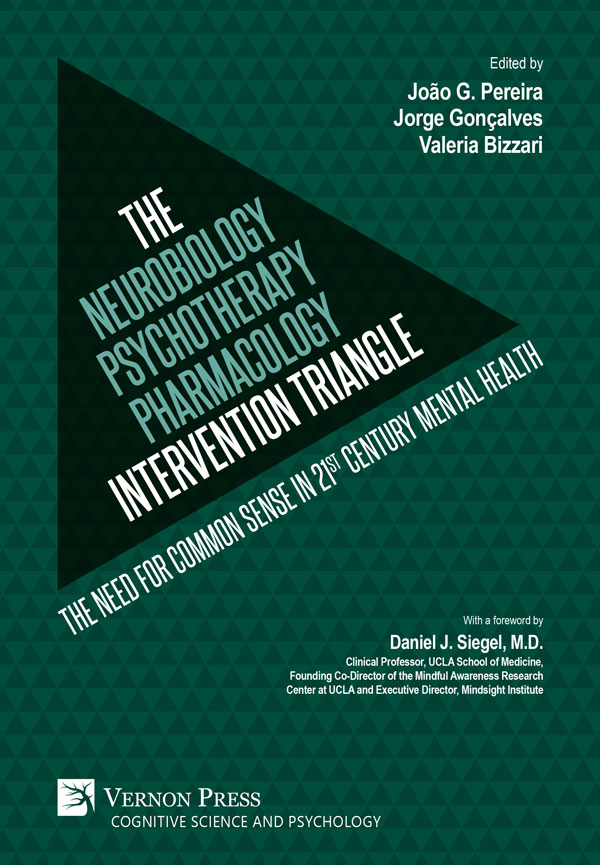
Without pretensions to the theory of everything and to the supreme algorithm, this book presents a sensible rational and a healthy effort to integrate current knowledge and to open the horizons of research in the territory-process of mental health and mental illness, its origin and its destiny, mode of understanding and art-science in response to their impasses and challenges.
By proposing a "Triangle Intervention," the self-regulated and autopoietic dynamic system of the human relationship is conceived and managed by reason of the imbricated sequential development and with frequent and fertile “loops” in the course of biogenic, sociogenic, and idiogenic factors-vectors , giving special emphasis to the latter because they are dependent on the neural networks of representation and generation - memory and imagination, nostalgy and hope, history and creativity - of the subject and agent of action. As if Man was not the first constructor of the Universe of Culture; and the investigator-therapist, his most lucid interlocutor. Because to investigate is to ask questions on reality, the authors of this volume have to emphasize a thinking thought, which asks - not, the already thought of the repeater - and an intellectual humility that meets the critic and seeks the debate; thus correcting error and enabling the construction of truth, always relative and provisional as long as life and work exist.
So this set of texts serves those who want to learn and produce knowledge; not to anyone who wants to accumulate and display knowledge. To paraphrase Rorty, this is the recipe abstracted from its reading: if we cultivate freedom, truth will avenge itself. And finally, do not be afraid to dare.
António Coimbra de Matos, Psychiatrist and Psychoanalist
"The Neurobiology - Psychotherapy – Pharmacology Intervention Triangle" presents what may be called an outline of future psychiatry, based on an ecological view of mental illness, on a democratic approach to treatment, and on a non-reductive view of neurobiology. From interdisciplinary and interrelated perspectives, the authors of the volume describe an ensemble of interventions that are suitable to replace the dominance of biological approaches, without denying the need to integrate pharmacologicial treatment into a person-centered psychiatry. To this purpose, several chapters describe the theoretical foundations of a circular interaction of biological, psychotherapeutic, and social network processes in which the patients are involved. Further chapters present a variety of approaches such as recovery-based practices, open dialogue and other social communicative interventions that may enhance the patients’ long-term social and mental well-being. A final part on phenomenology, existentialism and psychoanalysis integrates the traditional humanistic approaches into the outline of a person-centered, truly humane psychiatry. In sum, the volumen presents a multi-faceted, original and engaged collection of contributions which together constitute a major step forward for the whole field.
Prof. Thomas Fuchs
Karl Jaspers-Professor of Philosophy and Psychiatry
Head of the Section Phenomenological Psychopathology
Psychiatric Department, University of Heidelberg
Discover books that expand on the themes explored in this work—titles that engage with similar questions, intersecting disciplines, and complementary perspectives to deepen understanding and broaden the conversation.
Browse all titles
Joao Eduardo Kogler Jr., Frederick Adams, and Osvaldo Pessoa Jr. (Eds.)
View more