Loading...
Please wait while we load the content...

Loading...
Please wait while we load the content...
Stay informed about our latest publications, calls for proposals, and special announcements. As a subscriber, you'll also enjoy exclusive member discounts of 10%-20% on all orders. Join our community of scholars, librarians, and readers today.
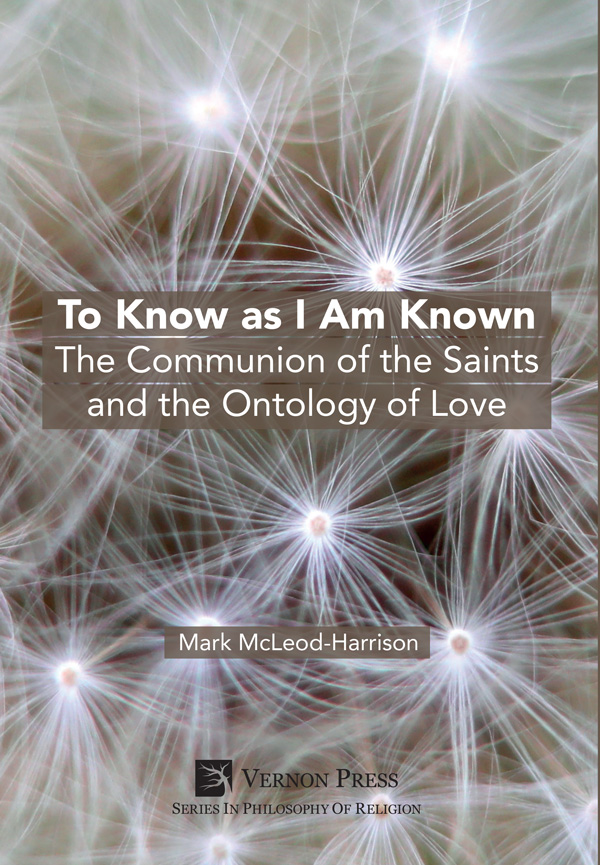

Availability
In stock
ISBN
9781622733880
Edition
1
Publication Date
August 5, 2018
Physical Size
236mm x 160mm
Number of Pages
276
Currency
Quantity
"McLeod-Harrison has given us a wonderful book, diving into deep waters. These reflections on the nature and possibility of Christian love and the communion of saints are rich, powerful, and insightful. And they are much needed in our individualistic age, where many have lost sight of the importance of the common good. The account he gives of the connections between love, morality, self-interest, and human fulfillment is of special interest."
Dr. Michael W. Austin, Eastern Kentucky University
“In his new book, Mark McLeod-Harrison helps us to make sense of the doctrine of the communion of saints, which has been surprisingly neglected by contemporary philosophers and theologians. Along the way, we find intriguing discussions of sin, love, humility, and self-interest, among many other topics. Highly recommended!”
Dr. Christian B. Miller,
A. C. Reid Professor of Philosophy, Wake Forest University
“Who are we and where are we going? What kind of people are we now, and what kind of people will we become? The Christian hope for humanity emphasizes our potentiality for enduring goodness in communion with God and others, but how is this possible? McLeod-Harrison brings conceptual tools and recent debates from analytic philosophy to bear on these questions, providing an ontological framework for understanding how we might one day become united with God and one another in love. Along the way, he explores the nature of personal identity and character, self-interest and love, free choice and social constitution, fallenness and the image of God, all with reference to Christian teachings Eastern and Western.” “The book is wide ranging and original in combining the insights of analytic philosophers and Christian theologians to address questions of enduring interest. I would predict that it will be of interest mainly to Christian philosophers interested in developing a coherent picture of heaven, but also to some Christian theologians who are interested in analytic philosophy.”
Scott A. Davison
Morehead State University
Discover books that expand on the themes explored in this work—titles that engage with similar questions, intersecting disciplines, and complementary perspectives to deepen understanding and broaden the conversation.
Browse all titles