Loading...
Please wait while we load the content...

Loading...
Please wait while we load the content...
Stay informed about our latest publications, calls for proposals, and special announcements. As a subscriber, you'll also enjoy exclusive member discounts of 10%-20% on all orders. Join our community of scholars, librarians, and readers today.


Availability
In stock
ISBN
9781622733248
Edition
1
Publication Date
April 6, 2018
Physical Size
236mm x 160mm
Number of Pages
188
Currency
Quantity
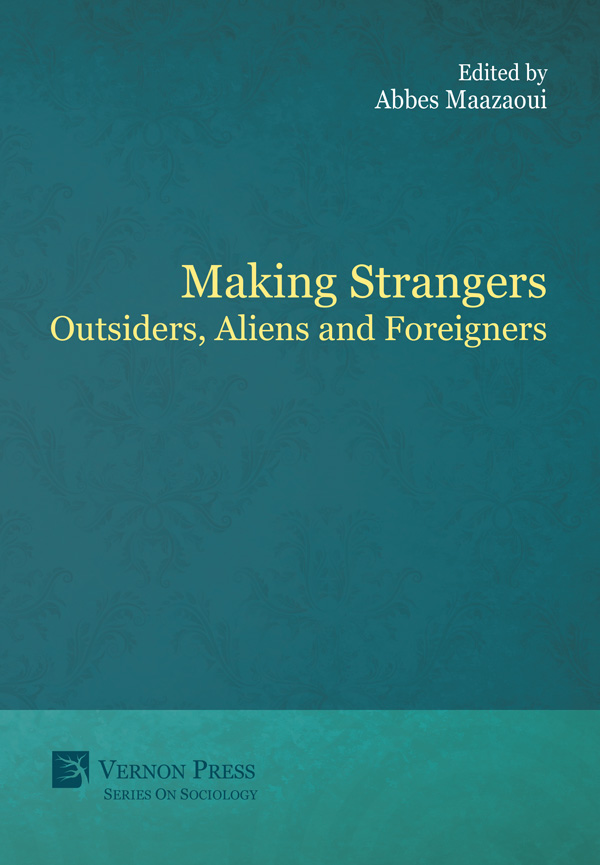
For this collection of essays, Abbes Maazaoui has chosen a theme of clear relevance to current events: the movement of masses of people from one culture to another has become, in the 21st century, a pressing topic across the globe. The phenomenon can be problematic for those who are uprooted and to whom Maazaoui’s terms—strangers, outsiders, aliens, foreigners—are applied, and, as well, for those who apply these terms to their new fellow citizens. To explore dimensions of this global problematic, Maazaoui has secured contributions from scholars located across the United States and from Canada, France, Taiwan, and Australia. Two articles focus directly upon the contemporary situation: the predicament of the DREAMers (children brought illegally into the country) in the United States and the “crisis of hospitality” as France struggles to align its republican ideals with its response to recent immigrants and asylum seekers. Most of the scholars focus their contributions upon specific literary texts; employing a variety of approaches, they interrogate these texts to reveal implications for the complex problems of national identity and immigrant experience that are vexing the Western world in the first decades of this century.
It is the volume’s diversity that is most impressive: the diversity of the contributors, but especially the diversity of the texts that they examine, which range from a Shakespearean contribution to Sir Thomas More (1603), to an 1833 Spanish novel set in the Middle Ages by the Duke of Rivas, to a 2014 British novel set in 2008 by the Bangladesh-born Zia Haider Rahman. Each scholar reads the chosen text as a literary construct, but also as a document that reveals ways of thinking about the experiences of strangers in strange lands. The social and political dimensions of those experiences, whether they transpire in medieval Spain, Renaissance England, or contemporary Asia, Europe, and North America, are shown to cast light upon difficulties faced by today’s massive migrations: by the challenges confronting the migrants themselves, but also by the challenges confronting the various cultures to which (and from which) they have migrated. Making Strangers is thus a most timely volume of social and literary criticism.
Dr. J.K. Van Dover
Fulbright Professor, American Studies, Comenius University, Slovakia
With the extraordinary – but oh so logical – premise that no one is a stranger by nature, but becomes one, is made out to be one, "Making Strangers: Outsiders, Aliens and Foreigners" examine, through language, literature, geography and the concept of identity, the nature, past and present, of this foreignness, a series of contemporary and universal interrogations that could not come at a better time here. From 16th century England to 19th-century Spain to today’s France, we learn, in the first section, that language has often been used as a political weapon to shame, manipulate and colonize the Other. Given the broad range in time and space of this section, this first part proves to be particularly strong, academically, and the authors of the five well-researched articles succeed here in joining history, fiction and reality, a mix which proves to be eminently interesting and useful. The following two sections, particularly the second one, on “alien geographies”, concentrate on the idea of representation in its various expressions in the field of literature, while always keeping in mind the notion of reality, which the reader can never help referring to, consciously or not. This is where Prof. Maazaoui’s Introduction proves to be particularly useful, because of the wide variety of literary references which could easily lose the reader; this well thought and concise introduction can and should, therefore, be used a guidebook, so the direction of the book is never forgotten. The third section, on “trouble identities”, despite having only three articles, efficiently create this perilous link between reality and fiction, between literature and everyday life. Amandine Guyot’s text on Conan Doyle is particularly brilliant in linking one famous detective and the concept of British imperialism and foreignness.
Overall, this collection of essays proves to be a shocking voyage to the burning frontiers of identity and current affairs, where the foreigners are not always the ones you think.
Dr. Jean Levasseur
Bishop's University, Canada
The book is a compelling read for anyone who is seeking a grounded explanation for the complexities that haunt today’s world but has not looked into literature for answers. Through a well-researched selection of articles by renowned scholars from all over the world, this book looks at the concept of strangeness as a made-up convention and presents a unique approach to our understanding of issues like immigration, genocide, colonization, nationalism, undue labeling of others, cultural identities, the refugee crisis and Brexit. In effect, one of the book’s strongest points is its wide-reaching and well-thought-out analysis of concepts like the use of language as a weapon of power, the identities of those who live between two cultures and the negative labeling of others as strangers, outsiders, foreigners and aliens.
Although the book accomplishes its goal of shedding light on the age-old complexities of humankind, the work must be continued with further publications. Strangeness is a recurring theme in literature, and this constitutes a unique opportunity to understand, and possibly reconsider, how we as humans behave at a personal, social, economic and political level.
Professor María Isabel Charle Poza
Lincoln University, USA
This timely book, 'Making Strangers', with an insightful Introduction by Abbes Maazaoui, is organized according to four denominations: Strangers, Outsiders, Aliens, and Foreigners. Twelve essays, very well researched, treat the problems of “difference” in relation to the identity of the self. The three parts are very well structured around “Languages of power,” “Alien geographies,” and “Troubled identities.” A historical perspective balances the problems and events of today. Indeed, this book discusses in depth what A. Khatibi calls “the untreatable Difference,” or what I have called “the otherness of others.” The displacement of people and the actual phenomenon of immigration have given way to a systematic redefinition not only of the notion of identity but of the immigrants who are transplanted, moving from one region or locale to another. In his Introduction, Maazaoui emphasizes the human “urge to categorize” what we do not understand. The "Us" and "Them" have always been categorized in terms of power, movement, politics and geography, and in relation to social, ontological, literary, national and international themes. The diversified texts of the book and their varied approaches shed new light on this contemporary burning issue. I highly recommend it for its diverse angles of vision on the problematic of the “outsider."
Prof. Dr. Hédi Bouraoui
York University, Canada
Discover books that expand on the themes explored in this work—titles that engage with similar questions, intersecting disciplines, and complementary perspectives to deepen understanding and broaden the conversation.
Browse all titles
Adam Bednarczyk and Magdalena Kubarek (Eds.)
View more
Désirée Cappa, James E. Christie, Lorenza Gay, Hanna Gentili, and Finn Schulze-Feldmann (Eds.)
View more