Loading...
Please wait while we load the content...

Loading...
Please wait while we load the content...
Stay informed about our latest publications, calls for proposals, and special announcements. As a subscriber, you'll also enjoy exclusive member discounts of 10%-20% on all orders. Join our community of scholars, librarians, and readers today.


Availability
In stock
ISBN
9781622732876
Edition
1
Publication Date
October 31, 2017
Physical Size
236mmx160mm
Number of Pages
169
Currency
Quantity
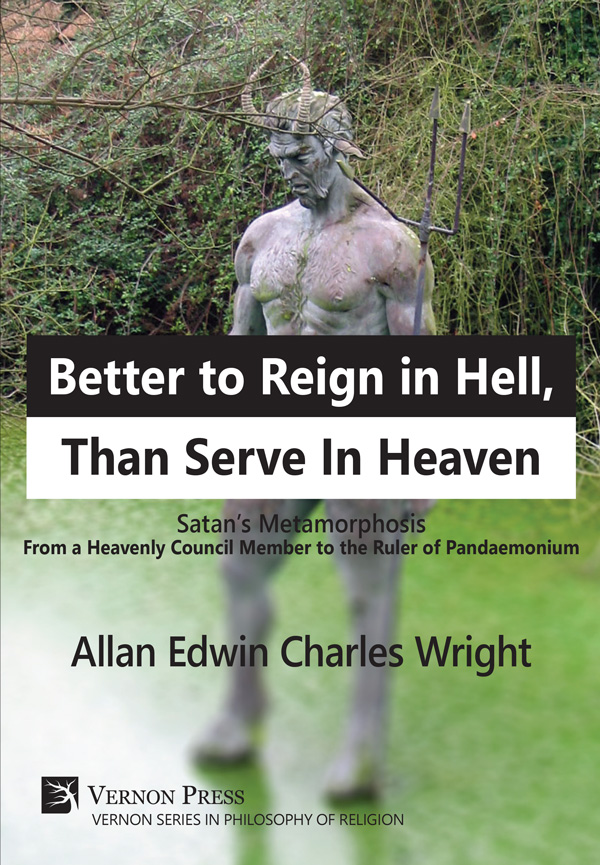
"Wright's book adeptly surveys the character Satan in ancient literature converging upon the Christian reconstruction in the First to Third Centuries CE. The quality of Wright's scholarship shines when he applies Smith's analytical framework of "Here, There, Anywhere," to the conceptual category of Satan providing explanation and understanding to the re-scripting of the mythic character, Satan, in literature. This book is a perfect volume for someone simply interested in learning more about the development of Satan in literature or for a university-level class exploring character constructions in Christian literature. More than illuminating the construction and reconstruction of the mythic character, Satan, Wright's scholarly impact, through utilizing Smith, explains the reason why these reconstructions occurred. Thus, providing a fresh and original approach to this area of study. Wright's book lays the ground work for more in-depth studies on the character Satan within in specific cultural contexts, for instance, the Pauline reconstruction in a First Century Roman Corinthian cultural context."
Dr. Mark Wheller, MacEwan University, Canada
"It is often assumed, both in popular understandings as well as in scholarly works, that the image of Satan has always been that of a universal malevolent deity. Allan Wright in his ground breaking book, Better to Reign in Hell, Than Serve In Heaven: Satan's Transition From a Heavenly Council Member to the Ruler of Pandaemonium, diverges from this common assumption and challenges often taken for granted views about the role of Satan in early Christian groups. Looking at a rich archive of texts from as early as the 1st century CE, while taking into account the broader social context in which those texts were written, Wright is able to demonstrate that the image of Satan went through a series of transformations. Furthermore, he is able to offer a plausible theory as to why, how, and by whom the image of Satan developed in the ways it did. Certainly, Wright’s book will be of great interest to a wide variety of audiences, and especially those who are interested in the development and identity formation of early Christian groups."
Vaia Touna, Department of Religious Studies, University of Alabama
"Provocative and insightful, Allan Wright’s research is crucial reading for those researching Satan within the landscape of early Christian societies. Offering a comprehensive overview of ancient texts ranging in time and space from Babylon to Rome to Alexandria, Wright argues that the figure we think of today as Satan, as God’s singular and archetypical cosmic nemesis, did not coalesce until the latter part of antiquity, when the real world enemies of Christianity began to wane in power and influence. Scholars will find points of disagreement with his readings of this text or that, but such disagreements are inevitable with a work that commendably covers such a broad range of material and issues with concision. This book makes a noteworthy contribution to scholarship on the history of Christianity."
Dr. Ian Douglas Wilson, University of Alberta, Canada
"In this learned and lucid volume, Allan Wright accomplishes something new: a critical, wide-ranging and colorful biography of Satan and his many transformations from his appearance in ancient near eastern literature to the fourth century of the Christian era. It turns out, Wright argues, that many previous biographers and historians of the Satan story did not get it right. The myth of Satan is much more complex than the dominant figure of popular and much scholarly discourse in which he figures as the ultimate evil deity. Not until late Christian antiquity was Satan imagined as the universal cosmic symbol of evil. Wright’s argument deserves to be read for its theoretical sophistication and its intricate elucidation of ancient myth-making."
Professor Willi Braun, Department of History and Classics, University of Alberta, Canada
Discover books that expand on the themes explored in this work—titles that engage with similar questions, intersecting disciplines, and complementary perspectives to deepen understanding and broaden the conversation.
Browse all titles