Loading...
Please wait while we load the content...

Loading...
Please wait while we load the content...
Stay informed about our latest publications, calls for proposals, and special announcements. As a subscriber, you'll also enjoy exclusive member discounts of 10%-20% on all orders. Join our community of scholars, librarians, and readers today.



Availability
In stock
ISBN
9781622732074
Edition
1
Publication Date
June 15, 2017
Physical Size
236mm x 160mm
Number of Pages
366
Currency
Quantity
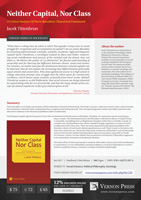
" What does a ruling class do when it rules? Does gender trump class in social struggle for recognition and accumulation of capital? Can we praise Bourdieu for inventing informational, scientific, symbolic, academic, legal and linguistic capital? Jacek Tittenbrun, a sociologist trained on Marx and Weber, researching social stratification and poverty of the nickeled and the dimed, does not think so. He blames the author of “La distinction” for flawed understanding of ownership and for blurring the difference between classes, strata and estates. For instance, no matter how fine the distinctions between cultural capitals can be observed, they do not explain the increasing class differentiation of formally equal schools and universities. Why does egalitarian access to a high school or college education prompt class struggle and the elitist quest for meritocratic excellence, which leaves many students, primarily from lower strata, behind? Tittenbrun suspects, as did Wallerstein, that social sciences are being colonized by capital along with the rest of social life, and that the many shades of the concept of cultural capital are in fact grey and not green at all."
Slawomir Magala,
Erasmus University Rotterdam and Jagiellonian University Cracow
" This is the most complete and systematic critical analysis of Pierre Bourdieu's theory of social structure. Tittenbrun's discussion of the types of capital and of reproduction, in particular, are the best I have seen. His criticism extends also to the work of Levi-Strauss, Bourdieu's mentor; and of economists and other social scientists, from Bohm-Bawerk and Clark on, who have conceptualized capital and other categories used by Bourdieu. As was the case with a predecessor in this genre, Engels' Anti-Duhring, the critique of Bourdieu serves Professor Tittenbrun as a basis for a coherent statement of his own theoretical position, in this instance in relation to capital and other core concepts of economic sociology."
Carlos H. Waisman,
Professor, Department of Sociology, University of California, San Diego
Discover books that expand on the themes explored in this work—titles that engage with similar questions, intersecting disciplines, and complementary perspectives to deepen understanding and broaden the conversation.
Browse all titles
Enrico Attila Bruni, Laura Lucia Parolin, and Cornelius Schubert (Eds.)
View more