Loading...
Please wait while we load the content...

Loading...
Please wait while we load the content...
Stay informed about our latest publications, calls for proposals, and special announcements. As a subscriber, you'll also enjoy exclusive member discounts of 10%-20% on all orders. Join our community of scholars, librarians, and readers today.
Availability
In stock
ISBN
9781648894756
Edition
1
Publication Date
September 20, 2022
Physical Size
236mm x 160mm
Illustrations
42 Color
Number of Pages
299
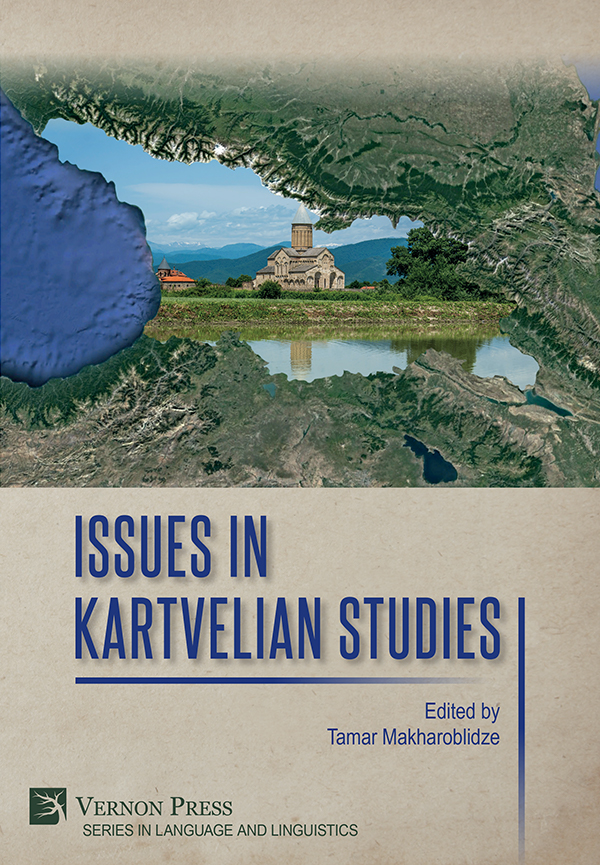
The Caucasian Republic of Georgia is a veritable paradise for linguists and folklorists. Unfortunately, few know this. Fortunately, Makharoblidze (Ilia State University) created the key to this paradise: the twelve articles in her “Issues in Kartvelian Studies” guide us through this tantalizing paradise. The book starts with a comprehensive article on the history of Georgian dialects—some outside Georgia—and another about their interrelations and relations with non-Georgian languages, incorporating recent findings and theories. Several articles discuss the Georgian literary language: its ergative case system still poses questions, as do its morphosyntactic predictability and its expressions of space, location, negation and its relative pronouns, all of which are the subject of perceptive articles. An article about Georgian Sign Language, which replaced a Russian Sign Language unsuitable for non-Russians, interestingly includes facial expressions. We also find a helpful overview of Georgian dictionaries, beginning in the 11th century! We then learn about the creation of the Georgian national language, its problems beginning in Tsarist times through the Soviet period and now continuing in dealings with minorities. Finally, there is a fascinating and wide interview with a ‘tav-khevisberi’ (chief priest) about what could be described as the Georgian Paganism of the northeastern highlands, followed by a detailed article on the influence of the Georgian Church.
Prof. Dr. Bert Beynen
Temple University
The volume offers original and fascinating investigations into a broad spectrum of topics in Kartvelian Studies. Contributions by renowned scholars in the field of Kartvelology explore historical and dialectal as well as synchronic perspectives on Kartvelian languages, including Georgian, Mingrelian and Laz. Georgian sign language is studied in one chapter. The book is of interest to readers also outside the field of Kartvelology. Specialists in typological and digital linguistics, psycholinguistics and sociolinguistics will discover contributions in their areas of specialization. In addition to Kartvelian linguistics, the volume embraces religious topics, such as traditional religious practices in the Georgian highlands and the role of the Georgian Orthodox Church in state and nation building, from earliest times and to the present day. This empirically rich volume with explorative and well-argued analyses is stimulating reading for those who want to gain further understanding of linguistic, historical and religious perspectives on this complex region.
Karina Vamling
Professor of Caucasus Studies
Malmö University, Sweden
Discover books that expand on the themes explored in this work—titles that engage with similar questions, intersecting disciplines, and complementary perspectives to deepen understanding and broaden the conversation.
Browse all titles
Esther Monzó-Nebot and Juan Jiménez Salcedo (Eds.)
View more
Brandon M. A. Rogers and Mauricio A. Figueroa Candia (Eds.)
View more