Loading...
Please wait while we load the content...

Loading...
Please wait while we load the content...
Stay informed about our latest publications, calls for proposals, and special announcements. As a subscriber, you'll also enjoy exclusive member discounts of 10%-20% on all orders. Join our community of scholars, librarians, and readers today.


Availability
In stock
ISBN
9781648894411
Edition
1
Publication Date
September 6, 2022
Physical Size
236mm x 160mm
Illustrations
67 Color
Number of Pages
227
Currency
Quantity
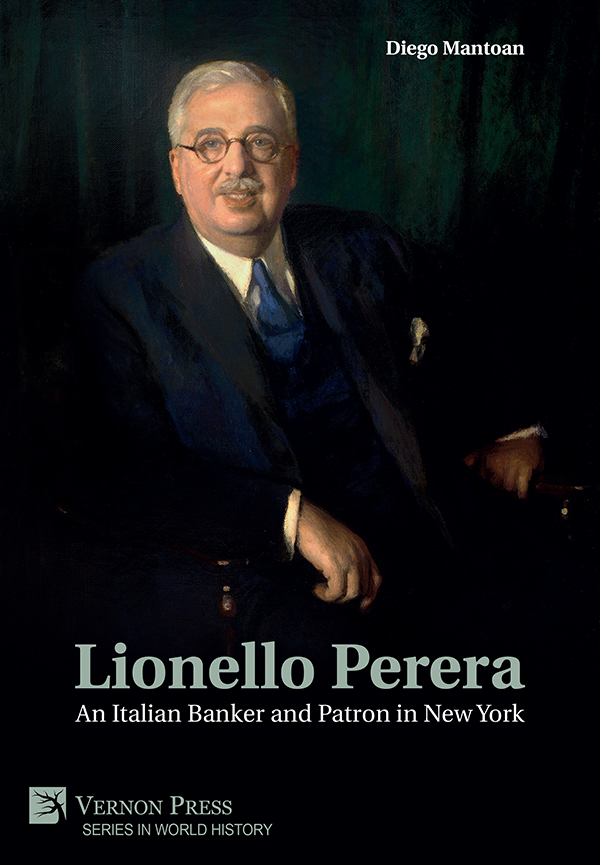
Diego Mantoan has penned a well-researched and engaging biography of the Italian American banker Lionello Perera. Scholars of immigration, New York City history, and especially the story of Italian immigration to New York will want to read this book. Mantoan’s account of Perera’s cultural and artistic activities is accompanied by reproductions of Perera’s drawings and art collection, which are extraordinarily evocative of his world.
Perera, who came from an Italian-Jewish family in Venice, is an important but atypical figure, a graduate of one of Italy’s first business schools in Venice (today’s Università Ca’ Foscari), founded in 1868 as part of an unsuccessful effort by the Italian government to revive Venice as a major port and financial center. The university itself has been a great success and today enjoys a global reputation and is one of the few strong non-touristic institutions in the city. I found the chapter on Perera’s time as a student in Venice, on how the Italian state was building up institutions while unfortunately exporting talent, fascinating. Italy is an unusual country in that Italian identity was created as a diasporic identity of people with a common language before (or arguably at the same time as) that identity became strong among people in the several states who lived in the ‘Stivale’ (the Boot). Mantoan shows how Perera’s liberal political identity was rooted in his family's opposition to the Austrian occupation of Venice and his uncle's escape to America to avoid conscription into the Austrian army. Mantoan astutely shows how this liberalism, developed in the early decades of the Kingdom of Italy, would translate into support for progressive Italian Americans, such as Fiorello La Guardia, who opposed Mussolini, despite is popularity among many Italian Americans, and a clear, but carefully expressed opposition to the fascist regime in Italy. Mayor La Guardia, who had known Perera since World War I, appointed him to the NYC Child Welfare Commission, where he continued his work helping immigrant communities.
Many Italian immigrants came to New York with little money and took some of the city’s most dangerous construction jobs: working underground as sandhogs or sanitation workers. Perera joined the New York banking firm of his uncle, Salvatore Cantoni, who had paid for his education as a businessman. In a drama worthy of ‘Dynasty or Succession,’ Perera succeeded in pressuring and buying out Cantoni’s non-Italian socialite sons-in-law to maintain control of the bank. Additional chapters explore the evolution of that banking business as a trusted repository for Italian American immigrants in the age before Federal Deposit Insurance. In 1924, Perera had to stop a run on the East Harlem branch that an anonymous phone call had started. Mantoan speculates tantalizingly on who was to blame for starting the false rumor, noting the involvement of the Tammany police commissioner, Richard Enright, on the board of a rival Italian bank, but I wish he had followed up more. Some recent literature has examined the importance of dominating local immigrant banks to maintain Tammany’s political hegemony. Enright was renowned for his toleration of the vice trade, part of the collaboration between Tammany and Italian organized criminals, who gained strength during the era of Prohibition, and came to dominate the Democratic Party-political machine, which they largely bankrolled between the ‘20s and the ‘50s.
After the bank run incident, Perera diversified his banking business and developed a close business relationship with Amadeo Peter Giannini, the founder of the Bank of America, and the Perera Bank became part of Giannini’s national bank holding company prior to a hostile takeover by the First National City Bank in the 1930s that forced Perera into retirement.
There was much more to Perera and his wife Carolyn Allen than banking. They were civic leaders of the Italian American community and raised money for the war effort in WWI and the Italian Red Cross, as well as for welfare organizations that provided relief to Italian immigrants. Leonello and Carolyn were both extraordinarily cultured artists, collectors, and patrons, close friends of celebrated figures such as Enrico Caruso (who drew a caricature of Perera that is in the book) and Arturo Toscanini (drawn by Perera in a wonderful caricature that is also reproduced. Some of Perera’s extraordinary drawings are lovingly displayed and discussed in this volume, and they are a treat, as are the reproductions of his art collection, which included a Bruegel and a beguiling self-portrait of Lorenzo Lotto. Mantoan, himself an art historian and an ‘impresario,’ is most in his element discussing this fascinating dimension of the Perera’s place in the cultural and collecting world of New York City.
Jonathan Soffer
Professor of History
Department of Technology, Culture & Society
NYU Tandon School of Engineering
Associated Faculty, NYU Department of History
Diego Mantoan’s book has the privilege of being the first publication to recount the life and works of Lionello Perera.
Perera, who was an Italian from Venice, emigrated to the United States in the late 19th century. Shortly after his arrival in America, he co-founded the Bank of America. Mantoan’s biography arouses interest in its readers by describing Perera’s tireless commitment to philanthropy and art collection. What emerges from reading the book and constitutes one of the most interesting elements is that Perera went to great lengths to overturn the negative image of Italian immigrants. Equally praiseworthy is Mantoan’s attention to the documentation of written and iconographic sources. The availability of these sources results from an extensive public dissemination of work that preceded the drafting of the volume.
Dr. Deborah Paci
Università degli Studi di Modena e Reggio Emilia, Italy
[...] This magisterial biography could not have been written without extensive bibliographic and archival research on both sides of the Atlantic. [...]
[Extract from review appearing at the journal 'Italian Americana,' 41.1 (Winter 2023), pp. 83-85. Reviewer: John Paul Russo, University of Miami.]
[...] there is much to be gained from Mantoan’s book and, hopefully, it will serve to inspire other biographies of less-well-known shapers of the Italian-American community.
[Extract from book review appearing on the journal 'Italian Canadiana', VOLUME 38.1 / SPRING 2024. Reviewer: Paul Baxa , Ave Maria University]
Discover books that expand on the themes explored in this work—titles that engage with similar questions, intersecting disciplines, and complementary perspectives to deepen understanding and broaden the conversation.
Browse all titles