Loading...
Please wait while we load the content...

Loading...
Please wait while we load the content...
Ave Maria University
Gavin F. Hurley, Sandra Waters, Katherine A. Troyer, Brenda S. Gardenour Walter, Brittany Roberts, Matt Sautman, R. Shelton Bellew, Mark Fryers, Henry Kamerling, Luisa Hyojin Koo, Mikal J. Gaines, Madelon Hoedt, Michael Charlton, Rosemary Briseño, and Dario Marcucci
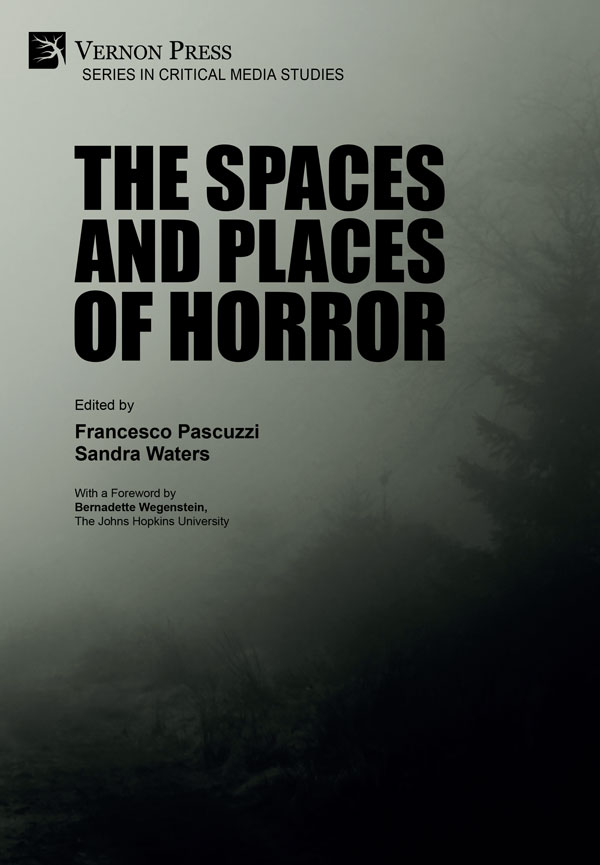
This volume explores the complex horizon of landscapes in horror film culture to better understand the use that the genre makes of settings, locations, spaces, and places, be they physical, imagined, or altogether imaginary. In The Philosophy of Horror, Noël Carroll discusses the “geography” of horror as often situating the filmic genre in liminal spaces as a means to displace the narrative away from commonly accepted social structures: this use of space is meant to trigger the audience’s innate fear of the unknown. This notion recalls Freud’s theorization of the uncanny, as it is centered on recognizable locations outside of the Lacanian symbolic order. In some instances, a location may act as one of the describing characteristics of evil itself: In A Nightmare on Elm Street teenagers fall asleep only to be dragged from their bedrooms into Freddy Krueger’s labyrinthine lair, an inescapable boiler room that enhances Freddie’s powers and makes him invincible. In other scenarios, the action may take place in a distant, little-known country to isolate characters (Roth’s Hostel films), or as a way to mythicize the very origin of evil (Bava’s Black Sunday). Finally, anxieties related to the encroaching presence of technology in our lives may give rise to postmodern narratives of loneliness and disconnect at the crossing between virtual and real places: in Kurosawa’s Pulse, the internet acts as a gateway between the living and spirit worlds, creating an oneiric realm where the living vanish and ghosts move to replace them. This suggestive topic begs to be further investigated; this volume represents a crucial addition to the scholarship on horror film culture by adopting a transnational, comparative approach to the analysis of formal and narrative concerns specific to the genre by considering some of the most popular titles in horror film culture alongside lesser-known works for which this anthology represents the first piece of relevant scholarship.
Everyday Empowerment and Likeability
Gavin F. Hurley
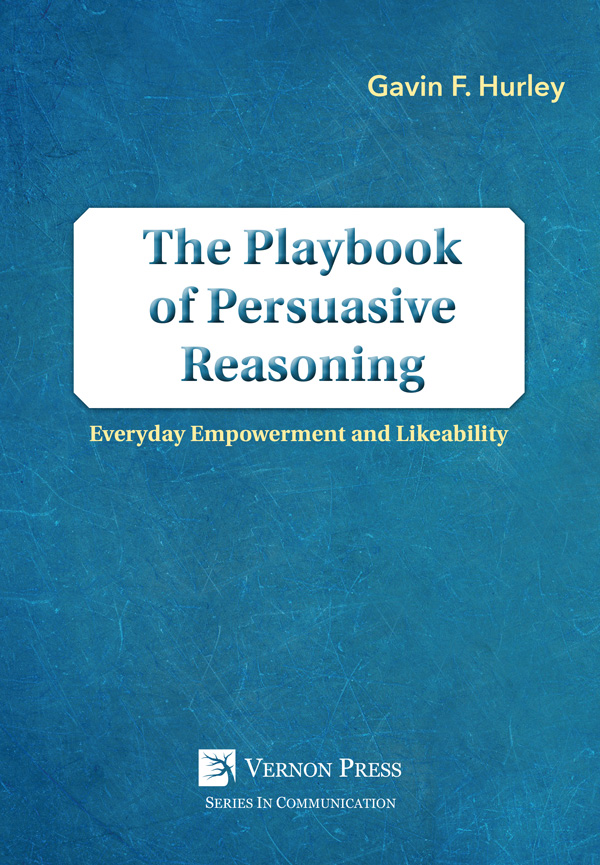
'The Playbook of Persuasive Reasoning: Everyday Empowerment and Likeability' provides an easy, practical guide to the strategies of persuasive reasoning, which Gavin Hurley argues is crucial to all effective communication. Helping professionals and students to become better and more likeable communicators, this fundamental “playbook” outlines numerous eye-opening communicative maneuvers for readers of all levels and backgrounds. It offers a unique approach to argumentation and persuasion and moves away from the more conventional methods which are often overtechnical, unnecessarily complex or too science oriented. Hurley demonstrates how to successfully apply these strategies of cooperative argumentation to your life in order to succeed professionally, socially and cerebrally. This he argues, will allow you to empower your messaging and increase your social magnetism. 'The Playbook of Persuasive Reasoning' is a down-to-earth guide on effective rhetorical strategizing. It is written for everyday application, based on everyday examples, and embedded in everyday language. Today, successful communication is a highly sought-after trait by international employers, clients, and customers alike. Gavin Hurley shows how a wide range of people can benefit from learning how to deliver more abstract material in an effective manner: both verbally and written. This guide is particularly appealing for professionals, including business managers, as well as academics and students, including public intellectuals. 'The Playbook of Persuasive Reasoning' is a useful book for anyone wanting to enrich their skills and strengthen their powers of communication in order to have a social and professional advantage.