Loading...
Please wait while we load the content...

Loading...
Please wait while we load the content...
Virginia Tech; Virginia Military Institute
Antara Mukherjee, Sushmita Sihwag, Olivia A. Kurajian, Hamza Iqbal, Tonisha Guin, Shelby E. Ward, Swagata Basu, Prantik Banerjee, Ruth Prakasam, Sanghita Sen, Didier Coste, Debra Castillo, Indrani Mukherjee, Nicole Crevar, E. Leigh McKagen, and Java Singh
As an epistemological perspective, ‘nomadism’ is an emerging field of scholarship, offering intersectionality with eco-criticism, feminism, post-colonialism, migration studies, and translation. Much of the scholarship that uses the precepts of nomadism to read cultural texts and phenomena is scattered as separate articles in academic journals or as single chapters in books wherein the primary focus is the intersectional fields. Few book-length publications solely focus on the ramifications of nomadism; Posthumanist Nomadisms across non-Oedipal Spatiality fills that void. The fifteen chapters in this volume explore the possibilities offered by the nomadic perspective to explore a wide range of literary and cultural texts; organized into three sections, “Nomadic Assemblages,” “Non-Oedipal Cartographies”, and “Space-Time Montages”, that work as one to negate absorption into the interiority of sovereign territory. These sections are not an attempt at corralling the nomadic spirit into separate enclosures; instead, they are bands of warriors that operate the violence of the hunted animal, dehumanized human others, and earth others. The chapters are in constant multi-vocal conversations with narratives that camp on the turbulent weathers of global transitory spaces. They charter real or intellectual turfs of interstitial/rhizomatic nomadic epistemologies as political resistance to the exclusionary practices of a violently wired world. This book will appeal to post-graduate students, researchers, and faculty in the departments of literature, comparative literary and cultural studies. Researchers in sociology, cultural anthropology, gender studies, and migration studies will also find the material applicable to the expanding approaches available in their fields.
Lisa V Mazey, Forrest Johnson, E. Leigh McKagen, E. Leigh McKagen, Evangeline Kroon, Hyunyoung Moon, Karen Tuthill-Jones, Mary Jane Androne, and Yeojin Kim
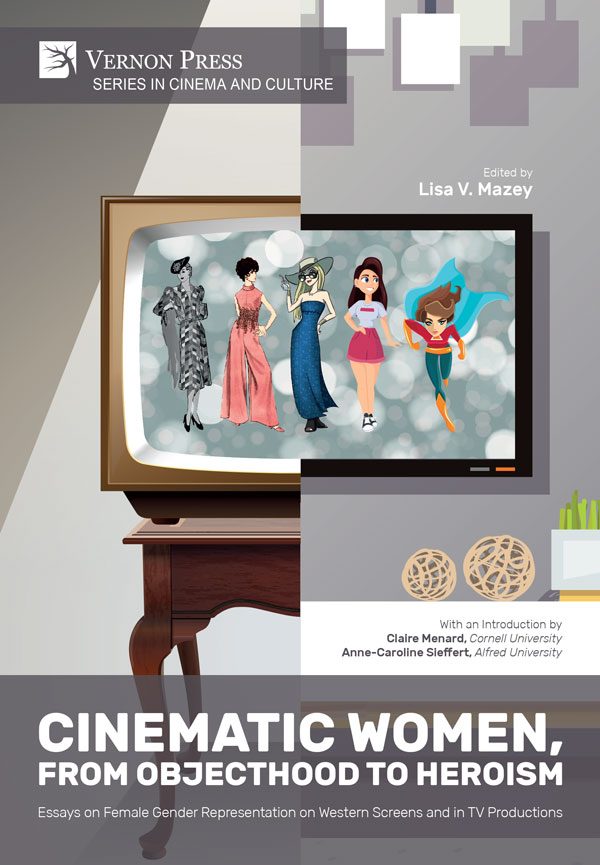
Women have fulfilled film roles that exhibit their historically subservient or sexualised positions in society, among others. Over the decades, the gender identity of women has fluctuated to include powerful women, emotionally strong women, lesbian women, and even neurologically atypical women. These identities reflect the change in societal norms and what is now acknowledged as more likely and more mainstream. The evolution of society’s views of women can be mapped through these roles; from 1950’s America where women were depicted as the counterpart to male characters and their masculinity either as a threat or support to the patriarchal norms; to more recent times, where these norms have been questioned, challenged, deconstructed and reconstructed to include women in a more equitable balance. The fight for equal access, equal pay and equal standing still exists in all walks of life and different cultures requiring continued scrutiny of the norms that made that fight necessary. The essays offer a unique vantage of the changing culture and conversations that allowed, encouraged, and praised an evolution of women’s roles. They strive to represent the issues faced by women, from the early heyday of Hollywood through to films as recent as 2007; examining depictions of the masculine gaze, mental and physical oppression, the mother figure, as well as how these roles may develop in the future. The book contains valuable material for film students at an undergraduate or post-graduate level, as well as scholars from a range of disciplines including cultural studies, media studies, film studies and women’s and gender studies.