Loading...
Please wait while we load the content...

Loading...
Please wait while we load the content...
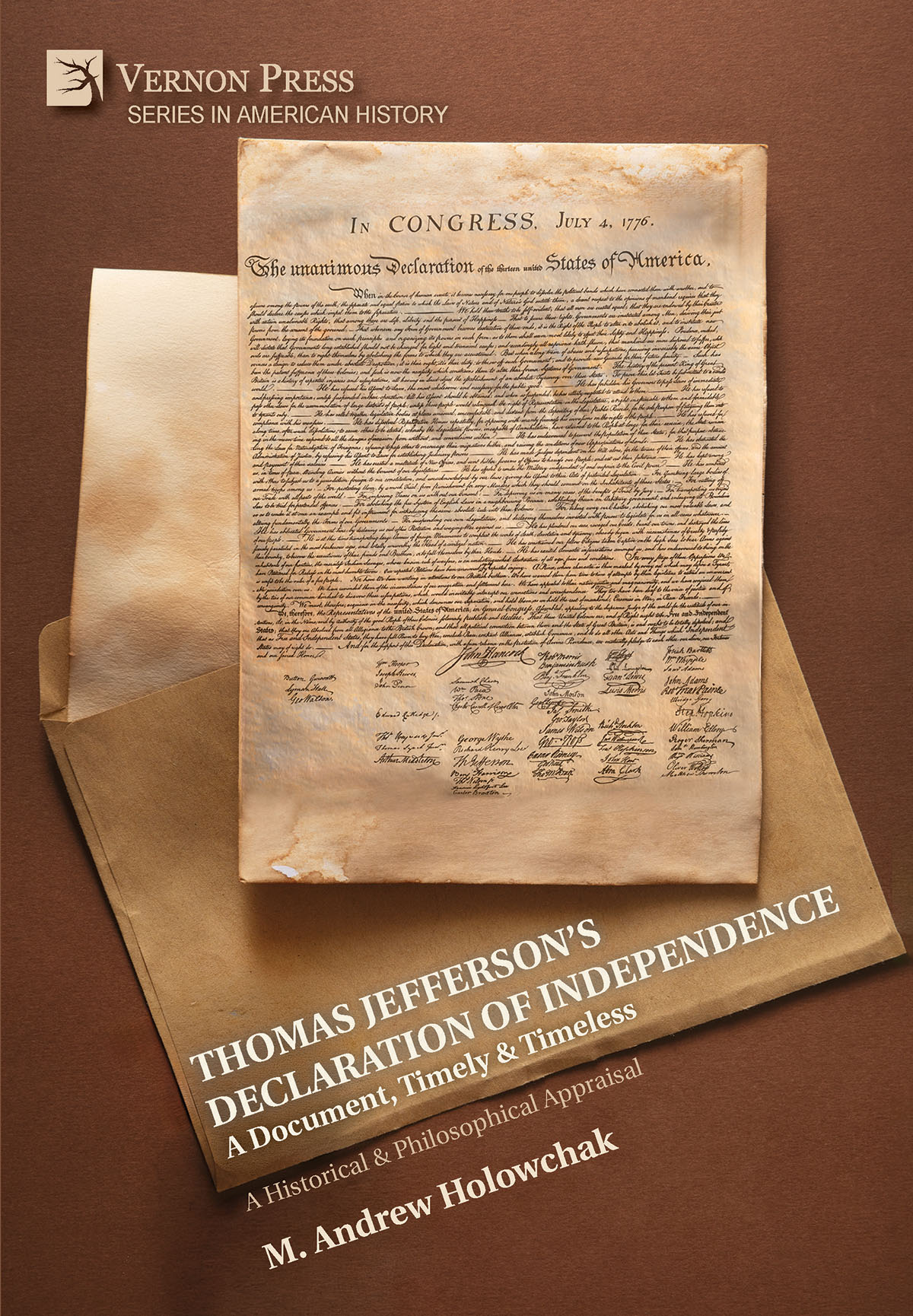
A Historical & Philosophical Appraisal
M. Andrew Holowchak
The Declaration of Independence is alive, because its sentences are crafted with elegance and concision—and the Congress much contributed to its concision—and because the author, not just the drafter, of the document captured things commonly known, yet profound, concerning human nature and human wellbeing. The Declaration of Independence, thus, is not just a proclamation to the world, of Americans’ independence and of the reasons for it, but it is also, and most singularly, a moral document that grounds a rich and robust liberal political philosophy. The bedrock of that political philosophy, argues Holowchak, is human equality, not human liberty.
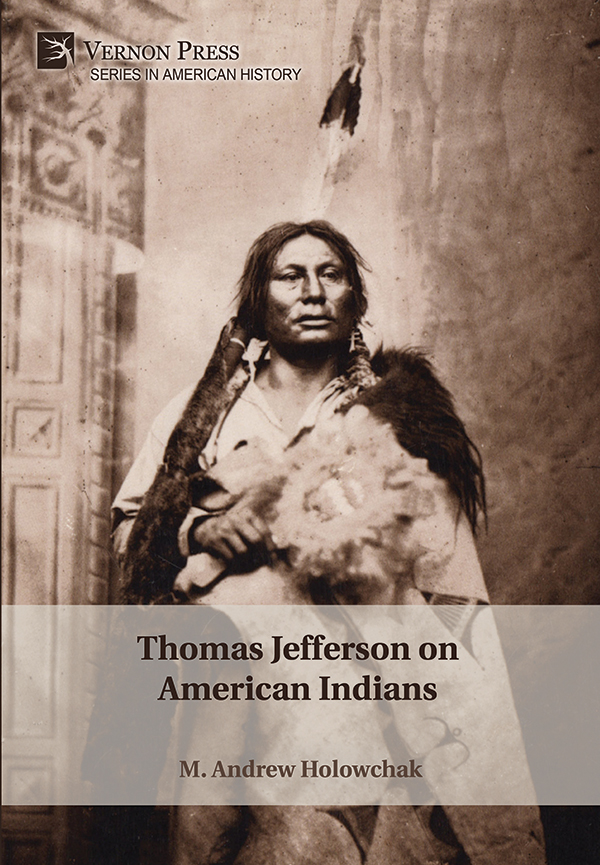
M. Andrew Holowchak
Jefferson’s views on Indians were characterized by ambivalence. Jefferson both loved and hated Native Americans, because he loved Native Americans. Jefferson was, through his father Peter, exposed early on and directly, though likely infrequently, to mysterious but congenial Indigenes, and he came to respect profoundly their courage, physical endurance, artistry, integrity, and most importantly, their large love of liberty, even if they were “uncivilized.” So impressed by Indians' culture was Jefferson that he made their nature and culture objects of study in his ‘Notes on Virginia.’ Though uncivilized, Indians showed marked signs of being readily civilizable. Thus, Jefferson, qua politician and philosopher, hoped that they would mix their blood with Whites and become part of what he saw as a great American “empire for liberty.” Miscegenation meant integration, willful or by force, into American culture and abandonment of Aboriginal ways and their radically different way of seeing the land upon which they lived, which Natives could only grudgingly accept. Was Jefferson’s Indian policy, though guided by true concern for their wellbeing, genocidal? This book ultimately aims to answer that question.
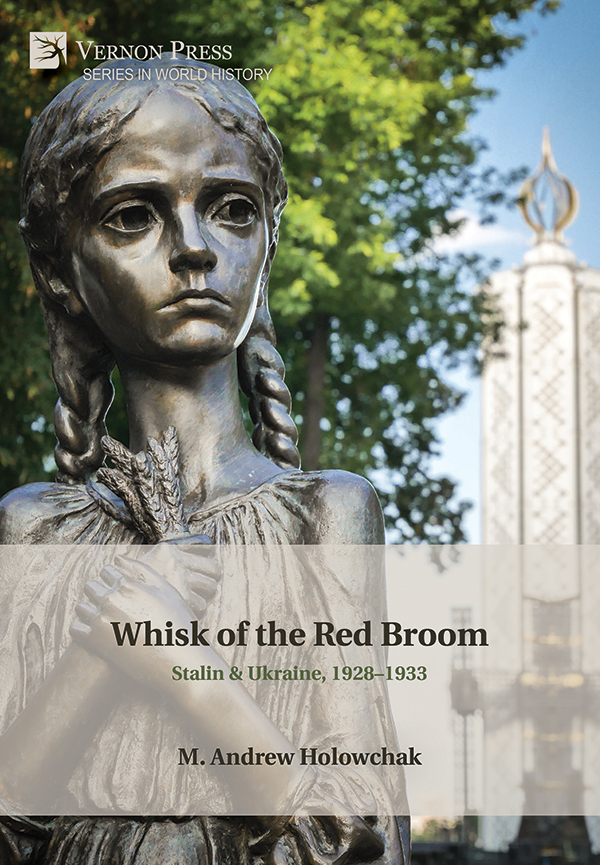
M. Andrew Holowchak
Once Joseph Stalin took the lead of the Soviet Bolshevists after the death of Vladimir Lenin, he quickly turned away from Lenin’s New Economic Policy, with its many concessions to capitalism, to a policy of one-country socialism, driven by his first Five Year Plan (1928) and a plan that other Bolsheviks like Lenin and Trotsky thought impossible. That shift, radical, forced Stalin to “urbanize” the USSR’s vast rural areas—that is, to impose a factory-like model on the Soviet countryside to maximize its efficiency. That required collectivizing the numerous Soviet farms—making large farms of the numerous small farms. Ukraine was to be the model republic due to its vastness and black, fertile lands. Not only were the republics to be collectivized, they were also to be Russified for the sake of model efficiency and centralization of control. And so, while Stalin, early in his political life, preached respect for the cultural diversity of its many republics and the right of secession of any republic, the need to collectivize the Soviet farms for the sake of one-country socialism demanded compliance. Ukrainian peasant-farmers were non-compliant, for they readily saw that the State was asking them for everything and giving back nothing but the pledge of efficient farms to benefit the State, and non-compliance forced Stalin’s authoritarian hand. He imposed laws that brutally punished non-compliant peasants, called “kulaks.” The plan was dekulakization. The intransigents were dispossessed of their property, alienated from other villagers, exiled, and exterminated. The result in Ukraine was the gross inefficiency of both collective and individual farms. That led to intolerance of Ukrainian culture and theft of Ukrainian grain, and even all other findable foodstuffs, to punish Ukrainians. The end was a great famine in 1932 and 1933 in which some four million Ukrainians died. Did Stalin believe that he could urbanize the Soviet countryside? Did Stalin think that socialism could take root in the backwater Soviet Union without the aid of Western succor? Did Stalin hate Ukrainians because many pressed for a cultural identity separate from that of Russia? Had Stalin’s plan of dekulakization from the beginning been a policy of political genocide? Those are some of the many questions I aim to answer in this book. I focus much on Stalin’s writings in the efforts to ascertain his mindset as a dictator.
Thomas Jefferson, History, & Liberty: A Philosophical Analysis
M. Andrew Holowchak
Liberty for Jefferson was 'the' driving force of human history and a realizable state of the human organism and of a society of men. Study of history and anthropology showed that humans were moving from the barbaric independence suffered in primal hordes, which lived inefficiently on lands, to a more economical, human-friendly use of land in social settings, demanding laws for order. Those laws, historically, favored the powerful few to the detriment of the hoi polloi. As a pupil of the Enlightenment, Jefferson argued that all humans were by nature equal, and thus, deserving of as much civic liberty as a reason-oriented and sciences-loving society, a Jeffersonian republic, could guarantee them. This book, philosophical, explains how such a society was possible, given Jefferson’s conception of the nature of man, and how the realization of one such society could lead, through contagion, to a global community of such societies. There are a large number of books that cover Jefferson’s political ideology (e.g., Gordon Wood’s 'Empire of Liberty' and Adrienne Koch’s 'The Philosophy of Thomas Jefferson')—too many to limn—but none that gets at the philosophical implications of TJ’s views on liberty. This book, examining TJ as a natural scientist and philosophy, examines and situates him in the manner of other great political ideologists of his day—e.g., Hume and Kant.
Complete Correspondence with Critical Commentary
M. Andrew Holowchak
This is the only book to offer the complete correspondence between Thomas Jefferson and Maria Cosway, a talented artist for whom Jefferson fell while in France. There is agreement in the secondary literature that Jefferson’s affection for Hemings was reciprocated. This book shows that that cannot be believed. Holowchak also shows that Cosway, through letters late in life, much longs for Jefferson’s company, suggestive of regret for not having earlier in life reciprocated Jefferson’s feelings—hence, the importance of a book with the complete correspondence. Holowchak also offers in the introduction a short psychobiography of Cosway that shows the significance of key early-life events—e.g., her childhood in a tavern, her removal to a convent, her introduction to art, and two singular dreams. Cosway would ever be tugged antipodally by the lure of earthy living as well as the asceticism of Catholic piety.
M. Andrew Holowchak
Why did Jefferson write 'Notes on the State of Virginia'? There are today two common theses. The first, the Alphabet-Soup Thesis, maintains that the book is more or less a loose collection of notes in answer to the 22 queries given by French diplomat François Barbé-Marbois. Jefferson’s altering the arrangement of his answers to the questions is a matter of allowing for a smoother “narrative” for his answers, but other than that, one ought to be cautious not to read too much into his restructuring. The second, the Deconstructionist Thesis, is that meticulous deconstruction of the text reveals a latent thesis, which Jefferson, consciously or subconsciously, kept from his readers. Both views are problematic. The former cannot explain why Jefferson fell so deeply into the project, rearranged Marbois’ questions so that the book would flow smoothly from nature to culture, and continually revise his often-lengthy answers, even after the Stockdale edition in 1787. The latter suffers from the fact that Jefferson tended never to write elliptically. "Thomas Jefferson’s ‘Notes on the State of Virginia’: A Prolegomena" is an attempt to provide an alternative, “dialectical” reading to current interpretations of the book. The book, Holowchak asserts, is neither a simple omnium gatherum nor is its message accessible only through deconstruction. There is an obvious movement from nature (Gr., 'phusis') in the first seven queries to culture (Gr., 'nomos') in the remaining 16 queries, but that “movement” is not linear. Early naturalistic queries set up neatly Jefferson’s discussion of the cultural aspects of Virginia, and Jefferson’s explication of the cultural aspects of Virginia cannot be grasped without frequent returns to the naturalistic queries, hence its dialectic. Jefferson’s aim overall, sums Holowchak, is the appropriation of what nature had given for humans’ use—to perfect the social state by taming nature and putting it to use for human betterment.
M. Andrew Holowchak
Jefferson tended to classify the books of his libraries under the Baconian headings of memory, reason, and imagination, which corresponded to history, philosophy, and the fine arts. Thus, education in the Fine Arts, which Jefferson listed as eight, was considered an indispensible part of the life of an educated person—especially a Virginian. An educated person needed knowledge of architecture, gardening, painting, sculpture, rhetoric, belle lettres, poetry music, and criticism, considered as a sort of meta-art. Knowledge of such arts was indispensible because each person, thought Jefferson, was equipped with a faculty of taste as well as ratiocination and a moral-sense faculty—each of which required cultivation for human thriving. An uncultivated imagination would severely impair ratiocination and moral sensitivity. This book is the first book-length attempt to flesh out and critically assess Jefferson’s views on taste and the Fine Arts. It is a must read for any serious biographer of Jefferson.
M. Andrew Holowchak
Jefferson’s years in France as minister plenipotentiary were a time of large edification. He approached his ministry as a “looker on”: Jefferson, while in France, always kept a critical distance from events, so that he could measure and critically examine them from the perspective of a dispassionate natural philosopher. Being dispassionate, Jefferson was pulled into events only insofar as circumstances required him to do so. Yet his “adventures” from his critical distance (e.g., his trip to London to meet the king, his ventures in the salons of Paris, and his travels through Southern France, Northern Italy, the Rhineland, and the Netherlands) were many, and varied. He even, at times, lost his critical, looker-on perspective from distance as he allowed himself to become immersed in events, as in the case of his relationship with lovely Italian artist and musician Maria Cosway. This book is a portal into the mind of Thomas Jefferson, as looker-on, during his tenure in Paris. Why was Jefferson so eager to accept the ministry to Paris? What was his impression of the great city and its people while he stayed? What lessons, while in Paris, did he learn which he could transport to Virginia and his country? Those and other questions Holowchak aims to answer in this book.