Loading...
Please wait while we load the content...
Loading...
Please wait while we load the content...

Explore peer - reviewed titles across the humanities and social sciences - rigorous research, fresh perspectives, and scholarship that inspires dialogue across disciplines.
Stay informed about our latest publications, calls for proposals, and special announcements. As a subscriber, you'll also enjoy exclusive member discounts of 10%-20% on all orders. Join our community of scholars, librarians, and readers today.
From special discounts and global distribution partners to downloadable catalogs, flyers, and high-resolution covers, we make it easy to enrich your library’s collection. Access bibliographic data, explore subject-specific listings, and stay updated on forthcoming titles.
Become part of our librarian network and access dedicated tools, discounts, and resources to support collection development and promote new titles to your patrons.

Partner with Vernon Press to provide your customers with high-quality, peer-reviewed scholarship. We offer flexible ordering options, reseller agreements, and promotional materials to support your sales and outreach.

Vernon Press provides dedicated resources to help instructors adopt our books for courses and to support students with affordable access to high-quality scholarship. From desk and examination copies to tailored student editions, we aim to make our titles accessible in the classroom.
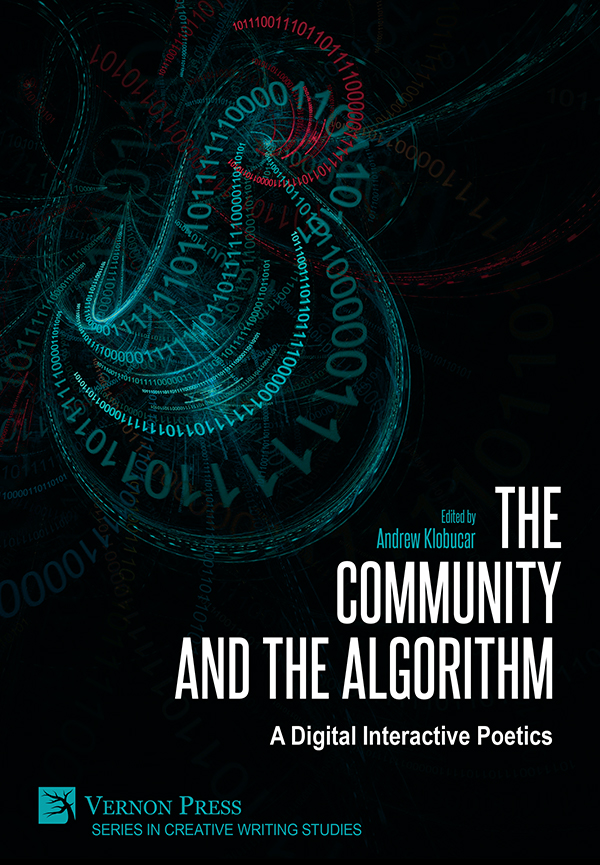
Daniela Côrtes Maduro, Effiam Yung, Rui Torres, Taeyoon Choi, Anna Nacher, Anastasia Salter, Rob Wittig, Charles Baldwin, Maria Aladren, Rachel Horst, Esteban Morales, Simon Overstall, Maria Lantin, Sharla Sava, Andrew Klobucar, and Kedrick James
Digital media presents an array of interesting challenges adapting new modes of collaborative, online communication to traditional writing and literary practices at the practical and theoretical levels. For centuries, popular concepts of the modern author, regardless of genre, have emphasized writing as a solo exercise in human communication, while the act of reading remains associated with solitude and individual privacy. “The Community and the Algorithm: A Digital Interactive Poetics” explores important cultural changes in these relationships thanks to the rapid development of digital internet technologies allowing near-instantaneous, synchronous, multimedia interaction across the globe. The radical shift in how we author and consume media as an online, electronic transmission effectively resituates the writing process across the liberal arts as less a solitary act of individual enquiry and reflection, and more an ongoing, collaborative process of creative interaction within a multimedia environment or network. Contributions in this anthology demonstrate a robust history and equally diverse contemporary approach to multimedia interaction for literary and artistic ends. Central to all media formats, computation is explored throughout this volume to critically examine how algorithmic procedures in writing help bring forward many key concepts to building creative communities in a digital environment. Each chapter in this book accordingly introduces readers to various new collaborative experiments using a broad range of different digital media formats, including VR, Natural Language Generation (NLG), and metagaming tools. This book will appeal broadly to students, instructors, and independent artists working in the digital arts, while its emphasis on social interactivity will interest theorists and teachers working in theatre, social media, and cyberpsychology. Its secondary focus on computation and media programming as a site of artistic experimentation will also interest programmers and web designers at various professional levels.
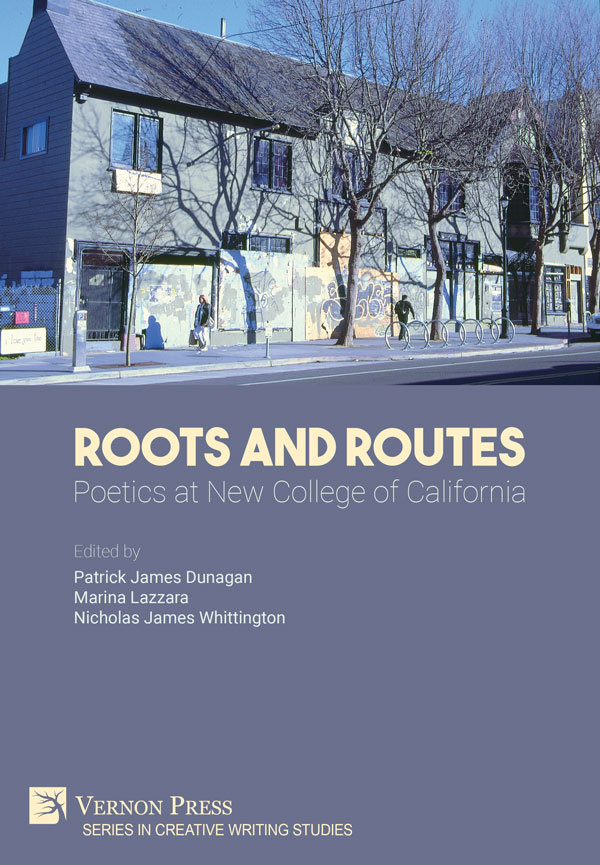
Christopher Winks, Justin Tisdale, John Thorpe, Susan Thackrey, David Levi Strauss, Dale Smith, Will Skinker, giovanni singleton, Aaron Shurin, David Samas, Michael Rothenberg, Judith Roche, Eugenia Hepworth Petty, Louis Patler, Ron Padgett, Hoa Nguyen, Sarah Menefee, David Meltzer, Duncan McNaughton, Michael McClure, Charles S. Maden, Jean-Vi Lenthe, Marina Lazzara, Joanne Kyger, Carrie Hunter, Anselm Hollo, Dave Hayman, Carl Grundberg, Tinker Greene, Christopher Gaynor, M.C. Fujiwara, Gloria Frym, Fitz Fitzgerald, Christina Fisher, Allen Ensign, Robert Duncan, Patrick James Dunagan, Adam Cornford, Jeff Conant, Norma Cole, John Clarke, Tom Clark, Steve Carll, Noel Black, Noam Birnbaum, Dawn-Michelle Baude, Todd Baron, Micah Ballard, and Stephanie Baker
'Roots and Routes' gathers essays, talks, interviews, statements, notes, and other prose writings by poets who studied and/or taught at the New College of California’s Masters in Poetics program over the course of its nearly 30-year existence. The collection evokes a much-needed anti-hierarchical, even anarchic, pedagogy in poetry, poetics, and the literary arts, and is part of a general reevaluation of standard higher education models on Creative Writing. As such it will appeal to a wide range of students and scholars interested in America’s recent literary history, as well as to poets outside the academy and the general reader interested in US poetry and poetics.
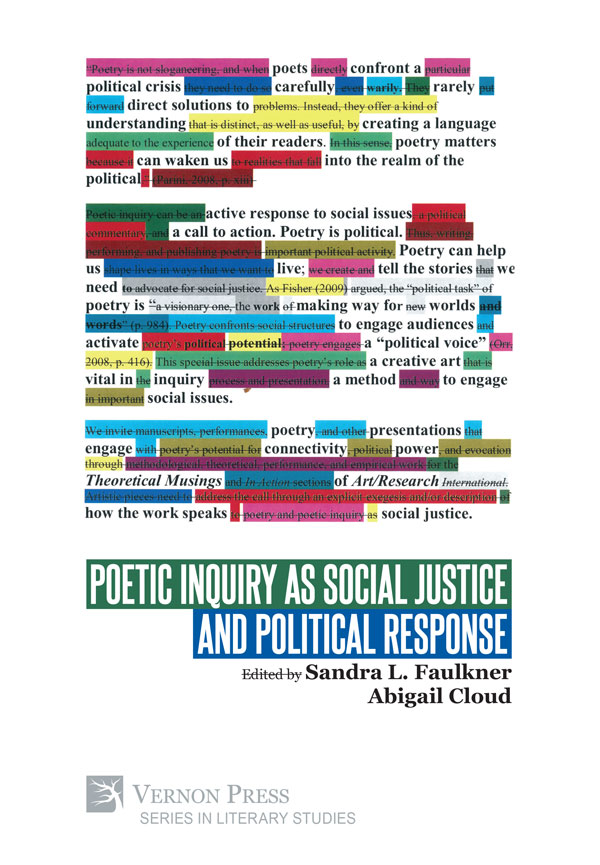
Mark D. McCarthy, Pauline Sameshima, John J. Guiney Yallop, Heidi van Rooyen, Anne McCrary Sullivan, Sheila Stewart, Sheila Squillante, Molly H. Sherman, Gisela Ruebsaat, Bonnie Nish, Robert Christopher Nellis, Heather McLeod, Margaret McKeon, Sarah MacKenzie-Dawson, Natalie Honein, Amanda N. Gulla, Sandra Filippelli, Kimberly Dark, Maya Borhani, Lee Beavington, Robin Barre, Laura Apol, Sean Wiebe, Sandra L. Faulkner, and Alexandra Fidyk
This volume speaks to the use of poetry in critical qualitative research and practice focused on social justice. In this collection, poetry is a response, a call to action, agitation, and a frame for future social justice work. The authors engage with poetry’s potential for connectivity, political power, and evocation through methodological, theoretical, performative, and empirical work. The poet-researchers consider questions of how poetry and Poetic Inquiry can be a response to political and social events, be used as a pedagogical tool to critique inequitable social structures, and how Poetic Inquiry speaks to our local identities and politics. The authors answer the question: “What spaces can poetry create for dialogue about critical awareness, social justice, and re-visioning of social, cultural, and political worlds?” This volume adds to the growing body of Poetic Inquiry through the demonstration of poetry as political action, response, and reflective practice. We hope this collection inspires you to write and engage with political poetry to realize the power of poetry as political action, response, and reflective practice.