Loading...
Please wait while we load the content...
Loading...
Please wait while we load the content...

Explore peer - reviewed titles across the humanities and social sciences - rigorous research, fresh perspectives, and scholarship that inspires dialogue across disciplines.
Stay informed about our latest publications, calls for proposals, and special announcements. As a subscriber, you'll also enjoy exclusive member discounts of 10%-20% on all orders. Join our community of scholars, librarians, and readers today.

From special discounts and global distribution partners to downloadable catalogs, flyers, and high-resolution covers, we make it easy to enrich your library’s collection. Access bibliographic data, explore subject-specific listings, and stay updated on forthcoming titles.
Become part of our librarian network and access dedicated tools, discounts, and resources to support collection development and promote new titles to your patrons.

Partner with Vernon Press to provide your customers with high-quality, peer-reviewed scholarship. We offer flexible ordering options, reseller agreements, and promotional materials to support your sales and outreach.

Vernon Press provides dedicated resources to help instructors adopt our books for courses and to support students with affordable access to high-quality scholarship. From desk and examination copies to tailored student editions, we aim to make our titles accessible in the classroom.
Alan J. Reid
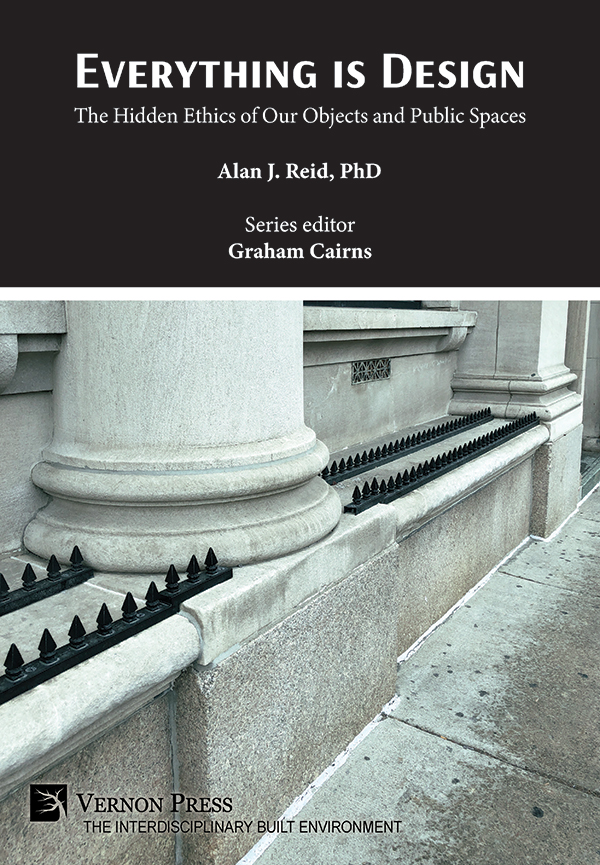
Ethics – to put it concisely – is ‘mindful well-being’. It is a set of standards that guides how we treat ourselves, one another, and the environment. When we design things for public use, we also communicate an ethical perspective. When we use things designed for us, we adopt their ethics. This book synthesizes several different disciplines as they relate to design, ethics, and the built environment. Our objects, according to philosophers like Ihde, Verbeek, and Latour, mediate our experiences with the world around us. Through their designs (and, by extension, our perceived affordances), we largely comply with what our objects and spaces want us to do. At the micro-level, the phones in our pockets command our attentive processes in order to feed an attention economy. At the macro level, urban planning and infrastructure can both promote inclusivity and foment violence. We are deeply intertwined with the objects and spaces that have been designed for us. Baked into every object, process, system, and environment are the remnants of the designer’s morals, ethics, values, and biases. Importantly, this book seeks to cultivate mindfulness of the reader’s interactions with their surrounding world, providing them with a line of inquiry that questions areas of unethical design in their built environment and offers useful critiques and new solutions to these ethical dilemmas. We often have the power to reject those things that are irresponsibly designed and unethical in nature, and it is through this agency as users that we can demand better from designers, developers, and companies. It is imperative to understand our mediated relationships with the built environment that surrounds us and the objects within it; this can help explain our behaviors and empower us to make ethical decisions that serve future generations.
Angela Foster, Morten Daugaard, Tom Nielsen, Alia Alaa Sherif, Karen Olesen, Jens Christian Pasgaard, Khoa Do, Abbey Jia Feng Wuu, Emil E. Jonescu, Viktoria K. Holmik, Yiming Wang, Jie Chen, Hanna Rodewald, Shuang Fei, Edna Langenthal, Aliaa Khalil Zidan, Alaa El-Habashi, and Caroline Donnellan
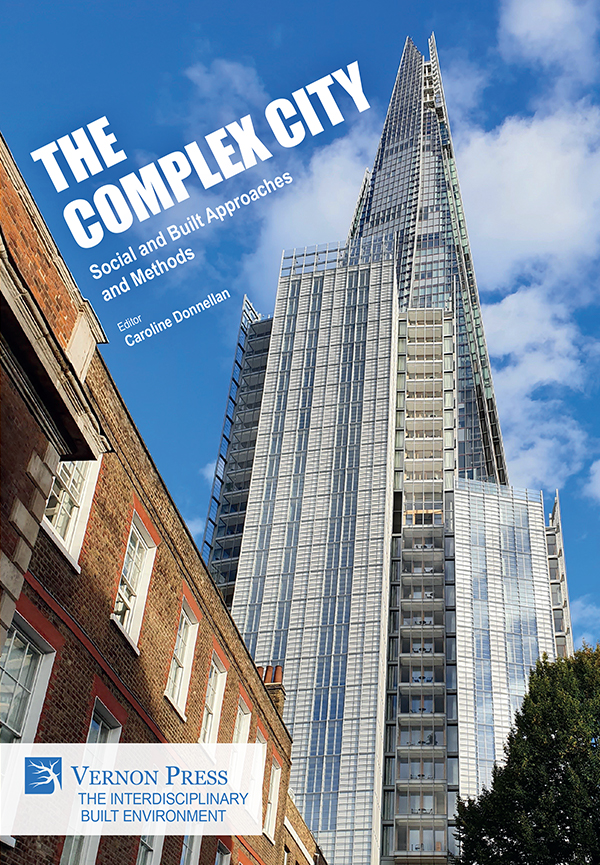
'The Complex City: Social and Built Approaches and Methods' explores different ways of understanding the city. The social city approach proceeds from the ground-up, it focuses on human interactions shaped by economic and environmental processes. The built city method looks through a top-down lens, examining policy and planning for buildings and infrastructure, including utilities and energy networks. This volume is different from other city anthologies in that it explores them through their differences, by presenting each chapter in one of the two categories. While there is invariably an overlap between the two areas, they are distinct positions. In doing so the book identifies how, despite their often adversarial approaches, they both belong to the same city. As essential components of the city they should not necessarily be resolved, as it is in this friction where creativity and innovation happens. 'The Complex City: Social and Built Approaches and Methods' is concerned about the ideas and solutions that they both offer. The book’s originality stems from this duality, and from its recognition that cities are living, organic, protean places of opportunity, crisis, conflict and challenge. The chapters demonstrate the complexity of cities as a set of ideas concerning what they engender, how they function and why they continue to act as a catalyst for different kinds of human activity. They explore issues of socio-political import and questions of the city as a physically constructed space. The themes are diverse and include the inception of the city as a place of competition to centres of regeneration and urban withdrawal. They cover a range of city and urban regions from Athens to Wellington from site specific singular perspectives to comparative assessments. The questions they raise include how do we inhabit urban areas, how do we make plans for them, and how do we, at times, ignore them entirely.
Questions of Access, Engagement and Creative Experience
Rumy Narayan, Gyungju Chyon, Taylor Kuhn, Reg Foucar-Szocki, Thomas Peterman, Donna Milani Luther, Diane Foucar-Szocki, Karim Musfy, Shoham Shefy, Shulamit Beimel, Edud Belferman, Thomas-Bernard Kenniff, Lisa Klautzer, Seo Yeon Hong, Kelly L. Anderson, Seyeon Lee, Adam Feld, Jody Nyboer, Kevin Bonnell, Renae Mantooth, Rebekah Radtke, Tom Coward, Katriina Heljakka, and Annika Blomberg
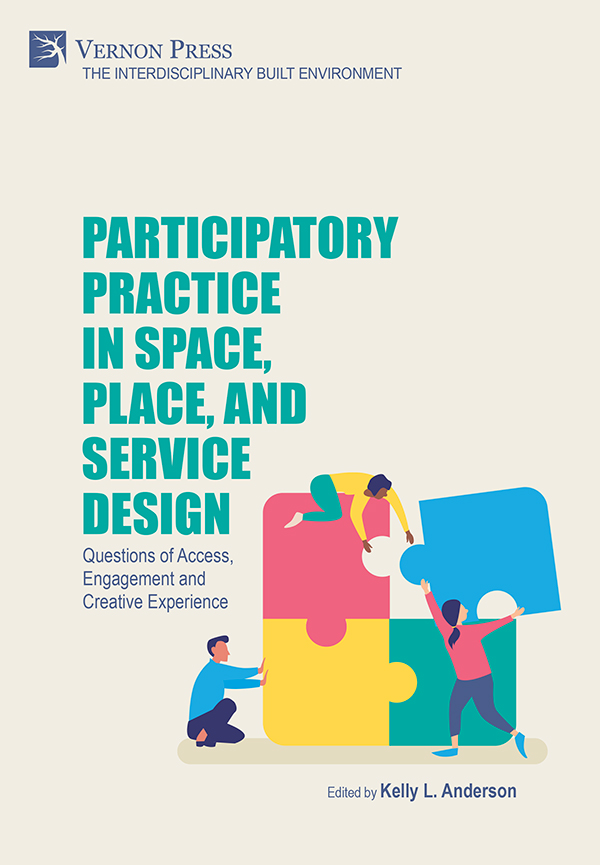
'Participatory Practice in Space, Place, and Service Design' is premised on a belief in the importance of participatory practices in finding creative solutions to the plethora of problems we face today. It argues that engaging professions with the public in mutual exploration, analysis, and creative thinking is essential. It not only ensures better quality products, places, services, and a greater sense of civic agency but also facilitates fuller access to them and the life opportunities they can unleash. This book offers a uniquely varied perspective of the myriad ways in which participatory practices operate across disciplines and how they impact the worlds and communities we create and inhabit. This book suggests that participatory practices are multi-disciplinary and relevant in fields as diverse as design, architecture, education, health care, sustainability, and community activism, to name a few of those discussed here. How do designed objects and environments affect wellness, creativity, learning, and a sense of belonging? How do products and services affect everyday experience and attitudes towards issues such as sustainability? How does giving people a creative voice in their own education, services, and built environments open up their potential and strengthen identity and civic agency? Addressing these questions requires a rethinking of relations between people, objects, and environments; it demands attention to space, place, and services.
Edie Barnard, Anton Kats, Laurène Courouve, Anne Duburcq, Amanda Spence, Deborah Kiel, Pamela Xaverius, Anne Niyigena, Vindhya Kakarla, Jenny Ombler, Jørgen Eskemose Andersen, Veronique Ezratty, David Ormandy, Marie-Helene Laurent, Fabienne Boutiere, Pierre-Andre Cabanes, Matthew Hutchinson, Ebele R.I. Mogo, and Sam Kebbell
Rapid urbanization represents major threats and challenges to personal and public health. The World Health Organisation identifies the ‘urban health threat’ as three-fold: infectious diseases, non-communicable diseases; and violence and injury from, amongst other things, road traffic. Within this tripartite structure of health issues in the built environment, there are multiple individual issues affecting both the developed and the developing worlds and the global north and south. Reflecting on a broad set of interrelated concerns about health and the design of the places we inhabit, this book seeks to better understand the interconnectedness and potential solutions to the problems associated with health and the built environment. Divided into three key themes: home, city, and society, each section presents a number of research chapters that explore global processes, transformative praxis and emergent trends in architecture, urban design and healthy city research. Drawing together practicing architects, academics, scholars, public health professional and activists from around the world to provide perspectives on design for health, this book includes emerging research on: healthy homes, walkable cities, design for ageing, dementia and the built environment, health equality and urban poverty, community health services, neighbourhood support and wellbeing, urban sanitation and communicable disease, the role of transport infrastructures and government policy, and the cost implications of ‘unhealthy’ cities etc. To that end, this book examines alternative and radical ways of practicing architecture and the re-imagining of the profession of architecture through a lens of human health.