Loading...
Please wait while we load the content...
Loading...
Please wait while we load the content...

Explore peer - reviewed titles across the humanities and social sciences - rigorous research, fresh perspectives, and scholarship that inspires dialogue across disciplines.
Stay informed about our latest publications, calls for proposals, and special announcements. As a subscriber, you'll also enjoy exclusive member discounts of 10%-20% on all orders. Join our community of scholars, librarians, and readers today.

From special discounts and global distribution partners to downloadable catalogs, flyers, and high-resolution covers, we make it easy to enrich your library’s collection. Access bibliographic data, explore subject-specific listings, and stay updated on forthcoming titles.
Become part of our librarian network and access dedicated tools, discounts, and resources to support collection development and promote new titles to your patrons.

Partner with Vernon Press to provide your customers with high-quality, peer-reviewed scholarship. We offer flexible ordering options, reseller agreements, and promotional materials to support your sales and outreach.

Vernon Press provides dedicated resources to help instructors adopt our books for courses and to support students with affordable access to high-quality scholarship. From desk and examination copies to tailored student editions, we aim to make our titles accessible in the classroom.
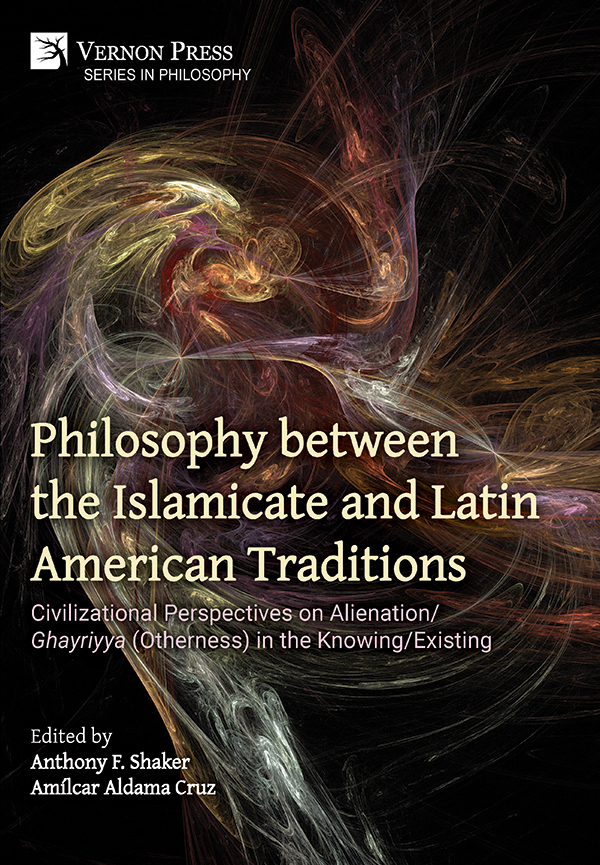
Civilizational Perspectives on Alienation/Ghayriyya (Otherness) in the Knowing/Existing
Anthony F. Shaker, Amílcar Aldama Cruz, Hilal Oytun Altun, Hamidreza Ayatollahy, José Antonio Antón Pacheco, Luce López-Baralt, Ángel Horacio Molina, James Maffie, Omneya Ayad, Mahdi Saatchi, and Hamedeh Rastaei
Latin America is a diverse mosaic of cultures that trace their origins back to Indigenous, African, Spanish, Portuguese and Islamic sources. Its philosophies, eloquently expressed by a long line of thinkers, are found not just in departments of philosophy, but also in its rich literature and art, which are given treatment in this volume. The Islamicate world is a unique, fourteen-century-old cultural mosaic that covers much of the known world. Despite its long civilizational experience, it too faces the challenge of emancipation from foreign domination and the chaotic cacophony of monologues afflicting our time. The papers collected here cover various aspects of the philosophies of these two constantly interacting traditions and how they impinge on an old problematic: “ghayriyya” (otherness) and “alienation”. Their themes include key figures like Ibn ʿArabī, Suhrawardī, Aḥmad b. Muṣṭafa al-ʿAlawī, Rudolfo Kusch, José Martí, Spain’s Moriscos, and contemporary Argentine philosophers; and expanding areas of research like the philosophy of the Nahua (popularly known as the “Aztec”) and the language reforms in Türkiye, both of which provide excellent examples of cultural self-alienation.
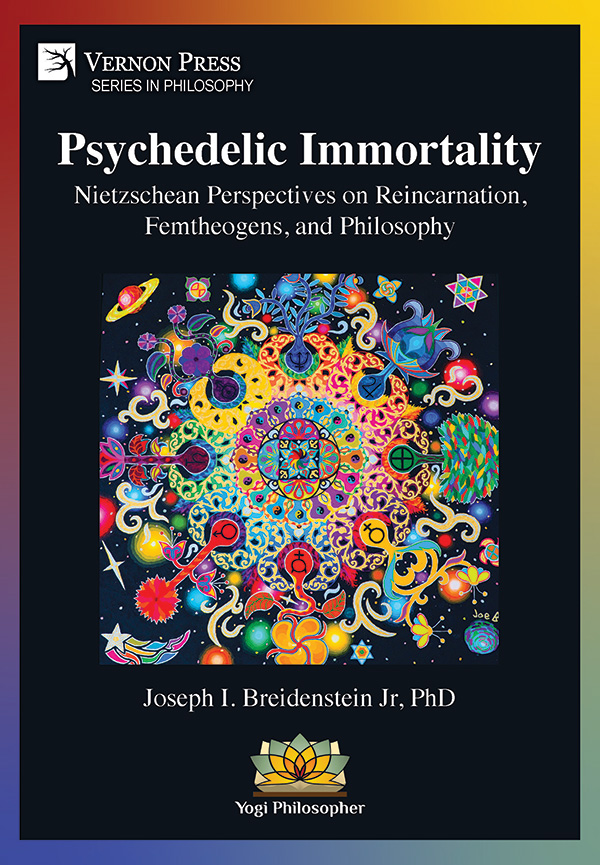
Joseph I. Breidenstein Jr.
Recent research has revealed a psychedelic inspiration for Nietzsche’s philosophy and, far from being a novelty in the history of philosophy, there is significant evidence that several of the first western philosophers ingested psychedelics as well. In his first book, Joseph I. Breidenstein Jr, PhD, maintained that western philosophy began as what we today would call a feminist religious reformation in the sense that many prominent presocratic philosophers were reviving a paleo/neolithic goddess-centered religiosity of rebirth within the largely patriarchal and death-glorifying culture of archaic Greece. And, in this book, Dr. Breidenstein Jr proposes that the presocratics’ psychedelic-reincarnationist-feminine model of education and/or worldview is better suited for democracy in the twenty-first century than the economic model of education that takes the west’s mainstream materialistic-secular worldview for granted. For several decades now, researchers have acknowledged both that the empirical evidence for reincarnation is overwhelming and that psychedelics can evoke past-life recollections, but ‘explanations’ for either reincarnation or how psychedelics do this have yet to be offered. By combining Nietzsche’s philosophy with the work of other thinkers, ‘Psychedelic Immortality’ both provides explanations for each of these phenomena and explores how situating education and democracy within the context of reincarnation can incite a renaissance of American culture and politics. For Nietzscheans and philosophers in particular, this book illustrates the contemporary relevance of two neglected aspects of Nietzsche scholarship—i.e. psychedelics and reincarnation—and, for researchers in such fields as feminist philosophy of religion, ecotheology, philosophy of education, social-political philosophy, and eastern philosophy, it offers a more plausible and healthier worldview in which to explore possibilities in their respective fields that are diminished by the mainstream paradigm. For spiritual seekers of all paths, it offers a conception of philosophy as a practice of awakening goddess consciousness that unfolds over the course of successive lifetimes.
K.H.A. Esmail
This is a clear and concise and original investigation of God’s nature and existence. First of all, it considers (among other things) two of God’s traditional properties: being all-knowing and being all-powerful. It argues he cannot possess these properties. But, it argues this is in accord with him being worthy of worship. Secondly, it introduces the notion of evil being “overridden”. It argues he has to bring about other free living things and it is plausible they have to be liable to experience evil due to their conditions. But, it argues the evil in this world is “overridden”. Thirdly, it considers the principal arguments for the claim he does not exist. (They refer to the evil in the world.) It argues they do not establish sufficient grounds for this claim. Finally, it considers some well-known arguments for the claim he exists. It argues they face difficulties. It sets out other arguments: eg, some arguments to increase any degree of belief one has that God can exist. It includes a number of Appendices: Some remarks on God’s sovereignty; Are there sufficient grounds for the claim that, very probably, God does not exist?; Theodicy and some theodicies; Some further remarks on God and time; Some further remarks on a living thing which possesses the power to do this or that freely; Some remarks on God being simple; Some remarks on God being present in a spatial realm and God being present in a non-spatial realm; ... . It covers as a whole the principal parts of the Philosophy of Religion. It unifies these parts to a significant degree. It proceeds regularly by way of formal and clear arguments. It will be of interest to advanced students and specialists in Philosophy, Religious Studies, and Theology. Given its explanation of key terms, its jargon-free language, its clarity and brevity.... , it will be of interest to others, too.
Ian Cutler
This book concerns why the writers featured sought to exile themselves from mainstream society, not least by embracing the ‘natural’ world and an ascetic lifestyle. With the help of generous references from the 30-plus vagabond writers featured (plus many more contributions from secondary texts), Cutler has identified what he regards as the key features of the temperament and philosophy of those who rejected mannered, conventional society for a vagabond life. Each chapter addresses a different aspect of vagabondage under such themes as: wanderlust; the compulsion not to live a settled existence; asceticism; affinity with nature; the desire to retain the innocence (and mischief) of childhood; aloofness yet compassion for the rest of human-kind; and the rejection of formal education for knowledge experienced via their own senses. Refusing to be compromised by the grand narratives of religion, politics, law, nationalism, and convention, they regarded themselves as ‘citizens of the universe’ rather than slaves of what they regarded as geographical and political states artificially created by humans. Cutler attempts to rescue from obscurity, the philosophy first espoused by the ancient Cynics and now practiced—outside of any organized movement—by this disparate group of thinkers and writers, by presenting arguments and conclusions that are original to this work.
Richard Feist, Jess Flarity, Kathryn Morris, Edmund Lazzari, Aglaia Maretta Venters, Carrie Melmoth, M. Blake Wilson, Matt Phillips, Steven Hrotic, Patrick Aura, John Hurtgen, and Joseph Hurtgen
From their founding in 1540 to this day, Jesuits have been controversial. Their centuries of missionary work have taken them to all corners of the world. They have been accused of killing Kings and Presidents and contributing to colonization and destruction of cultures—even participating in enslavement. But the Jesuits have also been seen as bringers of light and education. With their ferocity of purpose and intellectual rigor, the Jesuits’ impact on world history cannot be ignored. No surprise then, that Jesuits appear in literature, especially that literature of ideas, exploration, and social commentary, otherwise known as science fiction. This unique collection of essays explores how the Jesuit has long been part of science fiction’s history and how Jesuit ideas and characters are featured in some of science fiction’s greatest works. In this collection, we see Jesuits continue their missionary spirit as they take leave of the earth, moving their missionary labors literally towards the heavens. Reason and revelation are now indeed on other worlds. In this collection, we have explorations of philosophy, science, theology, and culture, all done in typical Jesuit fashion, always in various and foreign contexts. This collection is akin to others in its linking of religion and science fiction, but it is unique in its concentration on the Jesuits and science fiction. This collection will be of interest to scholars working and researching in the field of science fiction studies and would be suitable for courses on science fiction. But it will also be of interest and accessible to those of us who simply love science fiction for its power to explore other worlds and, in this case, to take some of the deepest human reflections, namely those on God, morals and culture, lift them up, and see what forms they may take on other worlds.
Jeremy Sampson, Sarah Mattice, Stephen Palmquist, Lorenzo Manera, Brandon Love, John Arthos, Catherine Homan, and John W. P. Phillips
Living in an era of immense and bewildering change in technology, pandemic and war, humanity has had cause to challenge the apparent old fixities and certainties of life. Essentially, are we being played? The premise of this volume is that all of human life is underpinned by powerful dynamic systems, so tightly interwoven into our daily lives that we are barely aware of them, whose true nature only comes to light at times of profound disruption or crisis. These powerful dynamic systems, philosophical or otherwise, often fall under the umbrella of ludic theory. Within these pages, some of the leading thinkers of ludic theory from three continents explore its diversity and relevance through the perspectives of some of the world’s most famous philosophers. In many ways, this volume follows on from Sampson’s 'Being Played: Gadamer and Philosophy’s Hidden Dynamic' (2019). It also draws upon other ludic-centred and ludic-inspired texts that include Mattice’s 'Metaphor and Metaphilosophy' (2014) and Arthos’ 'Gadamer’s Poetics: A Critique of Modern Aesthetics' (2014), together with Frazier’s 'Reality, Religion and Passion' (2009) and Homan’s 'A Hermeneutics of Poetic Education' (2020). Although this is not the first volume offering an integrated approach to ludic theory, see Ryall (ed), 'The Philosophy of Play' (2013), it offers a diverse and detailed approach to the subject, including not only Western philosophers, but also thinkers from Ancient China, 16th-century India and modern South America. This volume will be not only of interest to scholars and students of ludic theory and philosophy in general, but because of its deliberate globalised content, it is hoped it might have a wider appeal globally as humanity continues to grapple with significant challenges created by these current winds of change.
Daniel Rueda Garrido
Why do we act as we do? Why do we assume that the way of being and behaving in our community is right, good, and common sense? Why do we fail to understand those who are, act, and feel differently? These are some of the questions that this book raises and attempts to answer. This ontology is rooted in the phenomenological tradition but with the innovation of taking the "form of life" as the central ontological unit. We are our form of life, but, as a transcendental-immanent reality, this is not directly equivalent to culture or society; it is rather the "political" realisation in the world of an image of the human being shared by a given community. This overcomes the traditional dualities of individual and society, consciousness and body, facticity and freedom, actuality and possibility. The subject is a subject because it identifies with that image, which is equivalent to the intersubjective consciousness of how one should act and be in the world. This gives rise to multiple forms of life. The latter implies a certain power to be who one wants to be. In this way, the book is an invitation to self-examination, for if our form of life is voluntary (i.e., capitalism), it shatters the illusion that one cannot live in any other way, and places us before the anguished but inevitable task of justifying its adoption or resorting to its abandonment. The book offers a dynamic analysis of human existence as the actualisation of a form of life that is, at the same time, the exercise of a certain power over those who seek to live otherwise, especially when that form is institutionalised by a government as the essence of the national or transnational community.
Anna Tomaszewska, Paniel Reyes Cárdenas, Roberto Casales García, Daniel R. Herbert, Evelyn Vargas, Leonardo Ruiz Gómez, Laura Benítez Grobet, Stéfano Straulino, Jimena Portilla González, and Tom O’Shea
The present collection aims to examine this fertile period in the history of philosophy concerning its significance for understanding the relation between theoretical and practical reason, or, relatedly, facts and values. Our contributors have explored different important ways in which both the shortcomings and insights of the theoretical/practical distinction have shaped Western philosophy.
K.H.A. Esmail
This is a clear and concise and original investigation of God’s nature and existence. First of all, it considers (among other things) two of God’s traditional properties: being all-knowing and being all-powerful. It argues he cannot possess these properties. But, it argues this is in accord with him being worthy of worship. Secondly, it introduces the notion of evil being “overridden”. It argues he has to bring about other free living things and it is plausible they have to be liable to experience evil due to their conditions. But, it argues the evil in this world is “overridden”. Thirdly, it considers the principal arguments for the claim he does not exist. (They refer to the evil in the world.) It argues they do not establish sufficient grounds for this claim. Finally, it considers some well-known arguments for the claim he exists. It argues they face difficulties. It sets out other arguments: eg, some arguments to increase any degree of belief one has that God can exist. It includes a number of Appendices: God’s sovereignty; Are there sufficient grounds for the claim that, very probably, God does not exist?; Theodicy and some theodicies; Some further remarks on God and time; Some further remarks on a living thing which possesses the power to do this or that freely; Some remarks on God being simple; Some remarks on God being present in a spatial realm and God being present in a non-spatial realm; ... . It covers as a whole the principal parts of the Philosophy of Religion. It unifies these parts to a significant degree. It proceeds regularly by way of formal and clear arguments. It will be of interest to advanced students and specialists in Philosophy, Religious Studies, and Theology. Given its explanation of key terms, its jargon-free language, its clarity and brevity.... , it will be of interest to others, too.