Loading...
Please wait while we load the content...

Loading...
Please wait while we load the content...
Stay informed about our latest publications, calls for proposals, and special announcements. As a subscriber, you'll also enjoy exclusive member discounts of 10%-20% on all orders. Join our community of scholars, librarians, and readers today.


Availability
In stock
ISBN
9781622736348
Edition
1
Publication Date
April 14, 2020
Physical Size
236mm x 160mm
Illustrations
15 Color
Number of Pages
226
Currency
Quantity
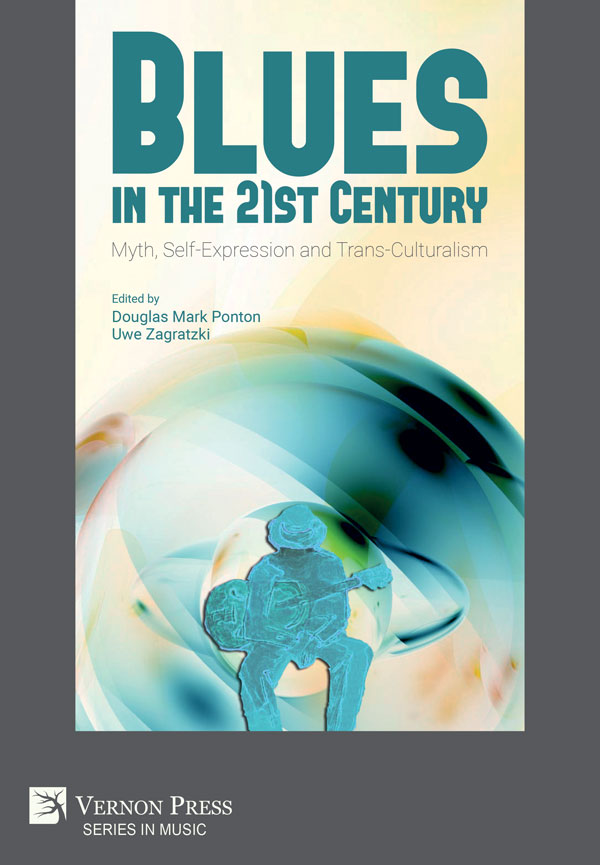
The volume Blues in the 21st Century: Myth, Self-Expression and Trans-Culturalism, edited by Douglas Mark Ponton and Uwe Zagratzki offers innovatively fresh approaches to the rich field of Blues studies. It does so by including voices from disciplines such as literary, cultural, and media studies as well as musicology, sociology and linguistics to inquire into the key—albeit contested—concept of authenticity. From race relations to digitality: the developments of 21st century Blues culture is a both fascinating and highly relevant topic and should be of interest to a great number of humanities scholars.
Dr Julius Greve
Institute for English and American Studies
University of Oldenburg, Germany
This book is an amazingly original interdisciplinary study of blues. The contributors to the volume explore this extraordinary musical and cultural phenomenon from various analytical perspectives, including Cultural Studies, Musicology, Literary Criticism, and Linguistics. They focus both on the works of individual artists, including Jimi Hendrix, Lightnin’ Hopkins, Ali Farka Touré; and on specific features of the Blues as a genre, its flexibility, changeability and evolution. The authors convincingly demonstrate that since its beginnings in the late nineteenth century the Blues has been more than a music style, by the 21st century it has become a transcultural medium of social and emotional expression, “a language and a body of cultural practices”. They rightly argue in the preface to the book, that “The popularity of the Blues among white audiences is testimony that its message, whatever it is, speaks not just to the skin but to the soul”. The volume explores a variety of issues that include authenticity, vocal technique, identity and emotions in Blues lyrics. The book is a significant contribution to the continuation of scholarly study of the Blues, and there is no doubt that it will be of great interest and demand among a readership not indifferent to this fascinating cultural, musical, social and philosophical phenomenon.
Dr Vladimir Ozyumenko
Professor of English Language
People’s Friendship University of Russia, Russia
Discover books that expand on the themes explored in this work—titles that engage with similar questions, intersecting disciplines, and complementary perspectives to deepen understanding and broaden the conversation.
Browse all titles