Loading...
Please wait while we load the content...

Loading...
Please wait while we load the content...
Stay informed about our latest publications, calls for proposals, and special announcements. As a subscriber, you'll also enjoy exclusive member discounts of 10%-20% on all orders. Join our community of scholars, librarians, and readers today.

Availability
In stock
ISBN
9781622734146
Edition
1
Publication Date
July 5, 2018
Physical Size
236mm x 160mm
Illustrations
44 Color
Number of Pages
292
Currency
Quantity
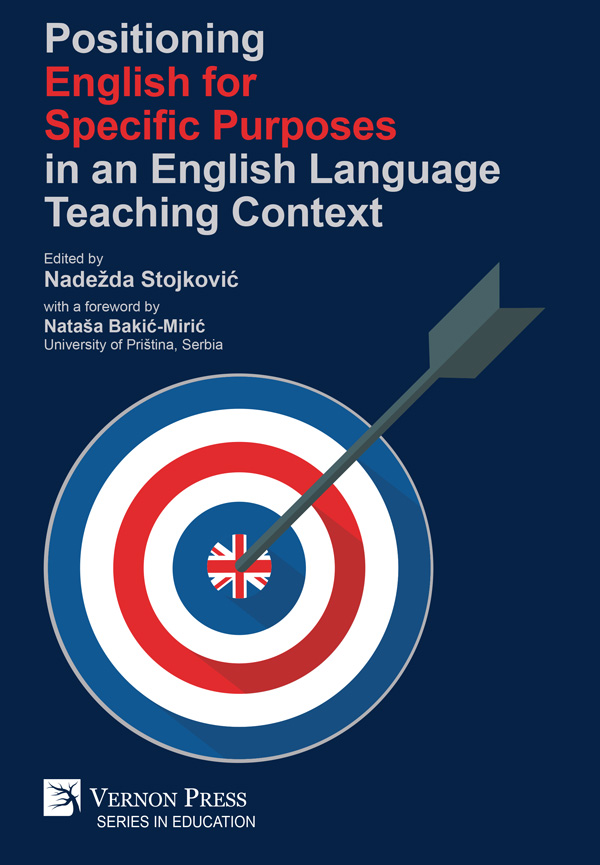
The book entitled Positioning English for Specific Purposes in an English Language Teaching Context, edited by Nadežda Stojković, PhD, is a collection of 19 research papers submitted by 28 scholars who conduct research and teach at different worldwide universities. The publication covers a diverse and an extensive list of English for Specific Purposes (ESP) topics ranging from interrelatedness of ESP and information and communication technologies, usage and roles of case studies, students’ diaries and real projects in ESP teaching to material design, learning motivation and many other topics relevant to the study and practice of ESP. The collection includes papers dealing with different ESP branches such as technology, engineering, medicine, business, economics, political science, and diplomacy thus demonstrating the heterogeneity of the conducted research and consequently being one of the major advantages of this publication. Another strong point of the publication is the shift of the research emphasis from a mere literature overview towards in-classroom practical experience of ESP teaching accompanied by students’ feedback. The publication provides valuable insights into numerous innovative teaching practices in this ever-growing field thus making a substantial contribution to establishing one of the most needed forms of adult language teaching. ESP practitioners will appreciate the publication whose scope will cater for their specific purposes classes and inspire further research in the field.
Prof. Dr. Dragana Bozic
Faculty of Electrical Engineering, Computer Science and Information Technology, University of Osijek, Croatia
The rationale behind the development of ESP has been to impart specified knowledge to the learner of English as a second language, but it has limited scope as it must remain within the confinement of the subject for which it has been developed. When you come across a book entitled “Positioning English for Specific Purposes in an English Language Teaching Context” it raises your expectation. That’s what happened to me, and I was eager to read and see how ESP was being positioned in the context of ELT.
The contents of the book came as a pleasant surprise. The boundaries set by the term “Specific Purposes” have been pushed in this collection of 19 articles. The book covers the integration of technology in the teaching of ESP, teaching-learning methods and their impact, student-centric research to analyse needs, practical task based teaching, study based research addressing employability, using technology to develop teaching aids and methods followed by other articles that widen the ambit of ESP and its impact. It is a book full of well researched articles. The topics are new provide ideas for further research in the field of ESP.
It is time that this new branch of teaching English that started in the late 1960s develops into a more comprehensive method of learning English, e.g. by including literature into its curriculum so that the finer aspects of a language are also learnt by the learner.
Prof. Dr.Somali Gupta,
Department of English, Govt. V.Y.T.PG.Autonomous College, Durg (C.G.)
Due to its focus on a wide range of practical issues of teaching ESP in academia, the book ''Positioning English for Specific Purposes in an English Language Teaching Context” is a valuable collection of papers written by scholars and practicing ESP teachers representing various Eastern European universities. Dr Stojkovic is both the editor and the co-author of Chapter 15 of the book, is right in pointing out that this book demonstrates “a plurality and diversity of ELT theoretical approaches, teaching practices, research insights”. However, it also demonstrates the potential to expand the suggested frameworks and approaches to other educational contexts in a wide range of countries, where ESP needs analysis, syllabus design, materials development and classroom teaching is done by local university teachers and lecturers who will benefit from this collective work most. This volume coheres and offers insightful ideas and perspectives to those interested in the cutting-edge ESP university teaching and its various aspects.
Research on ESP-related ICTs implementation has not been extensive and, therefore, chapters 1, 2, 12 and 18 add a lot to the practical value of this book and call for more action research along these lines in future. The book contributes to carry technology-assisted ad technology-mediated ESP teaching at tertiary level forward, leading ESP teaching and learning into a truly digital era.
Although the chapters responded to a vast array of research questions, a more detailed insight into ESP teacher competencies would have strengthened the book and could have unveiled what kind of competencies would enable an ESP teacher to effectively implement the most innovative ESP teaching into their university classrooms.
The fact that the research-oriented chapters with empirical data analysis can be read separately is positive since it opens possibilities to reach researchers with varied interests in a more straightforward manner. This structure is consistent with the book’s rationale since it provides an overview for those interested in designing and implementing similar ESP environments. Each chapter fosters professional curiosity and contributes to the overall practical value of this book, which has successfully achieved the stated aims and objectives. The fact that research agenda is serving ESP teaching practice makes this book unique and appeals to a wide audience of practicing university ESP, EAP and EOP teachers all over the world.
Prof. Dr. Elena Belyaeva,
St. Petersburg State University (SPbU), Russia
Discover books that expand on the themes explored in this work—titles that engage with similar questions, intersecting disciplines, and complementary perspectives to deepen understanding and broaden the conversation.
Browse all titles
Elizabeth J. Bienia and Teresa A. Citro
View more
Nadezda Stojkovic, Gabriela Chmelíková, and Ľudmila Hurajová (Eds.)
View more