Loading...
Please wait while we load the content...

Loading...
Please wait while we load the content...
Stay informed about our latest publications, calls for proposals, and special announcements. As a subscriber, you'll also enjoy exclusive member discounts of 10%-20% on all orders. Join our community of scholars, librarians, and readers today.


Availability
In stock
ISBN
9781622732647
Edition
1
Publication Date
February 28, 2018
Physical Size
236mmx160mm
Illustrations
23 Color
Number of Pages
258
Currency
Quantity
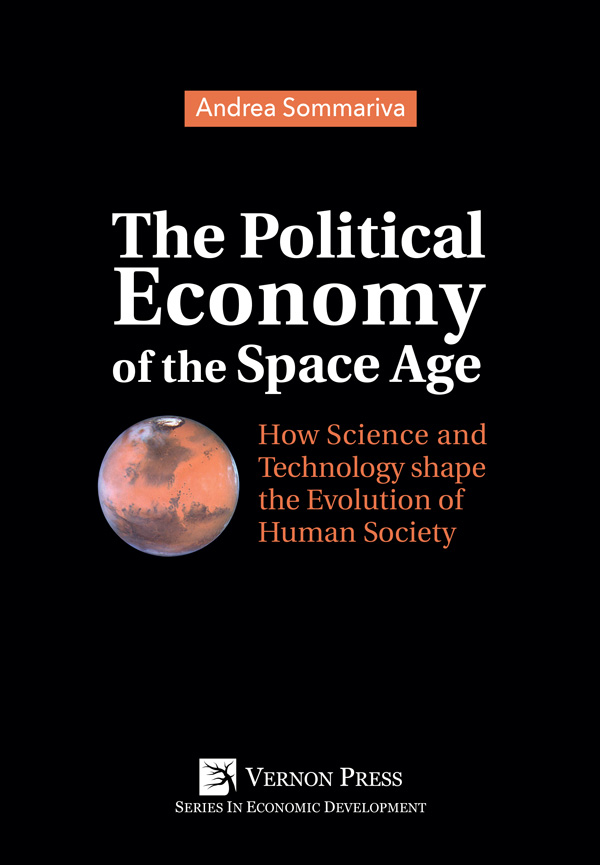
The book contains a story of space exploration, from the economical viewpoint. This contains much novelty, since most other books on the history of astronautics touch on the economic aspects only marginally. The author is very well qualified and his writing is quite involving. A very strong point is the fact that is much open to the future, dealing not only with Mars exploration but also with the exploration of extrasolar planets, while most of the works dealing with space economy usually stop to LEO commercialization and the most advanced topics they deal with is related to the Moon or the asteroids.
I find the book quite innovative and interesting. It can be used for postgraduate courses in space economy.
Professor Giancarlo Genta,
Director of the Aerospace Department at the Polytechnic University of Turin, Italy
Andrea Sommariva's book on the Political Economy of the Space Age is, first of all, a thoroughly researched account of the history and evolution of a field of theoretical and practical engagement which will shape the future of Human Society, as the title rightly states.
It provides the basis to understand better an area of scientific and technological research as well as of economic initiatives which are receiving growing interest both at the academic and at the practical level, and which will inevitably see a booming of its importance in the coming years. Even more than in similar breakthrough cases, those who engage in the related activities will benefit from a considerable advantage in tackling the economic challenges of the coming years.
At the same time, this book provides, through a fascinating reading, the possibility to jump into the (near) future and to imagine feasible solutions to many of the problems (e.g. for some natural resources) that today look very difficult to cope with.
Professor Carlo Secchi,
Emeritus professor Policy Analysis and Public Management, Bocconi University, Italy;
Vice president of ISPI (Institute for the Studies of International Politics), Italy
Discover books that expand on the themes explored in this work—titles that engage with similar questions, intersecting disciplines, and complementary perspectives to deepen understanding and broaden the conversation.
Browse all titles
Enrico Attila Bruni, Laura Lucia Parolin, and Cornelius Schubert (Eds.)
View more