Loading...
Please wait while we load the content...

Loading...
Please wait while we load the content...
Stay informed about our latest publications, calls for proposals, and special announcements. As a subscriber, you'll also enjoy exclusive member discounts of 10%-20% on all orders. Join our community of scholars, librarians, and readers today.
Availability
In stock
ISBN
9798881901813
Edition
1
Publication Date
April 1, 2025
Physical Size
236mm x 160mm
Illustrations
132 Color
Number of Pages
346
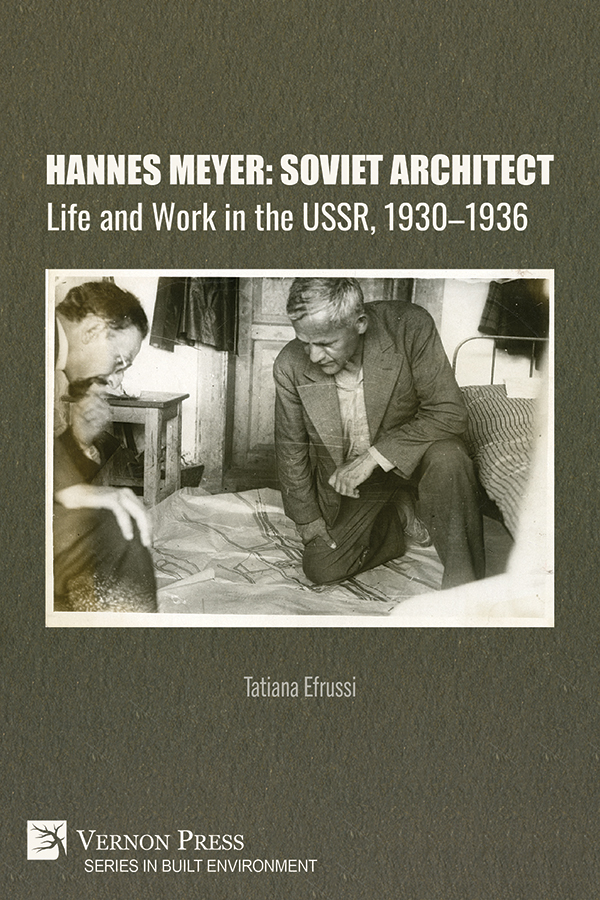
Efrussi's "Hannes Meyer: Soviet Architect. Life and Work in the USSR, 1930-1936" constitutes a critical contribution to the Bauhaus literature. Efrussi mined the post-Soviet archive, uncovering important details about Meyer's projects for the USSR that had previously gone unnoticed. The resultant book fills in a major gap in our knowledge about Meyer's work in the 1930s and forces us to rethink our broader understanding of the Bauhaus project.
Prof. Dr. Angelina Lucento
Department of Art, Art History, and Visual Studies
Duke University
Based on meticulous work with archival sources, Tatiana Efrussi’s book painstakingly documents the activity of Hannes Meyer in the Soviet Union, demonstrating how, designing and planning for Moscow, Izhevsk, Birobidzhan and elsewhere, the second director of the Bauhaus turned into a 'Soviet' architect, embroiled in the politics of architecture in the 1930s USSR.
Dr. Alla Vronskaya
Professor of the History and Theory of Architecture
Department of Architecture, City- and Landscape Planning
University of Kassel, Germany
Tatiana Efrussi has presented the definitive publication on the work of Swiss architect Hannes Meyer in the Soviet Union from 1930 to 1936. Following his dismissal as Bauhaus director in Dessau in 1930, Meyer went to Moscow on his own initiative with a whole group of loyal students and partners. Based on in-depth archival research, Efrussi now characterizes Meyer not only as an emigrant in the Soviet Union but also as a “Soviet architect” – and can thus not only fill in blind spots in his work biography but also make him visible as an actor in the architectural-political debates and power struggles of these years of Stalinist upheaval. Engaged, polemical, humiliated and forgotten for a long time – but remained true to himself as an internationalist and regionalist.
Dr. Thomas Flierl
www.thomasflierl.de
Discover books that expand on the themes explored in this work—titles that engage with similar questions, intersecting disciplines, and complementary perspectives to deepen understanding and broaden the conversation.
Browse all titles
Matthew Jones, Louis Rice, and Fidel Meraz (Eds.)
View more
Carmela Cucuzzella and Sherif Goubran (Eds.)
View more
Serra Akboy-Ilk
View more
Carmela Cucuzzella, Jean-Pierre Chupin, and Georges Adamczyk (Eds.)
View more


